Wow! It's as good as City of the Beasts! (Somewhere else in this blog, searching might find it.)
Jaguar and Eagle are now fast friends, and travelling in Africa with Jaguar's grandmother. It's not long before they're escaping the clutches of a local despot who is treading all over the pygmies and Bantu in the area.
More of the same magical, lyrical writing that I fell in love with in the last book. The best part is that there is one more book in this series.
Friday, July 14, 2006


Thursday, July 13, 2006
First Rider's Call - Kristen Britain
Sci-fi/fantasy, from a women's perspective. Not to shabby at all - a few more 'feelings' and 'emotions' than one might expect on the genre, but not at the cost of battles with orcs and stuff. Nifty.
Second book, but fortunately Ms Britain is considerate enough to have sufficent hints and background that the "First Rider's Call" stands pretty much on its own.
Cool.
Second book, but fortunately Ms Britain is considerate enough to have sufficent hints and background that the "First Rider's Call" stands pretty much on its own.
Cool.
Wednesday, July 12, 2006
Photography exposed - the story behind the image - Life Magazine
A whole bunch of famous pictures, with little stories next to them. Pretty, interesting, very suitable for the coffee table.
I think the descriptions are often too short, but then again, I like words as much as I do pictures.
I think the descriptions are often too short, but then again, I like words as much as I do pictures.
Monday, July 10, 2006
Saturday, July 08, 2006
Chiune Sugihara
The 31st of this month is the 20th anniversary of the death of Chiune Sugihara who basically became the Japanese Schindler during WWII while posted in Lithuania. At his discretion (and against the orders his bosses in Tokyo) he authorised thousands of visas to Jews to escape the onrushing Nazis.
The only reason I know anything about this is a television special on TV a couple of weeks ago; Wikipedia has a whole story here.
The only reason I know anything about this is a television special on TV a couple of weeks ago; Wikipedia has a whole story here.
Friday, July 07, 2006
The Camera - Ansel Adams
Now, this is a book on photography. Not only is Adams a pretty legendary photography, he talks about it really intelligibly (and usually intelligently, too). All the little electronic gizmos on a digital camera are pretty nifty, but I can imagine working with an 8"x10" view camera would be really cool.
#1: Composition, #2: Technical mastery of the medium to do the composition justice. Simple as that.
#1: Composition, #2: Technical mastery of the medium to do the composition justice. Simple as that.
Wednesday, July 05, 2006
New Complete Sailing Manual - Steve Sleight
I'm pretty sure this is the same book I can't find back after moving to Sydney. That's a shame - it's a really good book.
It's a sailing manual. If you like sailing, (and are still learning to do it), it's fabulous. If you're not interested in sailing, it's probably pretty boring.
It's a sailing manual. If you like sailing, (and are still learning to do it), it's fabulous. If you're not interested in sailing, it's probably pretty boring.
Monday, July 03, 2006
Digital Photographers Handbook - Tom Ang
I questioned my own judgement in picking up a book on digital photography printed in 2003. Apparently, 3.3 (and greater) megapixel cameras were in the realm of professional photographers.
Righty-o. I must be a real professional photographer then.
Conclusion: there really isn't a whack of difference between digital photography and film photography. The only thing is that if you stuff up a shot (technically), you can fiddle with it on the computer to recuperate the mistakes. Still, a fixed up boring shot is still a boring shot.
Righty-o. I must be a real professional photographer then.
Conclusion: there really isn't a whack of difference between digital photography and film photography. The only thing is that if you stuff up a shot (technically), you can fiddle with it on the computer to recuperate the mistakes. Still, a fixed up boring shot is still a boring shot.
Sunday, July 02, 2006
The salmon of doubt: hitchhiking the galaxy one last time - Douglas Adams
Ah, posthumous publications. Are they a last attempt to share the writer's brilliance, or a cynical cashgrab by the administrators of the estate and copyrights?
In this case, who cares. I'd forgotten why I liked Douglas Adams. He's pretty clever, and great fun to read. He reminds me (or vice versa, logical linearity isn't that important) of Terry Pratchett. Something to say, and a funny way to say it.
Yay for the guys and girls that put together the myriad jottings.
In this case, who cares. I'd forgotten why I liked Douglas Adams. He's pretty clever, and great fun to read. He reminds me (or vice versa, logical linearity isn't that important) of Terry Pratchett. Something to say, and a funny way to say it.
Yay for the guys and girls that put together the myriad jottings.
Somewhere East of life: Another European fantasia - Brian Aldiss
Criminy, did it again. Book three in a series. I suppose that's a risk of patronising the fiction section of the local library branch - they might not have everything in order.
Great vocabulary in this one; and a rather interesting twisty story. It's a good thing it ended when it did, though. The twists started getting a little routine, and the foil of the guy having his memory poached seemed to be running out of steam a bit... that is, after he'd been to backwater somethingistan trying to save a lost ikon from a mad guerilla (who he stabs in the throat), wandering almost randomly through Madrid, Budapest, and goodness knows where else.
The plot was almost like a Dali - the bits are recognisable, but the way they hang together is pretty different. Good fun.
Great vocabulary in this one; and a rather interesting twisty story. It's a good thing it ended when it did, though. The twists started getting a little routine, and the foil of the guy having his memory poached seemed to be running out of steam a bit... that is, after he'd been to backwater somethingistan trying to save a lost ikon from a mad guerilla (who he stabs in the throat), wandering almost randomly through Madrid, Budapest, and goodness knows where else.
The plot was almost like a Dali - the bits are recognisable, but the way they hang together is pretty different. Good fun.
Friday, June 30, 2006
The toughest Indian in the worlds: Stories - Sherman Alexie
No, there aren't too many motorcycles in this one. There are a lot of pretty odd stories though; what's he trying to do -make me feel guilty for being white?
Alright, that's the self-righteous "I didn't subjugate anyone" knee-jerk reaction out of the way. This guy can write some truly disturbing stuff - some of it sounds like a matter-of-fact record of hardship; some of it is truly whacked '60s paranoia story stuff.
Good or bad? I dunno. He's got the variety of styles down; they all share a common theme but are not boringly repetitive. I suppose it is good in that's interesting, but not necessarily pleasant.
Alright, that's the self-righteous "I didn't subjugate anyone" knee-jerk reaction out of the way. This guy can write some truly disturbing stuff - some of it sounds like a matter-of-fact record of hardship; some of it is truly whacked '60s paranoia story stuff.
Good or bad? I dunno. He's got the variety of styles down; they all share a common theme but are not boringly repetitive. I suppose it is good in that's interesting, but not necessarily pleasant.
Thursday, June 29, 2006
The Best of Outside: The first twenty years - Editors of Outside Magazine
There's a real breadth of stories in here, and while I felt skeptical at the claims of the magazine being an outlet for intelligent commentary, by and large I was won over. Even Tim Cahill's piece wasn't as painful as his books, possibly because it was an order of magnitude shorter.
Monday, June 26, 2006
Flash point - Paul Adam
A semi-fluffy thriller starring an intrepid photojournalist, some monks, some Tibetan guerrilla fighters and the new-born Dalai Lama, in a wholly unsubtle editorial on Chinese repression of Tibet.
I wonder whether the book is a vehicle for the editorial, or if the editorial is just to lend verisimilitude to the story.
I wonder whether the book is a vehicle for the editorial, or if the editorial is just to lend verisimilitude to the story.
Sunday, June 25, 2006
A short history of tractors in Ukrainian - Marina Lewycka
Okay, imagine you're an 84 year old man, and you think you have a shot with a 30-something Ukrainian woman with enormous breasts. What would you do?
Well, in this story, he 'helps' her go from Ukrana to England - as do numerous other men, apparently. He chews through his pension to buy her things, like travel visas, a blender, a car... And she marries him! Lucky guy, huh?
Nah, not quite, and the story of the buxom blonde bursting into the life of an old Ukranian migrant to England provides Lewycka a wonderful foil to do all sorts of things in one book: exploring a relationship of sisters born on either side of the end of the war; tracking through the dual personality of mechanisation as machines of agriculture and as machines of war; thinking about the changes in Eastern Europe and whether the rampant mode of capitalism from the early days of the Western model really need to be imitated for societies just starting down the path...
The tractors in the title got me interested enough to take the book, the notes on the back made me worried that it was going to be some girly maudlin story about families bonding in the face of hardship or some blather like that, and I ended up quite liking the book after all. Better than Updike's stories, that's for sure.
Well, in this story, he 'helps' her go from Ukrana to England - as do numerous other men, apparently. He chews through his pension to buy her things, like travel visas, a blender, a car... And she marries him! Lucky guy, huh?
Nah, not quite, and the story of the buxom blonde bursting into the life of an old Ukranian migrant to England provides Lewycka a wonderful foil to do all sorts of things in one book: exploring a relationship of sisters born on either side of the end of the war; tracking through the dual personality of mechanisation as machines of agriculture and as machines of war; thinking about the changes in Eastern Europe and whether the rampant mode of capitalism from the early days of the Western model really need to be imitated for societies just starting down the path...
The tractors in the title got me interested enough to take the book, the notes on the back made me worried that it was going to be some girly maudlin story about families bonding in the face of hardship or some blather like that, and I ended up quite liking the book after all. Better than Updike's stories, that's for sure.
Trust me: Stories - John Updike
Wow, what a lot of dysfunctional relationships in one book. There are many short stories, apparently spanning decades of the Updike's writing career. They're all quite well written, though his capacity to write about miserable relationships and cheating spouses boggles my mind. I know it goes on, but why on earth write 30 stories about it?
The title is "Trust me", and apparently that's the theme of the book - trust, in relationships between husbands and wives, parents and children, and whatever else. It seems to me that the stories together say that people can't be trusted.
Not my favourite collection of stories, but not a terrible read overall.
The title is "Trust me", and apparently that's the theme of the book - trust, in relationships between husbands and wives, parents and children, and whatever else. It seems to me that the stories together say that people can't be trusted.
Not my favourite collection of stories, but not a terrible read overall.
Thursday, June 22, 2006
When getting a wedding outfit takes 10 minutes
Chronologically, this picture comes before the Procession of the Pink Pants, probably a few days previously. I could check the EXIF data on the image, but that would mean switching windows... but who cares about how lazy I am. The guy in the orange pants is me. I happen to think the purple jacket is a dashing statement. The little guy is Kee - Nek's uncle who owns the guest house where we stayed. The bald guy is Glen - Liz's friend (not in the way that 'Liz's friend' was interpreted in SE Asia) who accompanied her kind of as the muscle. Liz is a little bit little, so it was a safety/comfort thing.
The guy you can't see because he's holding up a piece of material is the tailor. Lovely fellow, lent me the purple jacket on the condition that I not sweat in it. Righty-oh, no sweating in 30 degree humidity. I'm all over that. Think of home, Rob, in February.
So what's going on, now that we've all been introduced? Well, Kee was very encouraging of the idea that as a participant in a traditional Khmer wedding (particularly that of his niece) really ought to wear traditional Khmer clothing. No matter how silly it makes you look. Glen got to participate in the ceremony too, so he needed happypants too. In this image, Kee is bringing all his skills in convincing and persuading to bear: "Yes, you wear that. It's good."
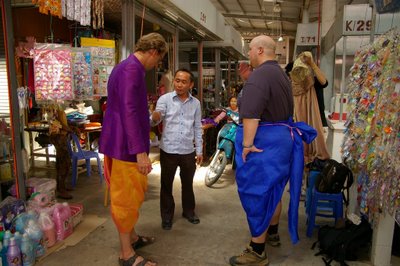 By gum, I'm sold! And indeed I was, on two lengths of silk (now destined to become cushion covers). That's right, I went to a wedding as father of the groom, wearing cushion covers.
You sort of stand in the middle of a couple of metres of silk, and a helper brings the ends together in front of you, kind of wraps/folds/rolls (the wardrobe girls on the wedding day had a genuine technique, we just faked it for the 'fitting') the whole works into a roll, and then that goes between the legs and is pegged up at the back. Tadah! All dressed.
Glen's tail is somewhat more pronounced as he has a more majestic girth than I do, hence it took a bit more material to get around. The consequence is that the rolled up bit is a lot longer... and ends up looking like that. In the market (one of a couple of markets; this may be the New Market, or the Central Market, but then again, those might be the one and the same. Never really did get the two straight. I know definitely wasn't the Old Market), the tail elicited nearly as much hilarity as the pink pants did.
Once our outfits were established (I also got an absolutely darling belt), we hung around briefly chatting in mutually incomprehensible languages with sporadic translations, but much smiling and laughter. Kee had appointed himself chauffeur on this expedition, and kept us to a rather strict and hectic schedule. Once we were done clowning around, we piled back into Kee's CRV, stuffed the tailor into the trunk (it's a little SUV, and there was pillows over the spare tire. He was fine.), and dropped him off from where we'd picked him up, and went back to the guest house to relive the glory of the day.
The guy you can't see because he's holding up a piece of material is the tailor. Lovely fellow, lent me the purple jacket on the condition that I not sweat in it. Righty-oh, no sweating in 30 degree humidity. I'm all over that. Think of home, Rob, in February.
So what's going on, now that we've all been introduced? Well, Kee was very encouraging of the idea that as a participant in a traditional Khmer wedding (particularly that of his niece) really ought to wear traditional Khmer clothing. No matter how silly it makes you look. Glen got to participate in the ceremony too, so he needed happypants too. In this image, Kee is bringing all his skills in convincing and persuading to bear: "Yes, you wear that. It's good."
 By gum, I'm sold! And indeed I was, on two lengths of silk (now destined to become cushion covers). That's right, I went to a wedding as father of the groom, wearing cushion covers.
You sort of stand in the middle of a couple of metres of silk, and a helper brings the ends together in front of you, kind of wraps/folds/rolls (the wardrobe girls on the wedding day had a genuine technique, we just faked it for the 'fitting') the whole works into a roll, and then that goes between the legs and is pegged up at the back. Tadah! All dressed.
Glen's tail is somewhat more pronounced as he has a more majestic girth than I do, hence it took a bit more material to get around. The consequence is that the rolled up bit is a lot longer... and ends up looking like that. In the market (one of a couple of markets; this may be the New Market, or the Central Market, but then again, those might be the one and the same. Never really did get the two straight. I know definitely wasn't the Old Market), the tail elicited nearly as much hilarity as the pink pants did.
Once our outfits were established (I also got an absolutely darling belt), we hung around briefly chatting in mutually incomprehensible languages with sporadic translations, but much smiling and laughter. Kee had appointed himself chauffeur on this expedition, and kept us to a rather strict and hectic schedule. Once we were done clowning around, we piled back into Kee's CRV, stuffed the tailor into the trunk (it's a little SUV, and there was pillows over the spare tire. He was fine.), and dropped him off from where we'd picked him up, and went back to the guest house to relive the glory of the day.

Tuesday, June 20, 2006
The Pink Pants
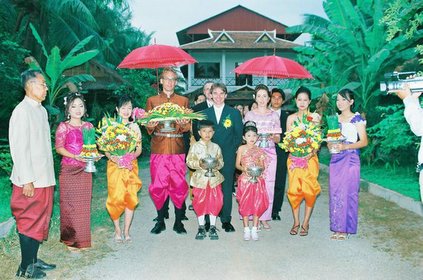 For all those who've heard about the pink pants, but not seen the pink pants, here are the pink pants as photographed at some ungodly early hour in the morning, probably near 6 am. I think Richard (centre, with the yellow flower) is grinning not because of his impending union with the light of his life, Nek, but because his best mate and best man, Shannon, has been joking about the pink pants for the better part of an hour. The old guy, our holy celebrant at left, was chuckling too. The guy holding the umbrella behind Simone... he laughed at the pink pants too. The cute little kids? They were too polite to laugh out loud. So they made big eyes and ran off to convulse in giggles behind the coconut tree. Nek's sisters, Hua and Boa (sorry if that's misspelt, I don't have a Khmer typeface on this computer) laughed very daintily... at the pink pants.
They'd have been just fine, but I think the orange (!) jacket really sets off the whole ensemble. So did Richard, Simone, Nek, Hua, Boa, the old guy.... It was a riot.
I forgot to mention that Simone had a couple of good chuckles at the pink pants too.
Enough about the pants. I had it on the highest authority (Nek's uncle, plus the tyrannical tailor women who bade me drop my trousers... in the courtyard...) and proceeded to swathe me in the pink silk you see radiant before you. Not the matching orangey silk that I had too. The pink silk. Shiny side out.
So what's really going on in that picture? I'm wearing pink pants. Just kidding. Richard, the guy in the middle, is getting married. His mother and father would normally be where Simone and I are, but they couldn't make the trip from Sydney to Cambodia, so we were subbed in. We're at a guest house down the road from Nek's uncle's guest house, where the wedding will take place. We are (all of us above) going to recreate the traditional procession from the groom's village to the bride's village, bearing all sorts of yummy presents to show her parents what a great guy the groom is. Traditionally we'd have walked a couple of kilometres; for the purposes of symbolism we trudged maybe 300 metres. Soon after this photo was taken, traditional (so I'm told, and I'll have to believe it, 'cos I don't know) Khmer wedding music started playing REALLY LOUDLY. EVEN LOUDER THAN WHEN WE ALL WOKE UP AROUND 4 AM. We therefore had many groggy looking spectators along the walk.
And so, the pink pants proceeded forth... peals of laughter issuing in their wake. And it's not like I could melt into the 5 foot tall crowd, either. Weddings are, indeed, a joyous affair.
Friday, June 16, 2006
Rob in Siem Reap
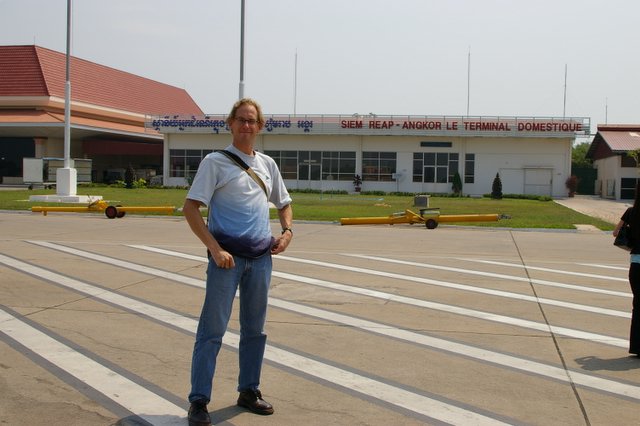 Me, same place, same time as Simone. The same people are just off frame.
Oh, I'm just messing around with this blog-this thingo. Seems to really smallify the pictures.
Simone in Siem Reap, Cambodia
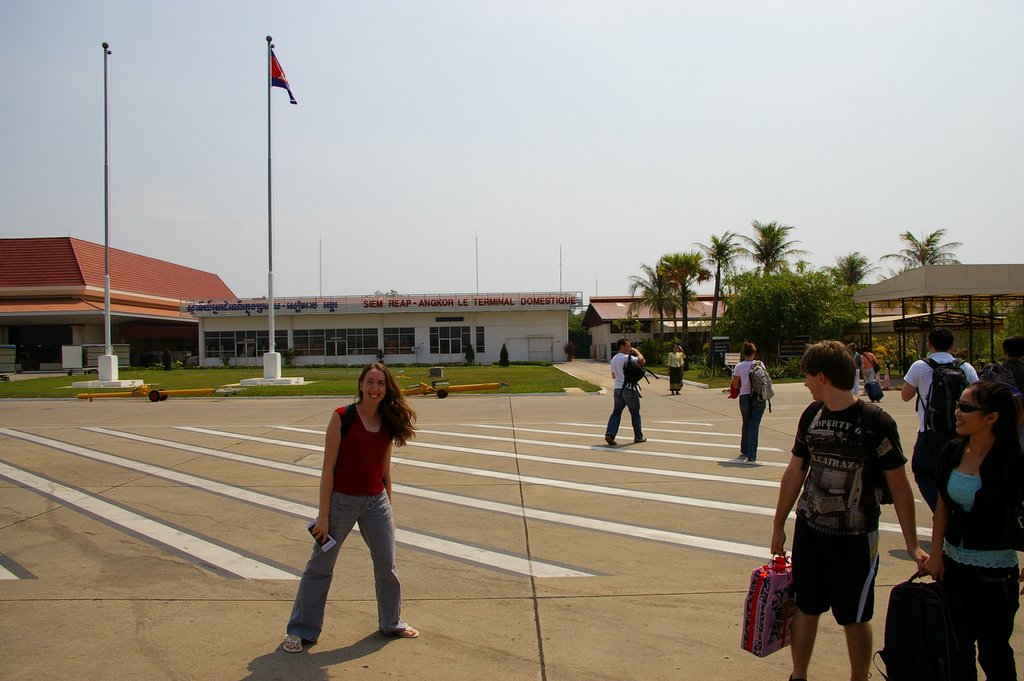 Simone's in the red top; her brother Richard's got the pink bag, and his soon-to-be wife Nek is looking on.
February 6, 2006
Interface - Neal Stephenson and Frederick George
A Manchurian Candidate for the computer age, according to Seattle Weekly.
Someone should have hired the candidate a bloody editor instead of a dim chimpanzee. There were so many mistakes in the book that I can only compare the reading to listening to a scratched CD. Stone the crows, that was annoying.
So, an utterly improbable sci-fi story, unless you are one of the conspiricists with tinfoil on your head. I'm not quite sure how implanting a stroke victim with a biochip that wires him into a computerised polling system renders him a special effect, as described on the back of the book. In fact, that's not the case at all. The li'l chip is courtesy of "The Network", one of those nefarious inchoate groups to whom the Government of the United States of America (God Bless y'all!) is but a means to an end. Naturally, that end is money - they've got the power already.
So, fella gets a stroke (he's already a Governor, so that helps), the Network offers to fix him up with this chip (after they practice on a bunch of Indian (India Indians) brain injury victims) which patches through connections from brain on either end of the damaged part. Neat idea. Of course, being all computery, it can respond to radio frequencies. So... the Network arranges for ongoing biometric polling of a sample of the electorate (far too small a sample, incidentally) that gets used live to advise the candidate via this chippy thing how to behave on the ol' election treadmill. And so on.
We therefore have a sci-fi commentary on 1) ethics in biophysical neurobiology (I don't know if that's what it's called... it's good enough for now), 2) American (God Bless!) electoral groundings, style over substance, etc, 3) a little bit of a cynical poke at the non-governmental power of capital flows, and 4) a plug for good old fashioned values of honesty, hard work, dignity, etc.
You know, I thought Neal Stephenson was a pretty decent sci-fi guy. This book... ah, he must have had an off day.
Someone should have hired the candidate a bloody editor instead of a dim chimpanzee. There were so many mistakes in the book that I can only compare the reading to listening to a scratched CD. Stone the crows, that was annoying.
So, an utterly improbable sci-fi story, unless you are one of the conspiricists with tinfoil on your head. I'm not quite sure how implanting a stroke victim with a biochip that wires him into a computerised polling system renders him a special effect, as described on the back of the book. In fact, that's not the case at all. The li'l chip is courtesy of "The Network", one of those nefarious inchoate groups to whom the Government of the United States of America (God Bless y'all!) is but a means to an end. Naturally, that end is money - they've got the power already.
So, fella gets a stroke (he's already a Governor, so that helps), the Network offers to fix him up with this chip (after they practice on a bunch of Indian (India Indians) brain injury victims) which patches through connections from brain on either end of the damaged part. Neat idea. Of course, being all computery, it can respond to radio frequencies. So... the Network arranges for ongoing biometric polling of a sample of the electorate (far too small a sample, incidentally) that gets used live to advise the candidate via this chippy thing how to behave on the ol' election treadmill. And so on.
We therefore have a sci-fi commentary on 1) ethics in biophysical neurobiology (I don't know if that's what it's called... it's good enough for now), 2) American (God Bless!) electoral groundings, style over substance, etc, 3) a little bit of a cynical poke at the non-governmental power of capital flows, and 4) a plug for good old fashioned values of honesty, hard work, dignity, etc.
You know, I thought Neal Stephenson was a pretty decent sci-fi guy. This book... ah, he must have had an off day.
The Devil and Miss Prym - Paulo Coelho
This is why I write these little warbles. I'd forgotten I'd read this book. I was rummaging through a pile of paper pulled it out, and was all like, whoa, like I've, you know, read this?
Perhaps it read so fast is why I didn't remember it... a train ride and a half is all it lasted. Unfortunately, I had nothing else to read for the last half of the commute home, so I got to ruminate on whether or not Paulo Coelho is 'all that' or if he's just a panacea for shallow yuppies seeking a sense of profundity in their solipsistic little lives. I really am undecided.
Between The Alchemist and this little number, which together constitute the entirety of Coelho's oeuvres that I've read, I've got this funny feeling that he's pulling the wool over my eyes by covering off deep questions about humanity in remarkably readable (hour and a half!) books. See, in this one he's all over the "are humans good, or are they evil; and if evil, is it an irredeemable evil" question. And that's fine - worse, and more foolish, than Coelho have taken it on.
The thing is, the story trips along so merrily it feels like it's fluffy! And how can a fluffy book be so doggone focussed on Good n' Evil? Remember those whacky thought experiments where an dilemma is posed and your response suggests what kind of person (you think) you are? You know, lead a group of people one way and there's a 100% chance that half of them will die, go the other way and there's a 50% percent chance either way that all live or all die. Which do you do?
Well, it's a bit like ol' Paulo came up with a thought experiment, and turned it into a novel. Plausible? What the heck, it's a thought experiment. I reckon it could have gone either way with regard to the ending.
I enjoyed reading the book; I enjoyed the way Coelho really worked the tension within the main characters; I'm not sure about the proposition that fear is humankind's main motivator; I thought the whole light/dark parts of the soul were a bit trite and cliché - especially after the visualisation or personification of the Devil, which was cool.
And I can't shake the idea that the story's not as profound as it seems. That frustrates me.
Perhaps it read so fast is why I didn't remember it... a train ride and a half is all it lasted. Unfortunately, I had nothing else to read for the last half of the commute home, so I got to ruminate on whether or not Paulo Coelho is 'all that' or if he's just a panacea for shallow yuppies seeking a sense of profundity in their solipsistic little lives. I really am undecided.
Between The Alchemist and this little number, which together constitute the entirety of Coelho's oeuvres that I've read, I've got this funny feeling that he's pulling the wool over my eyes by covering off deep questions about humanity in remarkably readable (hour and a half!) books. See, in this one he's all over the "are humans good, or are they evil; and if evil, is it an irredeemable evil" question. And that's fine - worse, and more foolish, than Coelho have taken it on.
The thing is, the story trips along so merrily it feels like it's fluffy! And how can a fluffy book be so doggone focussed on Good n' Evil? Remember those whacky thought experiments where an dilemma is posed and your response suggests what kind of person (you think) you are? You know, lead a group of people one way and there's a 100% chance that half of them will die, go the other way and there's a 50% percent chance either way that all live or all die. Which do you do?
Well, it's a bit like ol' Paulo came up with a thought experiment, and turned it into a novel. Plausible? What the heck, it's a thought experiment. I reckon it could have gone either way with regard to the ending.
I enjoyed reading the book; I enjoyed the way Coelho really worked the tension within the main characters; I'm not sure about the proposition that fear is humankind's main motivator; I thought the whole light/dark parts of the soul were a bit trite and cliché - especially after the visualisation or personification of the Devil, which was cool.
And I can't shake the idea that the story's not as profound as it seems. That frustrates me.
Wednesday, June 14, 2006
Realware - Rudy Rucker
After a brief hiatus, I'm back into the books!
And don't I start reading the 4th book of a tetrology. I suppose if I was a "real" sci-fi fan, I'd have known this instinctively. But I'm not. I go to the library, grab a bunch of books more or less randomly, and read them. I have a new appreciation for those books that have "Book 3 in the series!" written on the front.
Fortunately, it's written well enough, with sufficient clues to the futuristic gizmos and stuff that eventually it's all comprehensible. The little genealogy of the characters at the front doesn't help - and really, who flips to the front to see who's related to who as the story progresses? It worked in War and Peace, but then, I reckon Tolstoi needed help keeping everyone straight.
Anyway, way off in the mid-21st century, things are a little different, when at some point aliens make contact. Naturally, humans fight back. Die, unknown beings, die. Which most of the aliens appeared to do, from what I can make out. (I'm assuming this was covered in detail in one of the previous 3 books).
An alien survives, remembers one of the nice humans from the Moon fight. Guess what? It's the pretty, smart girl that the main boy character meets by chance and, like, totally falls for.
Realware is the alien technology that gets shared with humans. It's futuristic alchemy - turn stuff into other stuff. Are humans grown up enough as a species to handle this kind of power and freedom?
And don't I start reading the 4th book of a tetrology. I suppose if I was a "real" sci-fi fan, I'd have known this instinctively. But I'm not. I go to the library, grab a bunch of books more or less randomly, and read them. I have a new appreciation for those books that have "Book 3 in the series!" written on the front.
Fortunately, it's written well enough, with sufficient clues to the futuristic gizmos and stuff that eventually it's all comprehensible. The little genealogy of the characters at the front doesn't help - and really, who flips to the front to see who's related to who as the story progresses? It worked in War and Peace, but then, I reckon Tolstoi needed help keeping everyone straight.
Anyway, way off in the mid-21st century, things are a little different, when at some point aliens make contact. Naturally, humans fight back. Die, unknown beings, die. Which most of the aliens appeared to do, from what I can make out. (I'm assuming this was covered in detail in one of the previous 3 books).
An alien survives, remembers one of the nice humans from the Moon fight. Guess what? It's the pretty, smart girl that the main boy character meets by chance and, like, totally falls for.
Realware is the alien technology that gets shared with humans. It's futuristic alchemy - turn stuff into other stuff. Are humans grown up enough as a species to handle this kind of power and freedom?
Wednesday, April 19, 2006
Longleg - Glenda Adams
This was a curious little book. Ms Adams is a lecturer (so the bio claims) at one of the universities here in Sydney - UTS, I think. That tidbit has no real relevance to the book... so I figured I'd share it anyway.
Set in not too long ago Sydney, little laddie's growing up. His family's a little strange, consequently he's a little strange... and he finally finds himself when he's about 40 or so.
The story took a bit to get into - it started off sounding a bit like one of those sort of dusty, raspy historic novels, where the past seems to be so heavily troweled onto the pages that the flow of the story gets buried. A little perserverance is warranted, as the main character slowly attracts interest, and things start to make sense.
In fact, the story seems to gather just a little too much momentum, and starts to skip over things toward the end, so that it was a little less satisfying that I'd hoped.
Not a bad book all round, and rather fun to read about the places that I pass through from time to time.
Set in not too long ago Sydney, little laddie's growing up. His family's a little strange, consequently he's a little strange... and he finally finds himself when he's about 40 or so.
The story took a bit to get into - it started off sounding a bit like one of those sort of dusty, raspy historic novels, where the past seems to be so heavily troweled onto the pages that the flow of the story gets buried. A little perserverance is warranted, as the main character slowly attracts interest, and things start to make sense.
In fact, the story seems to gather just a little too much momentum, and starts to skip over things toward the end, so that it was a little less satisfying that I'd hoped.
Not a bad book all round, and rather fun to read about the places that I pass through from time to time.
Sunday, April 16, 2006
Hold the Enlightenment - Tim Cahill
Apparently, Tim Cahill is a travel writer with a sense of humour, and he also teaches people to write. Apparently.
This is one of those cases where someone's written the blurb on the back of the book, and the jerks are lying. It's not uproariously funny. It is trying to be funny - trying quite hard, in fact.
Consequently, it's rather sophomoric - remember that kid in school was was all profound and funny and stuff at the same time? It was Tim, and he's not grown up.
About the only good thing about the collection of short stories that constitutes the book is that he seems to know he's an entirely average writer who gets to go to some interesting places.
This is one of those cases where someone's written the blurb on the back of the book, and the jerks are lying. It's not uproariously funny. It is trying to be funny - trying quite hard, in fact.
Consequently, it's rather sophomoric - remember that kid in school was was all profound and funny and stuff at the same time? It was Tim, and he's not grown up.
About the only good thing about the collection of short stories that constitutes the book is that he seems to know he's an entirely average writer who gets to go to some interesting places.
Thursday, April 13, 2006
Catcher in the Rye - J D Salinger
Finally got around to reading an old classic. And it was pretty good.
What else is there to say about something that's been studied by everyone from high school students to PhD hopefuls?
What else is there to say about something that's been studied by everyone from high school students to PhD hopefuls?
Sunday, April 09, 2006
Interpreter of maladies - Jhumpa Lahiri
This is a great little collection of stories - I'm writing this far too long after finishing the book to really remember them in detail. There's one about a poor woman who lives as the caretaker sort of person for a small apartment building in India; there's a couple getting through the first bit of an arranged marriage - I think that's the one where he moves to America to work at a university...
I do recall that all the stories were notably empathetic - not in the sense that one comes away from reading them feeling "oh, those poor people" or "how darling the way they love each other". In little vignette style glimpses of peoples' lives, the verisimilitude in the special ordinariness of everyone's stories made the people exceptionally real.
It's not - and doesn't claim to be - an exhaustive or authoritative treatise on the lives of Indians around the world. It is a collection of well written, engaging short stories.
I do recall that all the stories were notably empathetic - not in the sense that one comes away from reading them feeling "oh, those poor people" or "how darling the way they love each other". In little vignette style glimpses of peoples' lives, the verisimilitude in the special ordinariness of everyone's stories made the people exceptionally real.
It's not - and doesn't claim to be - an exhaustive or authoritative treatise on the lives of Indians around the world. It is a collection of well written, engaging short stories.
Sunday, March 26, 2006
Stay Alive My Son - Pin Yathay
Now for a Cambodia book that really got me to say not much at all - what the hell can you say about the memoir of a guy who survived Pol Pot's insanity?
The title alone should be enough to provide that funny choking feeling in your throat - those are the words that his father said to him when they were separated during an enforced migration; and they are the words he said to his son as he left the boy with a friend of the family just before his attempt to escape the country on foot.
This book was hard enough to read; thankfully Mr Yathay did not include the gruesomeness that he might have.
The title alone should be enough to provide that funny choking feeling in your throat - those are the words that his father said to him when they were separated during an enforced migration; and they are the words he said to his son as he left the boy with a friend of the family just before his attempt to escape the country on foot.
This book was hard enough to read; thankfully Mr Yathay did not include the gruesomeness that he might have.
Wednesday, March 22, 2006
Red Lights and Green Lizards: A Cambodia Adventure - Liz Anderson
Hey, a book by someone who went and had an adventure in Cambodia! Of course I'm gonna read that...
Okay, so it's the story of two English doctors in the early '90's; I was there in 2006. They were in Phnom Penh; I was in Siem Reap. So, I don't know how good the story is at actually capturing what was going on while they were there. I do know that I didn't find the book as enthralling as the Duchess of Kent or the British Ambassador to Cambodia did.
It's a fairly straightforward chronology of a couple of doctors in their 60s or so who decide to, before they're too old and creaky, to depart the quiet doctoring life in England to do the good work in Cambodia for a year or so. That is, we get:
a) Their awakening and delight at their decision,
b) The hijinks of the flight over, shared with a bunch of other interesting travellers,
c) The wonder and shock at disembarking in a strange world,
d) The honeymoon period,
e) The reality sinking in period,
f) The adjustment and settling in period, and
g) The "I don't really wanna go home" period.
This is getting just a little harsh - it's wonderful stuff they did, bringing education and health services to a brothel, and helping run a hospital. It's just that these voyages tend to yield the same sort of stories, and without something to set them apart, it gets a little difficult to really get into the story - even when there is a shared locality.
Not a terrible story, there's some insights, but it's a lot of reportage.
Okay, so it's the story of two English doctors in the early '90's; I was there in 2006. They were in Phnom Penh; I was in Siem Reap. So, I don't know how good the story is at actually capturing what was going on while they were there. I do know that I didn't find the book as enthralling as the Duchess of Kent or the British Ambassador to Cambodia did.
It's a fairly straightforward chronology of a couple of doctors in their 60s or so who decide to, before they're too old and creaky, to depart the quiet doctoring life in England to do the good work in Cambodia for a year or so. That is, we get:
a) Their awakening and delight at their decision,
b) The hijinks of the flight over, shared with a bunch of other interesting travellers,
c) The wonder and shock at disembarking in a strange world,
d) The honeymoon period,
e) The reality sinking in period,
f) The adjustment and settling in period, and
g) The "I don't really wanna go home" period.
This is getting just a little harsh - it's wonderful stuff they did, bringing education and health services to a brothel, and helping run a hospital. It's just that these voyages tend to yield the same sort of stories, and without something to set them apart, it gets a little difficult to really get into the story - even when there is a shared locality.
Not a terrible story, there's some insights, but it's a lot of reportage.
Monday, March 13, 2006
The Leopard - Giuseppe Tomasi di Lampedusa
From the frontispiece: " Giuseppe Tomasi was a Sicilian nobleman, Duke of Palma and Prince of Lampedusa. He was born in Palermo in 1896 an died in Rome in 1957... He published nothing during his lifetime, but bequeathed, in addition to his great novel [that'd be The Leopard - R] a memoir, some short stories, an incomplete novel and some fascinating appraisals of English and French literature."
Must be nice to be a nobleman. Anyway...
This is a historical novel based on the transition in the 1800s in Italy from the end of the Kingdome of the Two Sicilies to the declaration of Rome as capital of Italy 1870. (Credit to the translator's note; I don't know much about 19th century Italy.) So, one political system is transitioning to another, the key characters are princes and their families... what can the book be about but the strangeness of a changing world?
It's really a pretty impressive book - challenging enough to get into through the style, has plenty of interesting little asides and allusions and interesting characters, and in the end feels nicely rounded out.
Thanks to Simone for this one!
Must be nice to be a nobleman. Anyway...
This is a historical novel based on the transition in the 1800s in Italy from the end of the Kingdome of the Two Sicilies to the declaration of Rome as capital of Italy 1870. (Credit to the translator's note; I don't know much about 19th century Italy.) So, one political system is transitioning to another, the key characters are princes and their families... what can the book be about but the strangeness of a changing world?
It's really a pretty impressive book - challenging enough to get into through the style, has plenty of interesting little asides and allusions and interesting characters, and in the end feels nicely rounded out.
Thanks to Simone for this one!
Friday, March 10, 2006
The Black Ice - Michael Connelly
Not a badbook, just another detective thriller type, set in LA. Apparently the critics think the book is excellent, so I guess I was lucky not to get a dog of the genre.
Friday, March 03, 2006
October Sky - Homer H. Hickam, Jr
Once in a while you find a memoir by someone who actually had an interesting life, and is able to write about it in an interesting way. Hurray!
Okay, Homer Jr lived in a West Virginia coal town in the 1950s, and instead of high school ball and working in the mines, he got stuck into rocketry. Being an egghead in a coal town wasn't always the best plan, but Homer and his mates made out alright.
I think what keeps this story interesting is that it doesn't rely on the "I did this, then that, then this, then that..." approach. He's managed to tie in the events that happened around his immediate experience, and then with the hindsight of a few decades, relate the whole works as intertwined events - like when his father, the coal company's head guy in the town, couldn't slip him some materials for building rockets after the company was bought out and the unions showed up and so on.
Almost made me want to go out and build a rocket.
Okay, Homer Jr lived in a West Virginia coal town in the 1950s, and instead of high school ball and working in the mines, he got stuck into rocketry. Being an egghead in a coal town wasn't always the best plan, but Homer and his mates made out alright.
I think what keeps this story interesting is that it doesn't rely on the "I did this, then that, then this, then that..." approach. He's managed to tie in the events that happened around his immediate experience, and then with the hindsight of a few decades, relate the whole works as intertwined events - like when his father, the coal company's head guy in the town, couldn't slip him some materials for building rockets after the company was bought out and the unions showed up and so on.
Almost made me want to go out and build a rocket.
Tuesday, February 28, 2006
Striptease - Carl Hiassen
Yes, two books in a row by the same author. What can I do? It's one of those two-in-one volumes.
Another amusing, fluffy, vaguely nonsensical Florida based crime/comedy novel. This time it starts in a strip joint and ends in a sugar cane field.
Light 'n easy...
Another amusing, fluffy, vaguely nonsensical Florida based crime/comedy novel. This time it starts in a strip joint and ends in a sugar cane field.
Light 'n easy...
Saturday, February 25, 2006
Native Tongue - Carl Hiaasen
Hurray! Fluff!
Light, easy, and not completely insipid.
From the back: PR man Joe Wilder didn't believe the theft of the last two blue-tongued voles on earth from a billionaire's Florida theme park. He just wrote the story. Before he could say Robbie Raccoon, he was hiding out in the Everglades with a one-eyed man and a gun toting granny in pink curlers, and ready to put the skids on the craziest crime con in the history of the state.
I think it's a parody of the hard-bitten crime novel genre... even if it's not meant to be, it was fun to read.
Light, easy, and not completely insipid.
From the back: PR man Joe Wilder didn't believe the theft of the last two blue-tongued voles on earth from a billionaire's Florida theme park. He just wrote the story. Before he could say Robbie Raccoon, he was hiding out in the Everglades with a one-eyed man and a gun toting granny in pink curlers, and ready to put the skids on the craziest crime con in the history of the state.
I think it's a parody of the hard-bitten crime novel genre... even if it's not meant to be, it was fun to read.
Monday, February 20, 2006
The Constant Gardner - John le Carré
A tour de force of plot development... the plot is developed slowly and meticulously. It's not a fast moving book at all, and not as exciting as the cover suggests.
Very writerly - hints of events in the past are fleshed out later on in the book. Only the main character turns out to be particularly interesting in terms of development; everyone else is sort of just there.
The story is built on the nefarious activities of 'big pharma', and essentially the argument against those activities drives the actions of the protagonists.
If it wasn't for the qualities of the writing, this would be a rather generic take on the 'big pharma does bad things' approach; however, le Carré manages to heighten the sinister without sounding like a loony lefty.
Very writerly - hints of events in the past are fleshed out later on in the book. Only the main character turns out to be particularly interesting in terms of development; everyone else is sort of just there.
The story is built on the nefarious activities of 'big pharma', and essentially the argument against those activities drives the actions of the protagonists.
If it wasn't for the qualities of the writing, this would be a rather generic take on the 'big pharma does bad things' approach; however, le Carré manages to heighten the sinister without sounding like a loony lefty.
Tuesday, January 31, 2006
The Mysterious North - Pierre Berton
Berton's a darn fine story teller, and here he is telling the story of his time in Canada's North from 1947 to 1954, with retrospective chapters from 1989, where with the hindsight of 25 years, he can comment upon what he's written.
I can't help but be a bit jealous of ol' Pierre - what an interesting batch of stories. Imagine, getting a phone call from a buddy who's flying to Baffin Island in a few hours, and he asks you if you'd like to pop along for the ride? Of course you do - and later on you fly around the Rockies in northern BC looking to prove/disprove the existence of an Eden-like valley amidst the rock and snow.
The way things used to be... I couldn't really imagine if it wasn't for stories like these.
And a special thanks to Simone for bringing this book home one day.
I can't help but be a bit jealous of ol' Pierre - what an interesting batch of stories. Imagine, getting a phone call from a buddy who's flying to Baffin Island in a few hours, and he asks you if you'd like to pop along for the ride? Of course you do - and later on you fly around the Rockies in northern BC looking to prove/disprove the existence of an Eden-like valley amidst the rock and snow.
The way things used to be... I couldn't really imagine if it wasn't for stories like these.
And a special thanks to Simone for bringing this book home one day.
Friday, January 20, 2006
Overthrown by Strangers - Ronan Bennett
This was a pretty good book - a bunch of people get mixed up with each other, and they are mostly non-descript and utter unremarkable in their abilities - strange for a book about people taking on the forces of evil (normally there's a trump card in their character that allows them to overcome). Not so these sad sacks. They seem clever at times... but is it enough?
I kind of enjoyed it for the unconventional ending, which is probably pretty realistic given the subject matter - the exercising of power in developing countries, and the naivete of starry eyed idealists who hop on in trying to make it all right.
This story actually drew me in enough to care about the characters - it starts off like any old thriller good vs. evil plot, but as I got into it, the story was like one of those stories but just enough not like the norm to be interesting.
I kind of enjoyed it for the unconventional ending, which is probably pretty realistic given the subject matter - the exercising of power in developing countries, and the naivete of starry eyed idealists who hop on in trying to make it all right.
This story actually drew me in enough to care about the characters - it starts off like any old thriller good vs. evil plot, but as I got into it, the story was like one of those stories but just enough not like the norm to be interesting.
Sunday, January 15, 2006
Naked - David Sedaris
This isn't a bad book at all, although it was not 'sidesplitting' as the NYT book review declares on the back cover.
Step one: Take the wave of memoir-itis where everyone thinks their life story is interesting enough to write a book about.
Step two: Write a whacked out parodic example of said wave.
Step three: Publish "naked".
What's so brilliant about it - that it's taking the mickey out of narcisism, or that it's a 'gay book', or what?
A nice light read, but if this is the freshest in American writing, the genre's getting pretty worn out.
Step one: Take the wave of memoir-itis where everyone thinks their life story is interesting enough to write a book about.
Step two: Write a whacked out parodic example of said wave.
Step three: Publish "naked".
What's so brilliant about it - that it's taking the mickey out of narcisism, or that it's a 'gay book', or what?
A nice light read, but if this is the freshest in American writing, the genre's getting pretty worn out.
Tuesday, January 10, 2006
The Abomination - Paul Golding
This is a gay book (literally) about a Continental boy dropped into a proper English school system (like his dad was), but his character is more like that of his Spanish mom. So he doesn't really fit in, which is exacerbated by his homosexuality. As he grows older, he doesn't become any more interesting.
Once the mild shock of the more graphic descriptions had worn off, it wasn't all that impressive, and again, I found myself not really caring too much about the character. Through his trials and tribulations, self-loathing, self questioning, defiance, I didn't feel like there was any great insights made, no profound linkages between the retread of a hard time in school and being gay (other than the other boys call you specific names).
I actually felt most for the mother. In the beginning, she's a bit of a character, to the end she's a shell of who she was, and she loses the spark of liveliness that made her interesting at the start. The father's just a bit of a twit, and while I think the reader's meant to loathe him in the same way the main character does, I couldn't muster the enthusiasm to really feel anything in this regard either.
So, overall not nearly as good as the cover quotes would suggest.
Once the mild shock of the more graphic descriptions had worn off, it wasn't all that impressive, and again, I found myself not really caring too much about the character. Through his trials and tribulations, self-loathing, self questioning, defiance, I didn't feel like there was any great insights made, no profound linkages between the retread of a hard time in school and being gay (other than the other boys call you specific names).
I actually felt most for the mother. In the beginning, she's a bit of a character, to the end she's a shell of who she was, and she loses the spark of liveliness that made her interesting at the start. The father's just a bit of a twit, and while I think the reader's meant to loathe him in the same way the main character does, I couldn't muster the enthusiasm to really feel anything in this regard either.
So, overall not nearly as good as the cover quotes would suggest.
Saturday, October 15, 2005
The Wealth and Poverty of Nations - David Landes
It's been a while since I read this, and my memory of it is a little hazy. The question being answered is, in short, why is it that some countries are so wealthy, and others are so poor?
Now, Landes wrote this as emeritus professor of history at Harvard, so that in itself should lend some credence to the book. I do recall, that I felt a little unconvinced at the end of the book - his position that the values and attitudes that led to and sustained the industrial revolution are the drivers of success felt glib and pat, but presented with such a tone of self-assuredness that I can't help but think that he is, rather than having a good think about things, regurgitating in book form the convictions that he's developed over however many years as a distinguished academic.
I don't really disagree with most of his observations. It's more the lack of any indicators of success besides wealth. The other thing I didn't really agree with was his estimation of sustainable wealth generation - e.g., the wealthy countries today are growing sustainably because their growth has been sustainable for the last couple of hundred years. Glib, pat, and debatable.
It's a historical tour de force, and I'd say a good point to start chatting about the issues raised, but by no means should it be held as the final word.
Now, Landes wrote this as emeritus professor of history at Harvard, so that in itself should lend some credence to the book. I do recall, that I felt a little unconvinced at the end of the book - his position that the values and attitudes that led to and sustained the industrial revolution are the drivers of success felt glib and pat, but presented with such a tone of self-assuredness that I can't help but think that he is, rather than having a good think about things, regurgitating in book form the convictions that he's developed over however many years as a distinguished academic.
I don't really disagree with most of his observations. It's more the lack of any indicators of success besides wealth. The other thing I didn't really agree with was his estimation of sustainable wealth generation - e.g., the wealthy countries today are growing sustainably because their growth has been sustainable for the last couple of hundred years. Glib, pat, and debatable.
It's a historical tour de force, and I'd say a good point to start chatting about the issues raised, but by no means should it be held as the final word.
Friday, September 30, 2005
City of the beasts - Isabel Allende
This is a really engaging mystical story. In broad strokes, young American boy has to go hang out with his grandma on the other side of the country during a family health crisis. Grandma's scheduled to go to the Amazon - she's a writer type for National Geographic or something. So, junior has to go along. The Amazon, in reality as well as in this book, is equal parts unknown mysterious and scary wonderland, and a place for unscrupulous people to try and boost their egos and bank balances at the expense of the indigenous folks.
Junior learns to adapt, to be brave and live up to his totemic animal's reputation (I kinda want a totemic animal. With my luck, it'd be something like a cricket.) Anyway, he learns to see with his heart and accept the rythm of the jungle.
Books translated, as this one is, into English run the risk of losing some of the qualities of the original language (Spanish, in this case). Either the translator was brilliant, or the original book has huge qualities that some could get lost and it is still wondrous to read - or both.
The book isn't supremely spiritual and metaphysical as to be impenetrable - on the contrary, it makes the (perhaps mythologized and romanticised) Amazonian wonder accessible. It makes the point of the plight of indigenous people without being preachy.
A good read, and recommended.
Junior learns to adapt, to be brave and live up to his totemic animal's reputation (I kinda want a totemic animal. With my luck, it'd be something like a cricket.) Anyway, he learns to see with his heart and accept the rythm of the jungle.
Books translated, as this one is, into English run the risk of losing some of the qualities of the original language (Spanish, in this case). Either the translator was brilliant, or the original book has huge qualities that some could get lost and it is still wondrous to read - or both.
The book isn't supremely spiritual and metaphysical as to be impenetrable - on the contrary, it makes the (perhaps mythologized and romanticised) Amazonian wonder accessible. It makes the point of the plight of indigenous people without being preachy.
A good read, and recommended.
Thursday, September 29, 2005
Down under - Bill Bryson
This is my first Bill Bryson book, and I'm still not sure if I like it or not. He's definitely good at writing from the point of view of the tourist. There are parts of the book, such as when he's describing the diversity and vastness of the continent, or the way the blackfellas been treated, when he demonstrates a sensitivity as well as an awareness of his own lack of deep understanding of things, when I really admire his style and observations.
Other times, he just sounds like a dumb American who lived as a whingeing Pom for twenty years, and who's been to Australia, likes it, and wrote a book about it.
Oh, he makes fun of cricket... nothing new there. It's not a terribly interesting story he tells, that's all. He seems to like it, but like so many journals of where people have gone and seen wondrous things, it's hard to really care about it.
Sure read the book, there's some flashes of brilliance, but over all, a pretty light read.
Other times, he just sounds like a dumb American who lived as a whingeing Pom for twenty years, and who's been to Australia, likes it, and wrote a book about it.
Oh, he makes fun of cricket... nothing new there. It's not a terribly interesting story he tells, that's all. He seems to like it, but like so many journals of where people have gone and seen wondrous things, it's hard to really care about it.
Sure read the book, there's some flashes of brilliance, but over all, a pretty light read.
Tuesday, September 27, 2005
Five past midnight in Bhopal - Dominique Lapierre & Javier Moro
Sucks to be poor and unimportant as the waves of the global market splash and ebb capital around, doesn't it? One day you're sitting there wondering if the damn rice is ever going to grow and the little power brokers in your remote province will ever cut you a bit of a break, when lo! some nice guy wanders around and gives you super duper seeds and an amazing cow, and life is going to be fabulous when the super seeds get eaten by little buggies and the cow doesn't have enough to eat so it keels over, so you have a really nice steak with no salad and then bugger all.
Act 2. Things get worse! So, you pack up the wife and kiddies and leave the nice little rural area you've been scratching by in for ever, and go to a city, where, as we all know, the streets are paved with gold. Well, maybe they were, because now there's just mud and more grinding poverty. Oh, but the kiddies can go make matches and cigarettes by hand in dark, close buildings, or scuttle over trains looking for things to salvage or maybe beg a couple of units of currency...
And lo! A wondrous thing happens. Out of nothing but concern for fellow human beings, and the boost in the pocketbook is really just a nice side effect, some big company which makes batteries, has decided to conquer the little buggies mentioned above, so the rice can grow proud and strong, the people can eat, prosper, and buy more bug-icide.
That company looks to your country which has lots of hungry people, and a history of climactic difficulties when it comes to feeding them, and decides that it'd be a heck of an idea to build a big factory right in your new city to manufacture this bug-icide. Right on, dude! Work, money and more food to buy with the money... a dream come true.
The factory gets built, people get good work, and training in handling the dangerous chemicals that go together to make their bug-icide. Your little slum even gets a television! Happy days!
Remember that bit about the pocket book? Turns out it's more important than we thought. So, things go downhill in the shiny new factory, as a couple of currency units here and a couple over there are saved... until... things go really wrong, and lots of people die, and no one really is assigned responsibility; the survivors and the victims' families never get compensated - and the compensation that they were supposed to get was minimal anyway.
Pretty crummy story, huh? It's a true one. A chemical plant blew up because it wasn't maintained, and killed 30 000 people in India.
This is by the same fellow who wrote City of Joy, and it's just as sensitive and disturbing.
Read it.
Act 2. Things get worse! So, you pack up the wife and kiddies and leave the nice little rural area you've been scratching by in for ever, and go to a city, where, as we all know, the streets are paved with gold. Well, maybe they were, because now there's just mud and more grinding poverty. Oh, but the kiddies can go make matches and cigarettes by hand in dark, close buildings, or scuttle over trains looking for things to salvage or maybe beg a couple of units of currency...
And lo! A wondrous thing happens. Out of nothing but concern for fellow human beings, and the boost in the pocketbook is really just a nice side effect, some big company which makes batteries, has decided to conquer the little buggies mentioned above, so the rice can grow proud and strong, the people can eat, prosper, and buy more bug-icide.
That company looks to your country which has lots of hungry people, and a history of climactic difficulties when it comes to feeding them, and decides that it'd be a heck of an idea to build a big factory right in your new city to manufacture this bug-icide. Right on, dude! Work, money and more food to buy with the money... a dream come true.
The factory gets built, people get good work, and training in handling the dangerous chemicals that go together to make their bug-icide. Your little slum even gets a television! Happy days!
Remember that bit about the pocket book? Turns out it's more important than we thought. So, things go downhill in the shiny new factory, as a couple of currency units here and a couple over there are saved... until... things go really wrong, and lots of people die, and no one really is assigned responsibility; the survivors and the victims' families never get compensated - and the compensation that they were supposed to get was minimal anyway.
Pretty crummy story, huh? It's a true one. A chemical plant blew up because it wasn't maintained, and killed 30 000 people in India.
This is by the same fellow who wrote City of Joy, and it's just as sensitive and disturbing.
Read it.
Monday, September 12, 2005
Drylands - Thea Astley
Cool - a fiction book, the first one in a long time. Shortish story shorter: The lives of a bunch of people in a fading Australian rural town are intertwined.
This is a pretty darn good book - it's readable AND it's technically interesting. There's a bunch of Aussie-centred subtexts I'm sure, but I've not been here long enough to pick up on all of them. I do know that chronology, psychology, economics and ecology are very believably dealt with in this book. The characters are not too complex; just enough so that they're interesting. The plot is the focus of writerly effort, I think, and it was worthwhile.
Good stuff, worth reading.
This is a pretty darn good book - it's readable AND it's technically interesting. There's a bunch of Aussie-centred subtexts I'm sure, but I've not been here long enough to pick up on all of them. I do know that chronology, psychology, economics and ecology are very believably dealt with in this book. The characters are not too complex; just enough so that they're interesting. The plot is the focus of writerly effort, I think, and it was worthwhile.
Good stuff, worth reading.
Sunday, August 28, 2005
Collapse: Why societies choose to suceed or fail - Jared Diamond
We're not as screwed as David Suzuki thinks, but we're still pretty screwed.
This is a damn big book. I started it on a flight from Ottawa to Sydney, and just finished it. Diamond seems like a pretty rigorous researcher, and he's generally a pretty good writer.
(Very) long story short: there's lots of factors that contribute the demise of civilisations. The environment is a really important one, but it operates in concert with other things, not the least of which is the decisions made by the civilisation. That's why the Easter Islanders died off, but the Icelanders and Inuit managed to stick around.
Well worth reading, this one.
This is a damn big book. I started it on a flight from Ottawa to Sydney, and just finished it. Diamond seems like a pretty rigorous researcher, and he's generally a pretty good writer.
(Very) long story short: there's lots of factors that contribute the demise of civilisations. The environment is a really important one, but it operates in concert with other things, not the least of which is the decisions made by the civilisation. That's why the Easter Islanders died off, but the Icelanders and Inuit managed to stick around.
Well worth reading, this one.
Wednesday, August 24, 2005
Public Relations - A matter of spin: N E Renton
This is basically a little collection of how-to tips for the public relations practitioner in Australia, from planning press releases to spinning and timing stories so that the media covers it the way you want to.
Trouble is, I think people are too damn good at this sort of stuff, and the PR folks have a grand old time getting away with little massages of news and so on.
There's not a lot to this book - it's more of "another treasure of wisdom" from "a renowned leader in Australian PR" blah blah blah. It's just a manual.
Trouble is, I think people are too damn good at this sort of stuff, and the PR folks have a grand old time getting away with little massages of news and so on.
There's not a lot to this book - it's more of "another treasure of wisdom" from "a renowned leader in Australian PR" blah blah blah. It's just a manual.
Monday, August 22, 2005
Naked Ape to Superspecies - David Suzuki and Holly Dressel
We're screwed, folks.
Well, that may actually be a glib interpretation. There's a lot of things going wrong with the world, and David Suzuki is a heck of a guide through the dystopia that we're turning our planet into. You know, we're kind of like dogs that haven't learned not to pee in the house, or stupid kids who get their own place and just have fun and trash the joint. Actually, I think we're more like the kids than the dogs - we're supposed to have some sense, being human and all.
About the book. David Suzuki, in case you haven't heard of him, is a geneticist turned environmentalist, and he's pretty darn good at it. His story is that he was having a grand old time down at the genetics lab, and one day he found out about some worrying goin's on over in corporate genetics ville, and had a fundamental re-thing about what was going on.
Essentially, there's no argument that humans (and their ancestors, and all the other creatures great and small) have an effect on the environment. But to use this argument as a panacea against the doom and gloom of the enviro-lefties is disingenuous. Humans, as superspecies rather than naked ape of days gone by, is able to cause enormous environmental change in such short periods of time that ol' Mother Earth can't keep up with cleaning up after us.
Sometimes we're pretty clueless: I think it was this book (though it could be one of the other envirodoom books I've read lately) that tells the story of some wonderful bio-engineered microorganism that was supposed to do something particularly handy, like eat pollution and turn it into sunlight, or make loaves of bread appear on wheat stalks or something like that. Neat, and readily commercialisable. The way things worked, in order to get approval to release this into the wild in the States, the FDA said to the company "Make sure this gizmo won't do anything real bad, m'kay?" And the company said "Sure! We'll run some tests." So they sterilized some soil, put the gizmo in the lab in the soil, and lo and behold, it sat there kind of bored cos there was nothing to do. Some bright young grad student had an idea. Soil isn't sterile, he thought to himself. So he wandered out on his lunch break, grabbed a bucket of soil and brought it in to the lab. He put in some of the genetically engineered wonder, and nearly pooped himself when in short order there was nothing left alive in the 'natural' soil. The wonder-organism killed off every other biotic element in the sample. Ergo, release this into the wild and... it's gonna kill off all the microorganisms, upon which everything that grows in the soil depends... and that we depend on to, you know, live.
It was a fluke that there's still stuff growing in North America, dudes. One bright young fella with a bucket of dirt made a big difference.
That's the story that's stuck with me after finishing the book. The book's typically well written, and is rigourously researched. I can't fault Suzuki's motives or persuasion.
The only problem is, it's the enviro-left again. The folks making the money off GMOs and wrecking our house have control of the discourse, and the regulations. The arguments that their technological wizardry is going to save the earth is drowning out the little pesty voices suggesting that they're mucking up more than their fair share of it.
Righto, here's a whack of links from the back of the book. I've updated URLs that I've been able to find.
Well, that may actually be a glib interpretation. There's a lot of things going wrong with the world, and David Suzuki is a heck of a guide through the dystopia that we're turning our planet into. You know, we're kind of like dogs that haven't learned not to pee in the house, or stupid kids who get their own place and just have fun and trash the joint. Actually, I think we're more like the kids than the dogs - we're supposed to have some sense, being human and all.
About the book. David Suzuki, in case you haven't heard of him, is a geneticist turned environmentalist, and he's pretty darn good at it. His story is that he was having a grand old time down at the genetics lab, and one day he found out about some worrying goin's on over in corporate genetics ville, and had a fundamental re-thing about what was going on.
Essentially, there's no argument that humans (and their ancestors, and all the other creatures great and small) have an effect on the environment. But to use this argument as a panacea against the doom and gloom of the enviro-lefties is disingenuous. Humans, as superspecies rather than naked ape of days gone by, is able to cause enormous environmental change in such short periods of time that ol' Mother Earth can't keep up with cleaning up after us.
Sometimes we're pretty clueless: I think it was this book (though it could be one of the other envirodoom books I've read lately) that tells the story of some wonderful bio-engineered microorganism that was supposed to do something particularly handy, like eat pollution and turn it into sunlight, or make loaves of bread appear on wheat stalks or something like that. Neat, and readily commercialisable. The way things worked, in order to get approval to release this into the wild in the States, the FDA said to the company "Make sure this gizmo won't do anything real bad, m'kay?" And the company said "Sure! We'll run some tests." So they sterilized some soil, put the gizmo in the lab in the soil, and lo and behold, it sat there kind of bored cos there was nothing to do. Some bright young grad student had an idea. Soil isn't sterile, he thought to himself. So he wandered out on his lunch break, grabbed a bucket of soil and brought it in to the lab. He put in some of the genetically engineered wonder, and nearly pooped himself when in short order there was nothing left alive in the 'natural' soil. The wonder-organism killed off every other biotic element in the sample. Ergo, release this into the wild and... it's gonna kill off all the microorganisms, upon which everything that grows in the soil depends... and that we depend on to, you know, live.
It was a fluke that there's still stuff growing in North America, dudes. One bright young fella with a bucket of dirt made a big difference.
That's the story that's stuck with me after finishing the book. The book's typically well written, and is rigourously researched. I can't fault Suzuki's motives or persuasion.
The only problem is, it's the enviro-left again. The folks making the money off GMOs and wrecking our house have control of the discourse, and the regulations. The arguments that their technological wizardry is going to save the earth is drowning out the little pesty voices suggesting that they're mucking up more than their fair share of it.
Righto, here's a whack of links from the back of the book. I've updated URLs that I've been able to find.
- GreenNet
- Friends of the Earth
- GreenPeace (Canada)
- The Population Institute
- Sierra Club (Canada)
- TWN
- Adbusters
- Redefining Progress
- Quebec Public Interest Research Group at McGill (QPIRG-McGill)
- Organic Consumers Association (Old site) (New site)
- Biotechnology.org
- Institute for Agriculture and Trade Policy
- International Centre for Technology Assessment
- Council of Canadians
- International Forum on Globalization
- Center for Media and Democracy - PRWatch
- CorpWatch
- David Suzuki Foundation
- Rainforest Action Network
- World Resources Institute
- Sea Sheperd Conservation Society
- Essential Information Encouraging Activism
- Health Care without Harm
- Environmental Rights Action
Saturday, August 20, 2005
Collateral language: A user's guide to America's new war - John Collins and Ross Glover, eds.
The trouble with lefty challenges to the way the world works is that for some reason, they can't get their position to be taken seriously either by the power elite nor the majority of the Joe and Jane Sixpacks. Heck, they can't even be heard. So what happens? A bunch of intelligent, concerned, and politically engaged people tell each other how misguided the people in charge are, how they're pulling the wool over the people's eyes, betraying the trust of democracy and freedom, and generally agreeing that something needs to be done.
Here we go again. This collection of essays, published shortly after the attacks of September 11, 2001, are fairly cogent and reasonable arguments against the status quo of the War on Terror(ism), and all the other things the US power elite does in order to ensure its global hegemony, like sponsoring the 'disappearance' of social democratic figures in South America in favour of despotic arseholes who'd rather kill off their own citizens in exchange for money and weapons from Uncle Sam.
The problem, and several of the essays get it, is that the discourse has been so effectively framed to support the dominant world view - America as a beacon of freedom and democracy, ill-defined terrorists (generally, whomsoever the American executive doesn't like) are threats, therefore high ho, it's off to war we go.
I had a rather leftish university education, and two things led to my distance from the cause, as it were: First, saving the world and advancing the cause of the proletariat, unless one is a suitably well-regarded professor or populist writer, does not the mortgage pay. Second, this problem of actually getting anything done sort of is disillusioning. Answers to the problem of being heard, of having an effect, are few and far between. The discourse has been so coopted and controlled by the elites, that when the lefties make a statment or organise a march, it's really easy for them to be marginalised as the nutters in the way of progress. Only the left takes the left seriously, unfortunately.
After that rather cynical rant, I must admit having a soft sport for the arguments in the book. Hell yeah, I think our civil liberties are being eroded in favour of a false sense of security. Hell no, I don't think bombing the bejesus out of poor hungry people is the way to global security. Hell no, I don't think accelerating the consumption of natural resources is the manifest destiny of the 'developed world'. Hell yeah, I think a nation ought to be able to protect its global trading interests (does anyone else want their copyright laws remodeled in America's image? Most Aussies don't seem to remember this part of the Free Trade Agreement). Hell yeah, I think people are being fooled by the power elites. Yeah, I think that innocent Iraqis, Afghanis, and Nicaraguans get just as dead as innocent Americans, and their families weep in sorrow and in anger just as much.
I am aware of populist resistance to the machinations of the global groups - WTO et al - but the stuff that doesn't make the headlines is the scary stuff. Genetic engineering and genome patenting and so on - we don't hear so much about that.
There's a bunch of non-mainstream news sources listed at the end of the book - I'll put in links to them here in the hope that maybe one or two more people see one of the alternative realities. The left needs to figure out how to play the power and discourse framing game with the big boys, though.
Interesting links from the book (page 223):
Here we go again. This collection of essays, published shortly after the attacks of September 11, 2001, are fairly cogent and reasonable arguments against the status quo of the War on Terror(ism), and all the other things the US power elite does in order to ensure its global hegemony, like sponsoring the 'disappearance' of social democratic figures in South America in favour of despotic arseholes who'd rather kill off their own citizens in exchange for money and weapons from Uncle Sam.
The problem, and several of the essays get it, is that the discourse has been so effectively framed to support the dominant world view - America as a beacon of freedom and democracy, ill-defined terrorists (generally, whomsoever the American executive doesn't like) are threats, therefore high ho, it's off to war we go.
I had a rather leftish university education, and two things led to my distance from the cause, as it were: First, saving the world and advancing the cause of the proletariat, unless one is a suitably well-regarded professor or populist writer, does not the mortgage pay. Second, this problem of actually getting anything done sort of is disillusioning. Answers to the problem of being heard, of having an effect, are few and far between. The discourse has been so coopted and controlled by the elites, that when the lefties make a statment or organise a march, it's really easy for them to be marginalised as the nutters in the way of progress. Only the left takes the left seriously, unfortunately.
After that rather cynical rant, I must admit having a soft sport for the arguments in the book. Hell yeah, I think our civil liberties are being eroded in favour of a false sense of security. Hell no, I don't think bombing the bejesus out of poor hungry people is the way to global security. Hell no, I don't think accelerating the consumption of natural resources is the manifest destiny of the 'developed world'. Hell yeah, I think a nation ought to be able to protect its global trading interests (does anyone else want their copyright laws remodeled in America's image? Most Aussies don't seem to remember this part of the Free Trade Agreement). Hell yeah, I think people are being fooled by the power elites. Yeah, I think that innocent Iraqis, Afghanis, and Nicaraguans get just as dead as innocent Americans, and their families weep in sorrow and in anger just as much.
I am aware of populist resistance to the machinations of the global groups - WTO et al - but the stuff that doesn't make the headlines is the scary stuff. Genetic engineering and genome patenting and so on - we don't hear so much about that.
There's a bunch of non-mainstream news sources listed at the end of the book - I'll put in links to them here in the hope that maybe one or two more people see one of the alternative realities. The left needs to figure out how to play the power and discourse framing game with the big boys, though.
Interesting links from the book (page 223):
- Alternet
- Amnesty International
- Common Dreams News Center
- Food First
- FreeSpeech Television
- Global Exchange
- Guardian Unlimited (Mainstream, but a little more critical)
- Human Rights Watch
- The Independent (Hey, a competitor to the Guardian?)
- Independent Media Center
- The MediaChannel
- Media Workers against War - ah, this appears to be no longer working.
- Media Working Group
- Middle East International
- Middle East Research and Information Project
- Mother Jones
- The Nation
- Posters for Peace
- The Progressive
- Re:constructions
- United for a Fair Economy
- War & Peace
- Z Magazine
Thursday, August 18, 2005
The Race - Tim Zimmerman
Well, I found me another 'extreme sailing' book - in the theme of the Vendee Globe, except with more people and fewer rules.
Zimmerman starts in true round-the-world sailing story tradition, by nailing the highlights of the various races that have marked milestones in sailing - Slocum's circumnavigation, the trans-atlantic solos, the Whitbread, the OSTAR, et cetera, et cetera. Not a particularly innovative start to the book, but what are the options, really? In any event, I kind of liked his summary, as it moved along the chronology pretty quickly - good for me as I've read a couple of versions of sailing history, perhaps not so good for someone for whom this is the first introduction. Then again, a quick introduction could be appreciated. In any event...
"The Race" is essentially a race around the world in crewed boats. Competitors take off, and first one to the finish wins. Stopping in port for repairs nets a time penalty. Since they sail around Antarctica, the boats have to be pretty tough to survive in the Southern Ocean - but not so tough that they fall apart in rough oceans.
Zimmerman's storytelling is competent, but I didn't get the same urgency to turn pages as I did in reading about the Vendee.
Zimmerman starts in true round-the-world sailing story tradition, by nailing the highlights of the various races that have marked milestones in sailing - Slocum's circumnavigation, the trans-atlantic solos, the Whitbread, the OSTAR, et cetera, et cetera. Not a particularly innovative start to the book, but what are the options, really? In any event, I kind of liked his summary, as it moved along the chronology pretty quickly - good for me as I've read a couple of versions of sailing history, perhaps not so good for someone for whom this is the first introduction. Then again, a quick introduction could be appreciated. In any event...
"The Race" is essentially a race around the world in crewed boats. Competitors take off, and first one to the finish wins. Stopping in port for repairs nets a time penalty. Since they sail around Antarctica, the boats have to be pretty tough to survive in the Southern Ocean - but not so tough that they fall apart in rough oceans.
Zimmerman's storytelling is competent, but I didn't get the same urgency to turn pages as I did in reading about the Vendee.
Tuesday, July 19, 2005
Leviathan: The unauthorised biography of Sydney (John Birmingham)
So, right from Year Dot, the various groups that formed the elite of Sydney have been wangling things to best suit their interests – gaining money and power – and essentially not even bothering to flip the bird at the interests of the rest of the population, and the city in general. Naturally, when a bunch of people starts screwing another bunch of people, that other bunch of people starts getting a little grumpy, and there is conflict.
I dare say Birmingham has done yeoman's work in researching his book. It's long, full of detail, and in a book this size, most importantly readable. The only real quibble I have with the book is that it is inconsistent in style - it wobbles between a historical recitation of events and a more interpretive approach. Birmingham writes that his inspiration is "New Journalism" - a style in which writers strive to bring the readers into the story more than just relating a series of facts. The only problem is that the style can come off reading like a clichéd detective novel, given the subject. I suppose it's a writerly approach to a project, and Birmingham has the bona fides to go for it - he's written for a bunch of different pop cultural magazines and done some pretty hard core journalism - but... I half expected Sam Spade to wander around a Sydney street corner.
As for the content of the book, I'm astounded that with all the shenanigans and selfishness that Birmingham details over Sydney's history that it even resembles a decent place to live. I rather thought that I'd find myself getting shafted so some enterprising hood could develop a monopoly in some lucrative endeavour. However, my short experience of Sydney is that it's not as bad as Leviathan makes it out to be - perhaps things have improved over the last 200 years.
Of course, perhaps it's simply accepted that some powerful interests get to screw everyone else over. Recently, a state government portfolio was amended to afford the minister veto rights over environmental and other potential interferences to development projects worth over $50 million. That's state, not local though. I really think that the instinct to corruption is inherent in greedy little humans, and that it's not unique to a city or a time.
What this book seems to do then, is highlight the evil that lurked within the hearts of some Sydneysiders. Its focus precludes it from presenting the rosy side of the coin - all the nice things that Sydneysiders do for each other, which make for a pretty dire picture indeed.
Tuesday, June 28, 2005
Australia in a nutshell: A narrative history (Frank G. Clarke)
In a nutshell indeed. 386 pages from 60 or 70 thousand years ago right up to “Honest John” Howard’s government. Clarke’s book is a greatly appreciated resource – I wish that I could remember more of it! There is not a wasted word in the book, and the usually silly, occasionally idiotic antics of governments over the years are fairly evenly treated in terms of political bias.
The focus is on the government and economy of the colony turned nation, which means that the book doesn’t share the same degree of minute detail as the biography of Sydney – of course, it deals with a wider area in fewer (and smaller) pages. There are references to all the regions of
Thankfully, this history overview is well written, and the story flows fairly logically – it’s hard to screw up a chronological approach – but the logic between themes is fairly well presented.
Monday, June 27, 2005
Sydney: Biography of a city (Lucy Hughes Turnbull)
First the good: It is really comprehensive, and as a new resident of the city, I can appreciate more how come things are they way they are. I also really liked how connections are made between the past and the present – like when some one’s ancestor started a restaurant, and the third generation is now running the shop, and it’s still a great restaurant. Fully 500 pages of minute detail help bring the past to life.
Next, the not so good. I suppose it is a challenge to put together 200 years of history of a city into a comprehensive story, but not to let it stretch to thousands of pages. Unfortunately, in accomplishing a 500 page comprehensive history, readability was sacrificed such that it reads like research notes with capitals at the start and periods at the end of the point form scrawls. Continuity between paragraphs is often missing – a paragraph will end with someone being hung, and the next paragraph starts with quarrying sandstone for a town hall. No, that’s not an exact quote, but it may as well be. The staccato beat of the sentences within paragraphs was hard to get through to, particularly as the continuity issues surface in this context as well.
There are thousands of interesting tidbits in the book, and it has value for those tidbits and bringing together all the stories of the people and places of
Finally, the story occasionally shifts from simple declarative chronology to editorial – particularly surrounding the architecture of the 1960s and 1970s building frenzy. It seems strangely out of place in the midst of a litany of events to see the authors undisguised opinions on architecture and civil planning pop up.
Wednesday, June 01, 2005
Long time no update!
It’s not that I haven’t been reading since the last update; I’ve just been a little busy what with moving and all; plus I haven’t had really consistent Internet access. Since this blog thing wasn’t at the top of my priority list lately, it slipped.
Before I left
The last book was Robert Ludlum’s The Sigma Protocol. The typical Ludlum plot convolutions made it interesting enough, but for some reason the book wasn’t as gripping as some of his other, earlier books. Maybe he’s getting tired of writing, or after writing so many books he can’t help recycling. Anyway, it was a nice quick read that didn’t take too much thought to get through.
Before that were two books on the history of the First Nations in
The second book was much more painful to read. It was an edited volume, that is, different people wrote the different chapters. The volume concentrated on the history of Ontario First Nations, and had the potential to be interesting. The history is interesting (to me, anyway). The book was not. I found it to be more of a digest of the archaeological record than a history. The number of times the authors stopped short in a description or analysis claiming that “There is no archaeological record known to us” was immensely frustrating. The book is presented as a history – there’s more to the history than what a small number of white men have been able to surmise from pottery fragments. I recognise the rigour of the scientific method that they are applying to their archaeology and analysis, but couldn’t there be some correlation between the data and the oral history? The book really made First Nations history feel like some sort of dead or petrified artefact that gets looked really really closely so that someone can with great authority proclaim that it really was there, but we don’t know anything about it.
Wednesday, March 23, 2005
Canada My Canada
Dayum, I liked Laurier LaPierre's 1992 book. Even though the English/French Canada thing has kind of lost its novelty for me, LaPierre got me to thinking that maybe I shouldn't be bored with it.
His basic premise, at least, such that I can figure out, is that the English/French thing is an oversimplification. Amen! There's a lot more going on than just Quebec and the ROC. His method is to identify about 15 major, formative moments in Canadian history - and props to LaPierre, he goes back to the Native peoples first showing up 15-40 000 years ago.
LaPierre's history is one that highlights the advantages of cooperation, getting along, respect, and all those good things that Canadians are supposed to be good at (but often stuff up really well.) I like that. He also finishes the book on a particularly hopeful note - he wrote the book after working in the round of consultations with citizens in 1991.
Finally, I've got to admire his stand of being a proud Canadien (his term for "French-Canadians) and being a Canadian. You can have it both ways: be yourself, in Canada.
I would suggest anyone aspiring to public office read this book. Three cheers, Laurier.
His basic premise, at least, such that I can figure out, is that the English/French thing is an oversimplification. Amen! There's a lot more going on than just Quebec and the ROC. His method is to identify about 15 major, formative moments in Canadian history - and props to LaPierre, he goes back to the Native peoples first showing up 15-40 000 years ago.
LaPierre's history is one that highlights the advantages of cooperation, getting along, respect, and all those good things that Canadians are supposed to be good at (but often stuff up really well.) I like that. He also finishes the book on a particularly hopeful note - he wrote the book after working in the round of consultations with citizens in 1991.
Finally, I've got to admire his stand of being a proud Canadien (his term for "French-Canadians) and being a Canadian. You can have it both ways: be yourself, in Canada.
I would suggest anyone aspiring to public office read this book. Three cheers, Laurier.
Saturday, March 19, 2005
Rogue Star
I finished Michael Flynn's book, and thought to myself, do I really want to read the books that come before and after it?
Sure, why not.
This is a tale in the not-too-distant future, which is a time-frame that can be hard to take on, because sometimes the predictions an author has to make look really silly just five years later in the context of the real world. Flynn does alright in this regard. It's all general and believable enough to suspend one's disbelief.
Summary: A space station is being built, there's a months-long manned space expedition to some asteroid, there's some competing commercial/political interests. The characters are a little clichéd, what with the stalwart Dominican rigger who's great at his job and follows an honesty as best policy approach, there's the other good ol' boys working on the space station, there's the range of lunacy within the 'save the world' group, there's the power brokers...
Flynn manages to bring in, besides visions of the near future, a sense of the magnitude of space projects, and the international cooperation (and rivalry) involved. The people in the book, and especially the main characters, are well developed - suprisingly so, to me, for a book of this genre.
I'd say it's pretty readable.
Sure, why not.
This is a tale in the not-too-distant future, which is a time-frame that can be hard to take on, because sometimes the predictions an author has to make look really silly just five years later in the context of the real world. Flynn does alright in this regard. It's all general and believable enough to suspend one's disbelief.
Summary: A space station is being built, there's a months-long manned space expedition to some asteroid, there's some competing commercial/political interests. The characters are a little clichéd, what with the stalwart Dominican rigger who's great at his job and follows an honesty as best policy approach, there's the other good ol' boys working on the space station, there's the range of lunacy within the 'save the world' group, there's the power brokers...
Flynn manages to bring in, besides visions of the near future, a sense of the magnitude of space projects, and the international cooperation (and rivalry) involved. The people in the book, and especially the main characters, are well developed - suprisingly so, to me, for a book of this genre.
I'd say it's pretty readable.
Friday, March 11, 2005
Go Figure
This is a translated book by Rejean Ducharme, where a fellow and his wife have lost their baby when something went wrong (I read this a while before I wrote this entry after was prompted by a library receipt in the car).
Basically, he encourages her to traipse off with a mutual friend (of sorts...) while he fixes up a cottage over the course of a summer.
This is one of those books that is by turns impressive and irritating. The main character seems to love his wive deeply, and she returns that love, but they only seem capable of hurting one another.
It's a long, arduous story of emotions and psychological well-being (they're not nuts, just ... well, a bit like angsty teenagers). It's curiously easy to forget that the latest cause for their strife is a miscarriage - especially in the context of what we learn as the book progresses (that they're both neurotic to begin with).
Aside from the story, which isn't bad, I absolutely loved how, even through the translation, phonetics, mnemonics, and homonyms snuck in all over the place, making the text really writerly (Thanks, Barthes), and a whole lot of fun to read while the plot was depressing.
Basically, he encourages her to traipse off with a mutual friend (of sorts...) while he fixes up a cottage over the course of a summer.
This is one of those books that is by turns impressive and irritating. The main character seems to love his wive deeply, and she returns that love, but they only seem capable of hurting one another.
It's a long, arduous story of emotions and psychological well-being (they're not nuts, just ... well, a bit like angsty teenagers). It's curiously easy to forget that the latest cause for their strife is a miscarriage - especially in the context of what we learn as the book progresses (that they're both neurotic to begin with).
Aside from the story, which isn't bad, I absolutely loved how, even through the translation, phonetics, mnemonics, and homonyms snuck in all over the place, making the text really writerly (Thanks, Barthes), and a whole lot of fun to read while the plot was depressing.
Friday, February 25, 2005
The Elder Gods
Yay! A new book by David and Leigh Eddings!
I am amazed how these two can take a theme (Gods and people interacting to save the world from a really tough, malevolent creature) and make it nice, new, shiny and fresh all over again.
And it's a series too!
The gods seem to work in shifts - one batch of four does their thing whilst the other batch of four nap for a couple of gazillion years. As the story unfolds, it's coming up on shift change, and the Vlagh (that big, scary malevolent critter) is getting ready to bring it on. The gods start gathering up their resources (people of different races, who thankfully agree to get along with one another so long as there's plenty of gold) and they get ready to bring it on.
One of the things I like about the Eddings' books is the wise-ass dialogue. I remember one episode in... I'll say the Belgariad, but I might be wrong, where a bad guy is tossed of a really high tower. A wizard/leader of the group asks where so-and-so got to, and the character to tossed the bad guy says something to the effect of "He's learning how to fly." The wizard then asks how the new apprentice of flight is doing, as a couple of muffled thumps reach their ears. The response? "Does bouncing count?"
Ah. That was delicious.
I am amazed how these two can take a theme (Gods and people interacting to save the world from a really tough, malevolent creature) and make it nice, new, shiny and fresh all over again.
And it's a series too!
The gods seem to work in shifts - one batch of four does their thing whilst the other batch of four nap for a couple of gazillion years. As the story unfolds, it's coming up on shift change, and the Vlagh (that big, scary malevolent critter) is getting ready to bring it on. The gods start gathering up their resources (people of different races, who thankfully agree to get along with one another so long as there's plenty of gold) and they get ready to bring it on.
One of the things I like about the Eddings' books is the wise-ass dialogue. I remember one episode in... I'll say the Belgariad, but I might be wrong, where a bad guy is tossed of a really high tower. A wizard/leader of the group asks where so-and-so got to, and the character to tossed the bad guy says something to the effect of "He's learning how to fly." The wizard then asks how the new apprentice of flight is doing, as a couple of muffled thumps reach their ears. The response? "Does bouncing count?"
Ah. That was delicious.
Tuesday, February 22, 2005
Blood Diamonds
I absconded into the realm of fluff for a while. Jon Land's novel is a fairly typical thriller - good guys, bad guys, secret weapons, and agents of good and evil who've attained some sort of super-human ability in their work of deduction, deception and combat.
The part I liked about this book was its relevance. "Blood Diamonds" are diamonds mined in Africa (typically) whose sale is used by governments and warlords alike to prosecute entirely self-defeating wars (as well as to enrich themselves) at the pathetic expense of the poor, dispossessed, hungry people in those countries, who would really, I think, have some livestock, arable land and a clean stream rather than being blown up, shot, and otherwise beaten upon.
I'm glad that this book was written, if only for the fact that it addresses real-life crap (slightly exaggerated for the story) in a forum outside of the normal preaching-to-the-converted arenas. Here's what I mean. I knew about 'blood diamonds' before reading the book. I knew that there are groups agitating to reduce the trade in those diamonds. However, and this is not to diminish the efforts of those groups, their voices seem to be lost in general tumult of voices clamouring for attention on behalf of ALL the world's problems. And the people that tend to listen to the merits of supporting a particular cause tend to be those who are already committed to some degree to helping that cause. It's hard to win new supporters, just because there are so many causes to choose from when decided to lend one's support. I suppose it's a supporter's market...
The political economy of international aid. I'll have to remember that for my Ph.D!
Anyway, good subject matter, somewhat above average writing, and thankfully a little thin on the combat-and-gear related jargon.
The part I liked about this book was its relevance. "Blood Diamonds" are diamonds mined in Africa (typically) whose sale is used by governments and warlords alike to prosecute entirely self-defeating wars (as well as to enrich themselves) at the pathetic expense of the poor, dispossessed, hungry people in those countries, who would really, I think, have some livestock, arable land and a clean stream rather than being blown up, shot, and otherwise beaten upon.
I'm glad that this book was written, if only for the fact that it addresses real-life crap (slightly exaggerated for the story) in a forum outside of the normal preaching-to-the-converted arenas. Here's what I mean. I knew about 'blood diamonds' before reading the book. I knew that there are groups agitating to reduce the trade in those diamonds. However, and this is not to diminish the efforts of those groups, their voices seem to be lost in general tumult of voices clamouring for attention on behalf of ALL the world's problems. And the people that tend to listen to the merits of supporting a particular cause tend to be those who are already committed to some degree to helping that cause. It's hard to win new supporters, just because there are so many causes to choose from when decided to lend one's support. I suppose it's a supporter's market...
The political economy of international aid. I'll have to remember that for my Ph.D!
Anyway, good subject matter, somewhat above average writing, and thankfully a little thin on the combat-and-gear related jargon.
Friday, February 18, 2005
Cosmopolis
Don DeLillo has written another pretty nifty book. Set in NY, NY, the last day on earth of a super-wealthy technology playa is delightfully surreal. The surreality (I don't know if that's a word - if not, it is now.) took a bit of getting used to, but in the end was a bit like reading one of those waking dreams, where things could make sense, but not from your particular perspective at the time. You sort of need to let all sorts of preconceptions slide - like since when is gravity a law, anyway?
My thesis advisor let me know about DeLillo all those years ago - thanks, Vinny! DeLillo's narrative realm is the city. He doesn't write about cities, per se, but writes about things that are informed by their occurring within the city. He's got postmodernism going on, what with the meaning of referants and empty signifiers and all that, he's got deconstructionism going; and the part that I kind of like, he's got a knack for picking up on little, seemingly normal parts of city life (I'm assuming - I don't live in New York. I'll keep an eye out in Sydney, and see if any of it generalizes down there), and troping them into narrative foils for some commentary or another.
Right now (I'm writing on 20 March 2005, backdating this because I didn't have time yet to make the captain's log) I'm reading another DeLillo. It's just as bizarre.
Anyway, I figure these books aren't for everyone's taste, but I'm pretty impressed by 'em.
My thesis advisor let me know about DeLillo all those years ago - thanks, Vinny! DeLillo's narrative realm is the city. He doesn't write about cities, per se, but writes about things that are informed by their occurring within the city. He's got postmodernism going on, what with the meaning of referants and empty signifiers and all that, he's got deconstructionism going; and the part that I kind of like, he's got a knack for picking up on little, seemingly normal parts of city life (I'm assuming - I don't live in New York. I'll keep an eye out in Sydney, and see if any of it generalizes down there), and troping them into narrative foils for some commentary or another.
Right now (I'm writing on 20 March 2005, backdating this because I didn't have time yet to make the captain's log) I'm reading another DeLillo. It's just as bizarre.
Anyway, I figure these books aren't for everyone's taste, but I'm pretty impressed by 'em.
Saturday, February 12, 2005
Whisper of the Ax
Richard Condon writes a wierd book - I didn't like it much at all. This is the same fellow that wrote the Mancurian Candidate, which was itself a little strange. The Whisper of the Ax did not leave me fulfilled or satisfied at all.
A brief summary: A bunch of people, whose characters are not wholly credible - that is, I had a lot of trouble suspending my disbelief - conspire to their different ends, and naturally, are thwarted from disrupting the flow of life in the United States and causing chaos for the greater good of their ideological perspective. Really, it was pretty boring.
After reading two of Condon's books, I'm starting to form the impression that he's mildly obsessed with the possibilities (or impossibilities) of, and cue the dramatic music here, mind control. In the Candidate, the principal is under mind control to assassinate the president, and in Whisper, there's a whole mind control industry dedicated to turning out good little guerrillas.
Not much to see here, carry on.
A brief summary: A bunch of people, whose characters are not wholly credible - that is, I had a lot of trouble suspending my disbelief - conspire to their different ends, and naturally, are thwarted from disrupting the flow of life in the United States and causing chaos for the greater good of their ideological perspective. Really, it was pretty boring.
After reading two of Condon's books, I'm starting to form the impression that he's mildly obsessed with the possibilities (or impossibilities) of, and cue the dramatic music here, mind control. In the Candidate, the principal is under mind control to assassinate the president, and in Whisper, there's a whole mind control industry dedicated to turning out good little guerrillas.
Not much to see here, carry on.
Friday, February 04, 2005
Camp Concentration
Holy mackerel, I'm going to read this one again before the library gets it back. The premise is pretty basic - in the context of some embattled, Orwellian society, one person (the main character) is imprisoned as a conscientious objector. Turns out he's a poet, and gets transferred to a top secret installation where nutcase scientists are trying to use a syphilus-derived treatment to get the inmates to achieve vaulting feats of genius.
Sure, why not. Blah, blah blah (It's a heck of a lot better than the book I'm reading now.)
What makes this book particularly interesting, is the intellectual name-dropping that Thomas M. Disch pulls off in the telling. I couldn't drop names with the same alacrity; the ones I do know he presents in a way that's familiar enough that I'll give him the benefit of the doubt on the other ones. It is a fascinating book. I'm sure that when I read it the next time (and look up the stuff I don't know) it'll be even cooler.
For example, I don't know who Ursula K. Leguin is, but she's just a little over the top in her fulsome praise, claiming that the book is a work of art and if you read it you will be changed. No: I don't think it's that kind of book. Notwithstanding, it's very interesting.
Sure, why not. Blah, blah blah (It's a heck of a lot better than the book I'm reading now.)
What makes this book particularly interesting, is the intellectual name-dropping that Thomas M. Disch pulls off in the telling. I couldn't drop names with the same alacrity; the ones I do know he presents in a way that's familiar enough that I'll give him the benefit of the doubt on the other ones. It is a fascinating book. I'm sure that when I read it the next time (and look up the stuff I don't know) it'll be even cooler.
For example, I don't know who Ursula K. Leguin is, but she's just a little over the top in her fulsome praise, claiming that the book is a work of art and if you read it you will be changed. No: I don't think it's that kind of book. Notwithstanding, it's very interesting.
Thursday, February 03, 2005
The Wedding
According to J. M. Coetzee, Imraan Coovadia's book is a tender love story rendered in prose of dazzling comic wizardry. Perhaps I don't have the same depth of wisdom as Coetzee (who I think is a fine writer) but this book kind of left me unsatisfied. I probably don't have enough personal experience (even second hand experience) of the Indian experience this century to really 'get' the book. There's a certain lovableness to the characters, but in the end, I didn't really care about them. The greatest pleasure I derived from the book was the presentation of what might be stereotypical patterns of speech; but after about the halfway point, even that wasn't particularly interesting.
This book is hailed on the covers as a brilliant first work; Coovadia certainly has skill as a writer, but I didn't feel the same affinity to the book as the authors quoted did. I thought the male main character was faintly dippy, the female antagonist was a pain in the ass, and the family interactions were typical.
I'm not saying don't read this book - I'm just saying that it's okay, not brilliant.
This book is hailed on the covers as a brilliant first work; Coovadia certainly has skill as a writer, but I didn't feel the same affinity to the book as the authors quoted did. I thought the male main character was faintly dippy, the female antagonist was a pain in the ass, and the family interactions were typical.
I'm not saying don't read this book - I'm just saying that it's okay, not brilliant.
Saturday, January 29, 2005
Omega
Jack McDevitt has a really interesting science fiction book here. Set a couple of hundred years in the future, with humans possessing faster-than-light travel, and all sorts of other nifty technological doodads, the story is of the "Omegas", big ol' scary interstellar travelling clouds that, well, home in on and destroy whatever looks like civilization - e.g., right angly stuff. Humans are looking for neighbours in the universe, and have found a couple - a bunch that like to fight, and a bunch that got walloped by the Omegas and went from some pinnacle of evolution to clubbing things with sticks.
Humans find another civilization because one of the clouds they're tracking noticed it and wandered over to beat up on it. Humans are also scared 'cos one of these clouds is coming to pay a visit in a few thousand years. Humans also know that they can't do much with these clouds - for example, they're not terribly bothered by a bunch of nuclear explosions inside them. Humans figure that this could be a good test run to fend off a cloud; besides, maybe they can make friends with the really nice civilization they found.
Fairly standard sci-fi stuff. What makes the book interesting (and I suspect it is contingent on the reader actually responding to these themes) is the way the story includes trenchant observations on ego, faith, epistemology, doctrine, and humanity.
I think I'm going to hunt down his "Polaris" and "Chindi".
Humans find another civilization because one of the clouds they're tracking noticed it and wandered over to beat up on it. Humans are also scared 'cos one of these clouds is coming to pay a visit in a few thousand years. Humans also know that they can't do much with these clouds - for example, they're not terribly bothered by a bunch of nuclear explosions inside them. Humans figure that this could be a good test run to fend off a cloud; besides, maybe they can make friends with the really nice civilization they found.
Fairly standard sci-fi stuff. What makes the book interesting (and I suspect it is contingent on the reader actually responding to these themes) is the way the story includes trenchant observations on ego, faith, epistemology, doctrine, and humanity.
I think I'm going to hunt down his "Polaris" and "Chindi".
Sunday, January 23, 2005
The Manchurian Candidate
Apparently this tale by Richard Condon has stirred controversy and debate over the past, what, 40 years or so. It's been somewhat on the fringe of my awareness for a while, so I finally decided to read it when I stumbled across it in the library.
The edition I picked up has a introduction including some manner of analyis, though clearly not in sufficent depth to cover the reactions of the whole period since the book was published. Clearly, though, the introduction's author knows far more about the book's and the author's circumstances than I do, making references to the screen-play qualities of the book, and the logic that it should have those qualities as Condon was in the midst of the Hollywood whirl while writing it.
The book is plenty readable - there are rough patches, where it's a little incomprehensible, and some of the vocabulary is inconsistent with the surrounding text. Of course, it is greatly appreciated when an author drops in an unusual, go-get-the-dictionary word; and it turns out to be the perfect word. That happens once in a while; occasionally, the word is not the perfect one, which just seems kind of embarrassing.
The story is just a little far-fetched, but appears to be based somewhat on real life events. The main character's patrol in Korea is ambushed, and brainwashed. The main character is moulded into the perfect assassin - once triggered, he completes the orders; once completed, he doesn't remember anything. Lovely fellow.
His mother is a scheming, despicable woman; and I have never really figured out where her allegiances lie. Most likely, to herself and herself alone. She mixes it up with a US Senator, and the arc of this duo's ascent not too subtly echos the black mould of McCarthyism - entirely understandably.
Blah blah blah, the story goes on, and comes to a logical, though not necessarily entirely pleasant ending.
I suppose this is one of those books that's a 'must read' from the American canon. Fortunately, it is a pretty good book.
The edition I picked up has a introduction including some manner of analyis, though clearly not in sufficent depth to cover the reactions of the whole period since the book was published. Clearly, though, the introduction's author knows far more about the book's and the author's circumstances than I do, making references to the screen-play qualities of the book, and the logic that it should have those qualities as Condon was in the midst of the Hollywood whirl while writing it.
The book is plenty readable - there are rough patches, where it's a little incomprehensible, and some of the vocabulary is inconsistent with the surrounding text. Of course, it is greatly appreciated when an author drops in an unusual, go-get-the-dictionary word; and it turns out to be the perfect word. That happens once in a while; occasionally, the word is not the perfect one, which just seems kind of embarrassing.
The story is just a little far-fetched, but appears to be based somewhat on real life events. The main character's patrol in Korea is ambushed, and brainwashed. The main character is moulded into the perfect assassin - once triggered, he completes the orders; once completed, he doesn't remember anything. Lovely fellow.
His mother is a scheming, despicable woman; and I have never really figured out where her allegiances lie. Most likely, to herself and herself alone. She mixes it up with a US Senator, and the arc of this duo's ascent not too subtly echos the black mould of McCarthyism - entirely understandably.
Blah blah blah, the story goes on, and comes to a logical, though not necessarily entirely pleasant ending.
I suppose this is one of those books that's a 'must read' from the American canon. Fortunately, it is a pretty good book.
Monday, January 17, 2005
Time Scout
Robert Asprin's tale of time tourism and adventure is remarkably entertaining and engaging, for what appears to be a pulpish sort of little paperback science-fiction diversion. Certainly not to be ranked among the Asimovs and Bradburys, the story has a core of sympathetic, albeit archetypal characters - the hardbitten, experienced elder statesman adventurer, a young woman with burning ambition and something to prove, an intelligent hippyish independent, a couple of lost souls, one or two unpleasant people, the requisite corporate entity that invites the derision of those involved at the lower levels, and, of course, an eccentric though brilliant seamstress/tailor/costume maker.
I particularly liked the way Asprin treated the issue of occupying the same space at different times, and vice versa; as well as the enormous emphasis placed on learning about different eras to which people may travel, and the fine detail that is required for time tourists to safely (e.g., anonymously) visit other times.
A fun little book.
I particularly liked the way Asprin treated the issue of occupying the same space at different times, and vice versa; as well as the enormous emphasis placed on learning about different eras to which people may travel, and the fine detail that is required for time tourists to safely (e.g., anonymously) visit other times.
A fun little book.
Saturday, January 15, 2005
Hot Plastic
Peter Craig has managed to write a book that I found interesting. The story follows the three major characters as they con their way around the US in the 1990s, elaborately purloining identities to gain funds, making fencing scams for the same purpose, shoplifting for the same reason... yep, all they do is flit around trying to hit the big one.
Why is it interesting? First, Craig manages to make the characters engaging. Second, he successfully uses the disjointed chronology technique, leaping between the end of the story and the backstory to hustle the plot along. Third, he rather comprehensively details the intimate details of the cons, but doesn't get overly concerned in technical details when it comes to the junior members forays into high-tech scams.
I'd say it's worth reading.
Why is it interesting? First, Craig manages to make the characters engaging. Second, he successfully uses the disjointed chronology technique, leaping between the end of the story and the backstory to hustle the plot along. Third, he rather comprehensively details the intimate details of the cons, but doesn't get overly concerned in technical details when it comes to the junior members forays into high-tech scams.
I'd say it's worth reading.
Tuesday, January 11, 2005
Shampoo Planet
Douglas Coupland is overrated, in my opinion. This book starts like it has attention deficit disorder, and while I can see some of the social commentary regarding the importance of shallow concerns such as appropriate product choice, it's not nearly as incisive, telling, or astute as it would have to be to be a fantastic book. It's not terrible - don't get me wrong; it just is kind of laboured, like he's trying really hard. It could be that I just didn't find the characters that interesting, too.
Monday, December 27, 2004
Old Enough to Say What I Want
Dave Broadfoot has got to be one of my favourite comedians. This is his life story, and is as funny as any of his monologues. I had no idea he was so old, though, and some of the stuff he's done and is able to relate humorously is amazing. By all means, if you like comedians, read this. As a bonus, he includes some of his material - Sgt. Renfrew, Big Bobby Clobber and the whole gang.
Saturday, December 25, 2004
Portfoolio 20 - The Years Best Canadian Editorial Cartoons
This is a collection of editorial cartoons for 2004. The cartoons are typically brilliant; the editorial blurbs introducing sections are somewhat wan as they try to mix written humour with a 20 second backgrounder on the issues being addressed by the cartoons.
Dead Heat
This mystery by Caroline Carver was more engaging to me than most mystery novels, perhaps because it's set in tropical Australia, where I lived for a few months. There's not much to the book - dangerous animals, hippy-ish healers, Chinese organized crime, and James Bond-ish Australian policemen - but it is a fairly rapid page turner and a bit of fun to read.
Wednesday, December 22, 2004
King of the Scepter'd Isle
Michael Greatrex Coney's book is an interesting concept, but somewhat dry in the reading. It's the fourth in a series, but fortunately the previous three books don't seem to be essential to getting the story. It's a take on the Arthurian legend, where Merlin and... I've forgotten the character's name - roam about England telling stories about Arthur and the Round Table and so on; stories so real that the audience feels like they are right in the story. There are also 'happentracks', basically parallel universes that converge and diverge through time. There are also a sort of supreme being, who manipulate or guide events along particular happentracks. There's gnomes, too, and gnome-human relations, and robots and interstellar grasshoppers.
These are all the ingredients of a fabulous story, but I found it sort of limp to read.
These are all the ingredients of a fabulous story, but I found it sort of limp to read.
Thursday, December 16, 2004
The Conqueror's Child
Ah, the thirty year long creative process wraps up. Again, I don't really agree with the fulsome praise heaped on this book by the reviewers cited on the covers.
Summary: Yay, everything kinda works out in the end.
The most interesting part of this series is that it is a feminist sci fi opus spanning 30 years - at a meta-analysis level, the shading of the good versus evil does show some evolution over time. I won't pretend to be sufficiently expert in the realm of feminist theory and/or dogma to say whether the books follow the evolutionary trends, though. Alldera the Conqueror would smite me down.
If someone was considering reading this series, I'd really suggest starting with the last book; and then starting from the beginning, because the first book is a little offputting in its simplicity of scenario and lack of nuance - frankly, tedious. However, the series is worth reading for the arc of development.
Summary: Yay, everything kinda works out in the end.
The most interesting part of this series is that it is a feminist sci fi opus spanning 30 years - at a meta-analysis level, the shading of the good versus evil does show some evolution over time. I won't pretend to be sufficiently expert in the realm of feminist theory and/or dogma to say whether the books follow the evolutionary trends, though. Alldera the Conqueror would smite me down.
If someone was considering reading this series, I'd really suggest starting with the last book; and then starting from the beginning, because the first book is a little offputting in its simplicity of scenario and lack of nuance - frankly, tedious. However, the series is worth reading for the arc of development.
Sunday, December 12, 2004
The Furies
This is book three of Suzy McKee Charnas' Holdfast Chronicles. Well, I was right - this is a feminist oeuvre through and through - and about as subtle as a sledghammer against a window. I'll avoid for now the arguments around feminism's different schools of thought and so forth.
The book, in my opinion, suffers for being so blatant - there's no mystery or challenge in trying to figure out who is a bad guy and who is a good woman. I'm writing this blurb after I finished the fourth book, and I think this, the third one, is the weakest in terms of holding interest.
I may as well carry on to deal with the fourth book...
The book, in my opinion, suffers for being so blatant - there's no mystery or challenge in trying to figure out who is a bad guy and who is a good woman. I'm writing this blurb after I finished the fourth book, and I think this, the third one, is the weakest in terms of holding interest.
I may as well carry on to deal with the fourth book...
Friday, December 10, 2004
Lucifer's Hammer
Larry Niven and Jerry Pournelle's book about the end of the world at the hands of an enormous comet is strangely fascinating. They clearly hail from the Hobbesian perspective of Man (I know, but it's Hobbes' term, not mine) in a state of nature. Of course, getting one's world destroyed in a very scary way probably constitutes a confounding variable, but suffice to say, there's a lot of nasty people in this book.
The second thing that strikes me about this book is the American (specifically, Californian)-centric nature. I'm not calling that an inherently bad thing, because it is a very effective means to constrain the scope of the book which otherwise would be thousands of pages long if written in the same degree of personal detail and addressing the whole world. What I am now curious about is sci-fi takes on the end of the contemporary world from other areas of the world. This book, for example, written in 1977 has as a minor theme the US-USSR Cold War rivalry. I wonder, for example, how would survivors in Africa, or the Andes, or ... wherever would be perceived as carrying on after a catacylismic event.
I just thought about it a bit more, and the device to limit the scope of the book is elegant in its simplicity - tsunami take care of the world's population, because people just seem to love that beachfront view (I know, port cities, trade, it's all economic and logical!); a nuclear war takes care of another large swath of the earth when one country gets jumpy on the trigger finger, and most of the rest of the world (which isn't much) doesn't seem to be all that important except for a few offhand mentions.
I find it hard to read about fictional people reduced to barbarity, and the nasty things they do to one another, especially when the real world has far too many examples of it already. I think the writers used the barbarity to try and make their point (a little crudely) about the strength of the American dream and the power of technology; I can understand the device, but I didn't really enjoy it.
The praise heaped on this book by reviewers (at least the ones plastered over the back and face page of the book) is overly effusive. It's not really that good, in my opinion - I was curious to see how it ended, but at no time did I have trouble putting it down - it's not a "just another couple pages" book. To the book's credit, I now have a literary interest in the cultural study of end-of-the-world stories.
The second thing that strikes me about this book is the American (specifically, Californian)-centric nature. I'm not calling that an inherently bad thing, because it is a very effective means to constrain the scope of the book which otherwise would be thousands of pages long if written in the same degree of personal detail and addressing the whole world. What I am now curious about is sci-fi takes on the end of the contemporary world from other areas of the world. This book, for example, written in 1977 has as a minor theme the US-USSR Cold War rivalry. I wonder, for example, how would survivors in Africa, or the Andes, or ... wherever would be perceived as carrying on after a catacylismic event.
I just thought about it a bit more, and the device to limit the scope of the book is elegant in its simplicity - tsunami take care of the world's population, because people just seem to love that beachfront view (I know, port cities, trade, it's all economic and logical!); a nuclear war takes care of another large swath of the earth when one country gets jumpy on the trigger finger, and most of the rest of the world (which isn't much) doesn't seem to be all that important except for a few offhand mentions.
I find it hard to read about fictional people reduced to barbarity, and the nasty things they do to one another, especially when the real world has far too many examples of it already. I think the writers used the barbarity to try and make their point (a little crudely) about the strength of the American dream and the power of technology; I can understand the device, but I didn't really enjoy it.
The praise heaped on this book by reviewers (at least the ones plastered over the back and face page of the book) is overly effusive. It's not really that good, in my opinion - I was curious to see how it ended, but at no time did I have trouble putting it down - it's not a "just another couple pages" book. To the book's credit, I now have a literary interest in the cultural study of end-of-the-world stories.
Monday, December 06, 2004
A Nation Forged in Fire : Canadians and the Second World War, 1939-1945
J.L. Granatstein and Desmond Morton wrote a fairly thin history volume, which is deceptive - it's quite well written, and includes a good stock of photographs.
It's hard to comment on the plot and character development of a war history book. This one's pretty good.
It's hard to comment on the plot and character development of a war history book. This one's pretty good.
Friday, December 03, 2004
1066: The Year of the Conquest
David Howarth has done some rather serious detective work surrounding the Norman invasion of England, decoding disparate sources such as the victor's tales, the loser's accounts, and even the Bayeux Tapestry, to deduce a fairly rigourous and tenable story.
It is a very academic undertaking - I would expect this for a graduate thesis in history; but Howarth does make it readable by bringing characters to life. It's not really a book to read for fun, but I rather enjoyed it - it's a great train book.
It is a very academic undertaking - I would expect this for a graduate thesis in history; but Howarth does make it readable by bringing characters to life. It's not really a book to read for fun, but I rather enjoyed it - it's a great train book.
Thursday, December 02, 2004
A World in Flames, 1944-1945
This is the second volume of Richard Malone's tales of his involvement in World War Two, and I think the novelty of the story is wearing off, because this volume wasn't as captivating as the first one. The book's value is in the perspective it provides of the war effort, and overall is well written. I think I'm getting war history burn-out, though.
Worth reading.
Worth reading.
Tuesday, November 30, 2004
The Regiment
Farley Mowat chronicles the history, mobilization and actions of the Hastings and Prince Edward Regiment during World War Two. It's a different kind of war history from that of Malone's books in that Mowat has a much more lyrical style, and is much more personal with the members of the Regiment, while writing from the third person - it is not an autobiography by any means.
I read this one exceedingly quickly, as it was due back at the library, and I could not renew it because someone else wanted to read it.
So, it was much more readable than Malone's two books, but of a completely different style so I wouldn' t be too keen on comparing the two. In any event, the only critique I might level at the book is that the misery of war is rather minimized - it reads as a bit of a light story, with only a few instances of combat tragedy - and even those don't jolt or stand out from the narrative in an attention-getting device.
I shouldn't criticize too sharply - Mowat was there, I wasn't; and if he captured the experience of the Hasty Pees, only the Hasty Pees could tell. It is definitely worth reading, though.
I read this one exceedingly quickly, as it was due back at the library, and I could not renew it because someone else wanted to read it.
So, it was much more readable than Malone's two books, but of a completely different style so I wouldn' t be too keen on comparing the two. In any event, the only critique I might level at the book is that the misery of war is rather minimized - it reads as a bit of a light story, with only a few instances of combat tragedy - and even those don't jolt or stand out from the narrative in an attention-getting device.
I shouldn't criticize too sharply - Mowat was there, I wasn't; and if he captured the experience of the Hasty Pees, only the Hasty Pees could tell. It is definitely worth reading, though.
Wednesday, November 24, 2004
A Portrait of War 1939-1943
Just prior to Remembrance Day I picked up some war history books from the library, and the first one I finished was Richard S. Malone's "A Portrait of War". The book details his involvement in Canada's participation in WWII, from an interestingly personal point of view, as opposed to the normal stories told based on troop movements, military actions, and political overtones. Malone was a newspaperman, and early in the war was tapped to work on the Defense Minister's staff, and eventually was involved in nearly every major Canadian activity. The book can read a bit like an exercise in name dropping - referring to General Montgomery as "Monty", in the context of a series of interactions the author had with the General; however, Malone's presentation serves to capture a sense of the personal, and this serves to provide an enriching background to the various events.
Malone's involvement included participating in the initial efforts to move Canada from a peacetime to a war footing, planning portions of invasions, facilitating meetings and the exchange of information between Canadian, British and eventually American war offices, and arranging press operations in Sicily and Italy (which included the inauguration of the Canadian military newspaper, the Maple Leaf.
It is not a fast read, and at times can get a little laborious, but it is a well written book overall that richly recounts a perilous time in history.
Malone's involvement included participating in the initial efforts to move Canada from a peacetime to a war footing, planning portions of invasions, facilitating meetings and the exchange of information between Canadian, British and eventually American war offices, and arranging press operations in Sicily and Italy (which included the inauguration of the Canadian military newspaper, the Maple Leaf.
It is not a fast read, and at times can get a little laborious, but it is a well written book overall that richly recounts a perilous time in history.
George Trosley-CARtoonist
George Trosley-CARtoonist looks pretty cool. Haven't had much time to look through it, but I will do so later.
Friday, November 19, 2004
The Slave and the Free (Walk to the End of the World and Motherlines)
This is one of the wierder sci-fi-fantasy books I've read. Before I get into that, this volume contains the first two books of a four-book series written by Suzy McKee Charnas over something like thirty years. Not a prolific pace for an author, and interesting since sci-fi (I know I'm probably mixing up genres a bit here, but never mind that, okay?) authors seem to be able to churn out books one after the other a bit like a sausage factory.
So that piqued my interest - perhaps this will be an extremely writerly book, which I think would be interesting in the genre. Okay, full disclosure - I just grabbed the book off the shelf in the library because it looked interesting, and it wasn't til later that I found out the rest of the stuff.
I'm still not sure if I like reading this series. Set formulaically after an apocalypse known as The Wasting, leftover and survivor humans are eking out a grimmish existance, with a rather bizarre set of customs and mores. In the first book, consider a patriarchal society embodying everything inequality of the sexes in the extreme. In the second, consider a matriarchal society - with no men. Read the book to find out how they procreate - as the process was hinted at I hoped against fleeting hope that it would not be so... It was.
So the social order of Charnas' vision isn't really to my taste. I suppose that would have something to do with her aims in writing the book - thirty years, the first book first published in 1974 - which strikes me as coinciding far too neatly with the cycles in radical feminism. (At the end of the second book, it's starting to sound like things aren't going to go too well for any male character that might appear in the third book. I hope the library has it.) Back on track: It's almost a Swiftian trope, but I will reserve judgement until I finish the series.
I would have to say that I am appreciating the vision and development of the books. The first one was a quick, interesting read; the second I found a little harder to get through. It could have been the subject matter, it may have been the writing. In any event, my interest is aroused enough to say "Bring on the next book," which I'll do next time I'm at the library.
Still... very wierd book.
So that piqued my interest - perhaps this will be an extremely writerly book, which I think would be interesting in the genre. Okay, full disclosure - I just grabbed the book off the shelf in the library because it looked interesting, and it wasn't til later that I found out the rest of the stuff.
I'm still not sure if I like reading this series. Set formulaically after an apocalypse known as The Wasting, leftover and survivor humans are eking out a grimmish existance, with a rather bizarre set of customs and mores. In the first book, consider a patriarchal society embodying everything inequality of the sexes in the extreme. In the second, consider a matriarchal society - with no men. Read the book to find out how they procreate - as the process was hinted at I hoped against fleeting hope that it would not be so... It was.
So the social order of Charnas' vision isn't really to my taste. I suppose that would have something to do with her aims in writing the book - thirty years, the first book first published in 1974 - which strikes me as coinciding far too neatly with the cycles in radical feminism. (At the end of the second book, it's starting to sound like things aren't going to go too well for any male character that might appear in the third book. I hope the library has it.) Back on track: It's almost a Swiftian trope, but I will reserve judgement until I finish the series.
I would have to say that I am appreciating the vision and development of the books. The first one was a quick, interesting read; the second I found a little harder to get through. It could have been the subject matter, it may have been the writing. In any event, my interest is aroused enough to say "Bring on the next book," which I'll do next time I'm at the library.
Still... very wierd book.
Monday, November 15, 2004
Latitudes of Melt
Joan Clark's novel really is amazing, in my opinion. A loose synopsis: in 1912 a baby is found on an ice pan off the coast of Newfoundland and is brought into a small community of fishermen and their families. She's a little different, but she gets along, finds love, marries, and so on. Late in the book, and thus later in her life, she has had children, and they range through their lives, until her granddaughter happens to extricate her past from the wisps of history, discovering who the baby was, and where she comes from.
That short summary does incredible violence to Clark's story. The descriptions of characters, environments and situations were arresting - I didn't really want the book to end. This was a really good book, one I'm glad to have read.
That short summary does incredible violence to Clark's story. The descriptions of characters, environments and situations were arresting - I didn't really want the book to end. This was a really good book, one I'm glad to have read.
Friday, November 12, 2004
The Seeds of Time
Kay Kenyon's first novel is pretty darn impressive. Humans have come up with "Time Diving" technology, which allows them to travel through time and space, with certain constraints, of course. Naturally, the ability to use this technology must have a need associated, and that need is the search for biological speciments from other time/spaces to rejuvenate the Earth's biosphere, with has been utterly degraded by human depredation. Along with the dwindling life potential on the planet, social organization has evolved (or devolved, as it's pretty clear that the structures are not all that pleasant) such that "Sick" people are routinely rounded up and put in camps to live out their miserable days, accompanied by homosexuals and mentally challenged people - basically a eugenic echo of social engineering. A pretty miserable place.
The central character, Clio Finn has escaped the mess on Earth and is a "Dive pilot" - she is one of the few who are uniquely capable of maintaining consciousness (and the contents of their stomachs) as they dive through time/space.
Adventures abound, they find a planet in time that has an almost ideal source of plant life, loyalties are strained and realigned, tough decisions are made, the Laws of Time are toyed with... it's really quite a well done story, particularly in terms of a nuanced take on the old science-fiction standby of time travel.
A quick read, but an enjoyable one.
The central character, Clio Finn has escaped the mess on Earth and is a "Dive pilot" - she is one of the few who are uniquely capable of maintaining consciousness (and the contents of their stomachs) as they dive through time/space.
Adventures abound, they find a planet in time that has an almost ideal source of plant life, loyalties are strained and realigned, tough decisions are made, the Laws of Time are toyed with... it's really quite a well done story, particularly in terms of a nuanced take on the old science-fiction standby of time travel.
A quick read, but an enjoyable one.
Saturday, November 06, 2004
Heartbreaks Along the Road
Roch Carrier's book is a big book, with a lot going on inside. I suppose it could be best called a satire of life in Quebec, probably just before the Quiet Revolution. The principal foci are social, political, and religious life, which, when I think about it, constitutes life in general in that era. The omnipresent corruption of "the Right Party", led by "Le Chef" touches pretty much every one of the myriad characters in the fictional village of Saint-Toussaint-des-Saints. Come election time, everyone who votes for the Right Party gets a "strippa road" or some other petty favour; anyone who votes for or otherwise supports the "communist Opposition" can expect to be a pariah from the electoral largesse. Tragedy abounds, comedy lurks in the oddest of places (a deep-fried saint, among others), and all through the tale reverberates with the spirit of the era.
The story is not as bleak as Last Days of Montreal, but ranges further and is more subtle in its critique. This book took me longer to read than normal, and I'm glad for it. A very good book.
The story is not as bleak as Last Days of Montreal, but ranges further and is more subtle in its critique. This book took me longer to read than normal, and I'm glad for it. A very good book.
Subscribe to:
Posts (Atom)

 Posts
Posts


