Full disclosure: I really like Pratchett, and the Discworld novels. I've read a bunch of them, and enjoyed every one, and have even laughed out loud while reading them on public transport.
Thud! is something like the 30th Discworld book, and the first one I've read that doesn't relate the state of the cosmos in Discworld - the Disc on the backs of 4 elephants standing on a huge turtle who is swimming through space.
Then again, the book is different from earlier Discworld books in that it is subtle in a slightly different way: it's almost like Pratchett's graduated from odd (though ingenious) parallels between the bizarre real world that readers inhabit and the bizarre magical world that the characters inhabit to parallels between big issues in the two worlds. Strangely absent is the word play of "In Sewer Ants" (Insurance) where the Discworld version is a delightfully apt characterisation of the industry, replaced by Sam Vimes' struggle to keep trolls and dwarves from reliving a centuries-old conflict that is based in... but I won't spoil the story by revealing what it is based in!
I particularly like Sam's priority of being home at 6pm to read to his son... regardless of which kings expect his presence at dinner.
It's a Pratchett Discworld book. Wonderful.
Sunday, January 28, 2007


Master & Commander - Patrick O'Brian
Props to Nick for telling me about this book - I bought it on his recommendation in Canada during our trip there over Christmas.
It's the tale of Captain Jack Aubry and Stephen Maturin, in the first of 20 historical novels. That basically means that the stories are largely true to history, but in order to make things read a little better, the history's been tidied up a little.
Not knowing that much about Nelson's navy, I'll have to rely on my gut in assessing the 'faultless portrayal' claimed on the back cover - and my gut says that it's pretty much spot on.
This first book in the series sets up the characters at the point in Aubry's career when he receives his first commission as Master and Commander of a ship, and relates the ups (daring captures of enemy vessels) and downs (being captured by the enemy) of the life of an 18th century navy man. All in all, it was a good read, and I am looking forward to the next 19 books.
It's the tale of Captain Jack Aubry and Stephen Maturin, in the first of 20 historical novels. That basically means that the stories are largely true to history, but in order to make things read a little better, the history's been tidied up a little.
Not knowing that much about Nelson's navy, I'll have to rely on my gut in assessing the 'faultless portrayal' claimed on the back cover - and my gut says that it's pretty much spot on.
This first book in the series sets up the characters at the point in Aubry's career when he receives his first commission as Master and Commander of a ship, and relates the ups (daring captures of enemy vessels) and downs (being captured by the enemy) of the life of an 18th century navy man. All in all, it was a good read, and I am looking forward to the next 19 books.
Pictures Posted!
Finally put up some photos from the trip to Canada on Web albums
There are also some on Flickr.
Also, but not from Canada, but Australia Day on Zooomr
There are also some on Flickr.
Also, but not from Canada, but Australia Day on Zooomr
Sunday, January 21, 2007
Photos - Landing in Sydney
Normally, we end up landing in the dark when we get back to SYD, so it was a real treat to have pretty clear conditions (and light) coming in.
These haven't been digitally manipulated in any way, so they are still a bit flat with the early morning light.
The photos are here, on Flickr.
These haven't been digitally manipulated in any way, so they are still a bit flat with the early morning light.
The photos are here, on Flickr.
Like a rookie, sailing for the very last time
Beautiful day to be back on the water yesterday... if only my performance had done it justice. In the cadet race (the earlier, shorter race for younger and more neophyte participants) things went alright, with a top-three finish.
In the real race is where things went awry. For some odd reason, my bung (drain plug for draining water that gets into the hull) came out, with the obvious consequence of having an open hole in the hull. Those holes are definitely not one-way flow devices: halfway into the first lap of the race, I was wondering why the boat was handling so oddly, and when the waves started coming over the front instead of sort of splashing to the side, I headed for shore and safety.
Drained the boat, fastened the bung (and checked it three times) and rejoined the race. By now the wind had really picked up, and my ability in stronger winds is quite minimal... I rejoined in last place and stayed quite solidly there.
But it was a beautiful day nevertheless.
In the real race is where things went awry. For some odd reason, my bung (drain plug for draining water that gets into the hull) came out, with the obvious consequence of having an open hole in the hull. Those holes are definitely not one-way flow devices: halfway into the first lap of the race, I was wondering why the boat was handling so oddly, and when the waves started coming over the front instead of sort of splashing to the side, I headed for shore and safety.
Drained the boat, fastened the bung (and checked it three times) and rejoined the race. By now the wind had really picked up, and my ability in stronger winds is quite minimal... I rejoined in last place and stayed quite solidly there.
But it was a beautiful day nevertheless.
Thursday, January 18, 2007
Picture in the SMH
 Here is the picture that Simone sent in to the Sydney Morning Herald.
The boy (at left) really tried very hard to defeat his nemesis (the girl, at right), however she seemed to be much more practiced in both manoeuvring her bucket and playing to us tourists.
Setting the scene:
This picture was at the floating village near Siem Reap. I don't know that the village had a name other than "the floating village." The name is remarkably appropriate: if other villages followed the same nomenclature, there would be many "villages on land", perhaps a few "villages near trees"...
But I digress. There is a really big lake near Siem Reap - I think I remember the name, but I'm not going to embarass myself in front of the Internet by guessing wrong. For eminently practical reasons, every structure in the village floats, simply moored where the homeowner wishes. Every structure is thus situated: the mosque, the church, the store, the school and the separate basketball court (courtesy of the Japanese dev-aid folks), and of course, the tourist centre, from whose gently bobbing decks this photo was snapped.
The tourist centre is about the furthest structure out into the lake (it is a REALLY big lake - goes on past the horizon), and us tourists drive into the sort of shore-based gateway to the village, hire a boat (and driver, plus a young guide), which then putters out to the centre, as we gape amazedly at the village. Once at the tourist centre, one can continue to gape at the expanse of water, thrill to the crocodiles caged just below deck, be surprised by great big fish leaping out of their live wells (and thus consigning themselves to the warm part of the café), eat fresh coconut, and buy souvenirs.
Alternatively, one can seek a quiet corner of the complex, marvel at the whole experience and try to convince oneself that one is a traveller, rather than a tourist.
The kiddies pictured quickly put paid to that bit of self-delusion: one is not a traveller, one is not even a tourist. One is a mark, an ATM if you will, and all they have to do is figure out the code. In this case, it was showing off their alacrity paddling a round vessel with a single paddle, and insisting on remuneration in exchange for permission to take their photo. This approach is employed when the traditional technique of paddling up beside where the tourists are sitting in the shade snaffling up cool liquids and sweet treats, and then begging for scraps. (The girl was good at this: she scored an almost full coconut. The lad, on the other hand, was either not pitiable or not cute enough. I think he got a couple of nuts.)
Tuesday, January 16, 2007
Back down under!
Just got back from three weeks in the old country. Lotsa pictures, too. As there's time, (and as was promised with the Cambodia tour), they'll get posted up.
But, speaking of pictures: apparently one of my Cambodia pictures made it onto the front page of the Travel section in the January 13 edition of the Sydney Morning Herald.
Now, that's pretty cool.
But, speaking of pictures: apparently one of my Cambodia pictures made it onto the front page of the Travel section in the January 13 edition of the Sydney Morning Herald.
Now, that's pretty cool.
Sunday, December 03, 2006
And the thunder rolled...
Another Saturday on the water, and what a day it was. There was only the lightest of breezes in the morning, but around lunchtime things really picked up. I have no idea what the wind speed was, only that it was getting up to very challenging levels.
So the race started, we took off down the river tacking back and forth like madmen and madwomen. With the force of the wind, many tacks included a generous portion of swim time. All through the first lap the wind continued to increase ahead of the coming thunderstorm. Things did go quite well on the first lap, until a gybe around a mark that was intended to turn into a run. The actual result was a spectacular capsize - I was ejected from the boat, rather than sort of just leaking into the river. At this point I had been catching up some other boats. They righted their vessels much more quickly than I did, so that was the end of that charge.
However, while capsized I did make significant progress along the course: The sail was sticking up perpendicular to the water, so a few hundred metres of course was completed while capsized. Of course, pointing the boat into the wind so that I could actually right it, get in, and get underway took a long time...
Eventually, back underway running before a strong breeze, planing in front a closing RiverCat ferry, things started looking up again, and thanks to my relative light weight, I started catching up on the downwind leg. The following reach worked really well, I actually passed another boat (okay, Jeff was making some emergency adjustments to his rudder). Then it's back to working into the wind... covered half the upwind leg, and then capped it, righted it, capped it, righted it, capped it... all the while not making any headway at all. I think this marks the point where the conditions exceeded my modest sailing ability.
With the see-saw nature of this adventure, my rudder pin was dislodged and the rudder fell off. Hurray! Caught it before it sank to the gluey bottom of the river.
Once I had re-attached the rudder, caught my breath, I started applying the principle of not going completely head-to-wind, and limped around the course, the 'encouragement' of the race leaders lapping me ringing in my ears, exhaustion and refrigeration taking their toll.
Halfway through my second lap the race was abandoned 'cos of that thunderstorm. We may be mad enough to sail in strong winds and driving rain, but when there's lightning and thunder, sitting in the middle of a wide expanse of water with a little bitty aluminum mast sticking up doesn't seem the wisest thing to do.
And for the defining moment of brilliance, I had left my backpack under a tree... which seems to be in the path of the park's primary drainage routes, and hence everything, including my phone, drowned.
I must be mad to love this so much.
So the race started, we took off down the river tacking back and forth like madmen and madwomen. With the force of the wind, many tacks included a generous portion of swim time. All through the first lap the wind continued to increase ahead of the coming thunderstorm. Things did go quite well on the first lap, until a gybe around a mark that was intended to turn into a run. The actual result was a spectacular capsize - I was ejected from the boat, rather than sort of just leaking into the river. At this point I had been catching up some other boats. They righted their vessels much more quickly than I did, so that was the end of that charge.
However, while capsized I did make significant progress along the course: The sail was sticking up perpendicular to the water, so a few hundred metres of course was completed while capsized. Of course, pointing the boat into the wind so that I could actually right it, get in, and get underway took a long time...
Eventually, back underway running before a strong breeze, planing in front a closing RiverCat ferry, things started looking up again, and thanks to my relative light weight, I started catching up on the downwind leg. The following reach worked really well, I actually passed another boat (okay, Jeff was making some emergency adjustments to his rudder). Then it's back to working into the wind... covered half the upwind leg, and then capped it, righted it, capped it, righted it, capped it... all the while not making any headway at all. I think this marks the point where the conditions exceeded my modest sailing ability.
With the see-saw nature of this adventure, my rudder pin was dislodged and the rudder fell off. Hurray! Caught it before it sank to the gluey bottom of the river.
Once I had re-attached the rudder, caught my breath, I started applying the principle of not going completely head-to-wind, and limped around the course, the 'encouragement' of the race leaders lapping me ringing in my ears, exhaustion and refrigeration taking their toll.
Halfway through my second lap the race was abandoned 'cos of that thunderstorm. We may be mad enough to sail in strong winds and driving rain, but when there's lightning and thunder, sitting in the middle of a wide expanse of water with a little bitty aluminum mast sticking up doesn't seem the wisest thing to do.
And for the defining moment of brilliance, I had left my backpack under a tree... which seems to be in the path of the park's primary drainage routes, and hence everything, including my phone, drowned.
I must be mad to love this so much.
Wednesday, November 29, 2006
The Children of Men - P.D. James
Nothing like the movie, that's for sure. It's a lot better by virtue of having the whole backstory to give the tale some context, which I really appreciated. In the movie, I could identify (besides the general idea of the movie) only 3 of the characters (the rest were tweaked, I suppose under artistic licence), and a couple of discrete points in the plot.
It certainly wasn't as descriptively gory and brutal as the movie, and the ending was far more interesting - there's no escape in a boat in the book.
I suppose a movie that slavishly adhered to the storyline in the book would have been rather boring - it would have been all about the main character's (Theo) path through dystopic future Britain. The movie needed to have all the stuff getting blown up and people being shot and references to terrorism and whatever else in order to keep in topical and interesting so enough people would go see it. The book, on the other hand, is free to wander a little more philosophically.
Chalk up another point for the books in the old books vs. movie version tally.
It certainly wasn't as descriptively gory and brutal as the movie, and the ending was far more interesting - there's no escape in a boat in the book.
I suppose a movie that slavishly adhered to the storyline in the book would have been rather boring - it would have been all about the main character's (Theo) path through dystopic future Britain. The movie needed to have all the stuff getting blown up and people being shot and references to terrorism and whatever else in order to keep in topical and interesting so enough people would go see it. The book, on the other hand, is free to wander a little more philosophically.
Chalk up another point for the books in the old books vs. movie version tally.
Sunday, November 26, 2006
Monsieur Ibrahim
Saw a promo for this movie a while ago, and we just rented the DVD and watched it.
It's pretty understated and cerebral; the humour is the same way. It's a bit of a thinker, what with the Sufi storekeeper befriending the young Jewish boy and passing on all sorts of bits of wisdom about life and happiness and so on.
It's pretty understated and cerebral; the humour is the same way. It's a bit of a thinker, what with the Sufi storekeeper befriending the young Jewish boy and passing on all sorts of bits of wisdom about life and happiness and so on.
Vellum - Hal Duncan
Whoa... either Hal's really freaking brilliant or he's on an extended disassociative experience. Basic premise: underlying the 'real' world is the Vellum, which is a sort of meta-history/time/place/map/everything. There's good guys and bad guys. There's this weird mystical thang and nano-thingys that sort of complement it in a scientific wonderland remake of old legends and stories. People seem to exist in a multipley-instantiated way... the experiences of one instance kind of meld and distort the those of the other instances. Myths and stories and histories from all over the world roll around with each other like spaghetti on a toddler's high chair tray...
Basically there are a handful of key characters whose stories live in multiple times, multiple places, and in multiple aspects. So just try and keep up with 3 time periods for 3 people in a couple of different locations, all in a page or two.
This book hurt to read. It's fascinatingly intricate, and really, it's kind of fun to have a book that so terribly convoluted that it requires careful attention.
Basically there are a handful of key characters whose stories live in multiple times, multiple places, and in multiple aspects. So just try and keep up with 3 time periods for 3 people in a couple of different locations, all in a page or two.
This book hurt to read. It's fascinatingly intricate, and really, it's kind of fun to have a book that so terribly convoluted that it requires careful attention.
Moving Mars - Greg Bear
Pretty good bit of science fiction here - the Moon and Mars have both been colonised, globalisation is reaching its logical conclusion back on Earth, and whaddaya know, there is economic and political tension between the three chunks of rock.
It's not a particularly rollicking tale, and just sort of proceeds steadily through the plot... beginning, middle, end, close book. However, it's got that good mix of the familiar and the fantastical which keeps it pretty engaging.
It's not a particularly rollicking tale, and just sort of proceeds steadily through the plot... beginning, middle, end, close book. However, it's got that good mix of the familiar and the fantastical which keeps it pretty engaging.
The CRSC Marathon to the Gladesville Bridge
Instead of sailing a normal race course around our normal sailing patch of the Parra, we had a marathon, sailing from near the Concord Bridge right down to the Gladesville Bridge (with a loop into Hen and Chicken Bay), and back. Way too cool, sailing in new waters. Arrr, we be explorers.
I didn't place too proudly, so in addition to my lack of experience and/or skill, I claim the following handicaps:
1) Different boat from usual, so every quirk I was used to wasn't there, and the quirks that were there were inscrutable to me.
1a) This boat seemed to absorb water into the hull. Seemed like about fifty litres over the course of the race, so ... it got slower (even slower than at the start!)
2) The Mortlake ferry got in my way. It's on cables, so I was rather cautious about trying to slip past. In the end I circled around a couple of times to avoid running into the ferry and the cables. I suppose a better sailor would have avoided the situation altogether, or handled it more effectively, but hey.
3) No telltales or leech pennants on the sail. As long as it wasn't flapping, it was set right.
4) ... er, no, that's about it.
On the upside, coming in last does mean I got to sail for longer than anyone else. Again.
I didn't place too proudly, so in addition to my lack of experience and/or skill, I claim the following handicaps:
1) Different boat from usual, so every quirk I was used to wasn't there, and the quirks that were there were inscrutable to me.
1a) This boat seemed to absorb water into the hull. Seemed like about fifty litres over the course of the race, so ... it got slower (even slower than at the start!)
2) The Mortlake ferry got in my way. It's on cables, so I was rather cautious about trying to slip past. In the end I circled around a couple of times to avoid running into the ferry and the cables. I suppose a better sailor would have avoided the situation altogether, or handled it more effectively, but hey.
3) No telltales or leech pennants on the sail. As long as it wasn't flapping, it was set right.
4) ... er, no, that's about it.
On the upside, coming in last does mean I got to sail for longer than anyone else. Again.
Saturday, November 25, 2006
Lee Kernaghan in Concert
Great crowd, good venue, good music.
My favourite part was when Lee remarked on the "No photography/video/audio recording allowed" sign at the entrance, noted that "They don't realise this is a Lee Kernahan concert!" and proceeded to invite the audience to fire up whatever recording devices they had. A little later on, he noticed one of the fans near the stage with a video camera, reached down and took it... and made an impromptu video of the band on stage, the crowd, and so on for a few minutes, and then handed the camera back to the fan.
Classy.
Oh, and the concert was great too.
My favourite part was when Lee remarked on the "No photography/video/audio recording allowed" sign at the entrance, noted that "They don't realise this is a Lee Kernahan concert!" and proceeded to invite the audience to fire up whatever recording devices they had. A little later on, he noticed one of the fans near the stage with a video camera, reached down and took it... and made an impromptu video of the band on stage, the crowd, and so on for a few minutes, and then handed the camera back to the fan.
Classy.
Oh, and the concert was great too.
Friday, November 24, 2006
Pathway to Treason - Ken Harris
A cautionary tale against taking Australia recklessly down the republic route by an erstwhile public servant (or some such function). Set in 2021 or thereabouts, 'Straylya's adopted the republican model by essentially doing a find-and-replace on the Constitution, replacing "Governor General" with "President," without due consideration to the bounds of authority between the Prez and Parliament. She'll not be right. Imagine the hijinks when the President decides that hey! the Constitution doesn't say anything about me being a figurehead, and in fact... yep, there it is, I'm the Commander in Chief of the armed forces. No worries... but what's this about the Government (with the Prime Minister in charge) having authority too... hm. What potential for conflicting ideologies and subsequent orders.
In order to bring this all to a head, the book's plot relies on trusty terrorists to assassinate the Australian and American ambassadors to ... some place in Asia. And off we go!
In the end, this is more of a policy paper masquerading as a novel. Even the effusive praise on the cover is from generals and political types.
In order to bring this all to a head, the book's plot relies on trusty terrorists to assassinate the Australian and American ambassadors to ... some place in Asia. And off we go!
In the end, this is more of a policy paper masquerading as a novel. Even the effusive praise on the cover is from generals and political types.
Thursday, November 23, 2006
Chameleon - Mark Burnell
Just another thriller for the 21st century. No one is who they seem; ideology and emotion collide, but rather straightforward afterall.
Not a bad book by any stretch, and with a few interesting twists and turns, but... not a standout. I've already forgotten the main character's name, though the 'bad guy' was Boba, or Bola... or something like that.
Not a bad book by any stretch, and with a few interesting twists and turns, but... not a standout. I've already forgotten the main character's name, though the 'bad guy' was Boba, or Bola... or something like that.
Wednesday, November 22, 2006
In your dreams - Tim Holt
Hurray, this one was funny and reminded me of Terry Pratchett, with a fun melding of the fantastical and the mundane - a building that knows when it's hallways should be shorter or longer between two points, depending on whether it is the chairman of the bank or a lowly intern making the trek.
Plus one of the most reluctant heroes, as well as a greatly humourous debunking of the hero archetype, AND a solid story, this was a great book.
Plus one of the most reluctant heroes, as well as a greatly humourous debunking of the hero archetype, AND a solid story, this was a great book.
Tuesday, November 21, 2006
It was worth the sunburn
Spent close on 7 hours on the water on Saturday, as the remaining scraps of sunburn peel will attest to. All those seemingly fruitless circuits around the marks are paying dividends: I no longer swirl at the dreary depths of the results form. Even better, I made it around the course before the timekeeper ladies went off for tea. Granted, I came last, but it was within the time allowed by the sailing rules. I might have been second last had I made the last tack properly and not nearly capsized. So:
September 2, didn't finish (on time).
September 9, didn't race 'cos of work.
September 16, didn't finish on time.
September 23rd, didn't finish (but I am listed first among the didn't finishers!).
September 30, didn't race.
October 7, first finish! Hurray!
October 14, sailed a different boat, so that confused the racecounter a bit, finished second last!
21 October, last of the non-finishers.
28 October, didn't finish, but made it into the first lot of non-finishers.
4 Nov wasn't so good, dead last.
Remembrance Day we did some short races, and I placed 21st out of what looks like 27 active boats, but if we count everyone, it's 21st out of 40 or so.
18 November, dead last, but only by 13 seconds.
Aye, these be promising results.
September 2, didn't finish (on time).
September 9, didn't race 'cos of work.
September 16, didn't finish on time.
September 23rd, didn't finish (but I am listed first among the didn't finishers!).
September 30, didn't race.
October 7, first finish! Hurray!
October 14, sailed a different boat, so that confused the racecounter a bit, finished second last!
21 October, last of the non-finishers.
28 October, didn't finish, but made it into the first lot of non-finishers.
4 Nov wasn't so good, dead last.
Remembrance Day we did some short races, and I placed 21st out of what looks like 27 active boats, but if we count everyone, it's 21st out of 40 or so.
18 November, dead last, but only by 13 seconds.
Aye, these be promising results.
Sunday, October 29, 2006
Children of Men
What an...odd movie. It's not really an escapist exercise at all, this one. It reminded me a little of 'V for Vendetta', in the blatantly obvious links between current world affairs and a dystopic future.
I really didn't like all the spattering blood and random dying. You know, after the first dozen or so the point's pretty well made.
Simmo's just made the point that it is pretty '1984-ish' with Clive Owen's character starting off all jaded and not caring about the miserableness of the world but rather believing that he just has to go along with it.
The other thing was the backstory: there was none, beyond 'the entire world's gone to crap, and the human race has been infertile for the last 18 years.' Yep, I feel a real connection to this story. Bah.
Apparently it's based on a book by P.D. James. I hope that this is a case of the movie being a lousy manifestation of the book.
So: it's great in that it's an indictment of the conflict-laden paradigm of contemporary foreign policies, and of painfully xenophobic mentalities. It's not so great in that it's gross, blatant, and a little unengaging.
I really didn't like all the spattering blood and random dying. You know, after the first dozen or so the point's pretty well made.
Simmo's just made the point that it is pretty '1984-ish' with Clive Owen's character starting off all jaded and not caring about the miserableness of the world but rather believing that he just has to go along with it.
The other thing was the backstory: there was none, beyond 'the entire world's gone to crap, and the human race has been infertile for the last 18 years.' Yep, I feel a real connection to this story. Bah.
Apparently it's based on a book by P.D. James. I hope that this is a case of the movie being a lousy manifestation of the book.
So: it's great in that it's an indictment of the conflict-laden paradigm of contemporary foreign policies, and of painfully xenophobic mentalities. It's not so great in that it's gross, blatant, and a little unengaging.
Thar she blows - all over the place!
That was a windy Saturday to be out in a little ol' boat. I'm not sure what the final score on the wind speed was, but I think it was up there on par with the day I got a black eye and broken glasses from a swinging boom.
I reckon there's about 8 guys at the club that handled it alright and completed the race - the majority of us headed for shore after a lap or so.
Strong winds compound the difficulty factors: 1) Really strong winds can be tough to handle. 2) Those winds whip up pretty neat waves that can be fun to surf down, or fly off the top of. They also break over the bow and spray which makes 3) things a lot wetter than normal, and 4) add in the winds and it gets pretty chilly. (I should get some more insulation!)
All that whingeing aside, it is freaking awesome hanging off the side of the boat on the knife-edge of capsizing, but just flying along (and actually believing that you are in control!)
Whew.
I reckon there's about 8 guys at the club that handled it alright and completed the race - the majority of us headed for shore after a lap or so.
Strong winds compound the difficulty factors: 1) Really strong winds can be tough to handle. 2) Those winds whip up pretty neat waves that can be fun to surf down, or fly off the top of. They also break over the bow and spray which makes 3) things a lot wetter than normal, and 4) add in the winds and it gets pretty chilly. (I should get some more insulation!)
All that whingeing aside, it is freaking awesome hanging off the side of the boat on the knife-edge of capsizing, but just flying along (and actually believing that you are in control!)
Whew.
Bobbin Head Walk
Catch up time. One fine Sunday Simone and I had a stroll up in scenic Bobbin Head, part of Ku-rin-gai Chase National Park, about a 30 minute drive from lovely Meadowbank.
It was a bushwalk around Cowan Creek - we started a little late, but managed to walk for a good way. Wonderful having this nature reserve so close to the metropolis.
Took some pictures too.
It was a bushwalk around Cowan Creek - we started a little late, but managed to walk for a good way. Wonderful having this nature reserve so close to the metropolis.
Took some pictures too.
Saturday, October 28, 2006
Sydney African Film Festival
Well, Simone's gone and done it again and made me just a little bit more cultured and aware of the world.
We attended the opening of the Sydney African Film Festival, put on by a bunch of folks from the University of Sydney, and proceeds from the festival go to Hands of Help, which is one of those charitable organisations that sends caring wealthy(ish) Westerners to go and build schools and other civil infrastructure that governance-challenged dicators don't seem willing to spare funds for out of their corrupt practices.
So, it's all a good cause. We saw three featurettes, also known as short films, which were written, produced, filmed etc., by African filmmakers. Just a little confronting, particularly "Noura's Summer" starring Noura who's just done really really really well at school and is pretty much set to get a scholarship to university. As an added bonus she's been promised in marriage. WARNING: PLOT SPOILER. She suicides.
And that set the tone for the evening - stories of how crap life is in the poor parts of Africa (I know, that's most of it, but there are undoubtedly a delightful corrupt elite who are doing alright).
We attended the opening of the Sydney African Film Festival, put on by a bunch of folks from the University of Sydney, and proceeds from the festival go to Hands of Help, which is one of those charitable organisations that sends caring wealthy(ish) Westerners to go and build schools and other civil infrastructure that governance-challenged dicators don't seem willing to spare funds for out of their corrupt practices.
So, it's all a good cause. We saw three featurettes, also known as short films, which were written, produced, filmed etc., by African filmmakers. Just a little confronting, particularly "Noura's Summer" starring Noura who's just done really really really well at school and is pretty much set to get a scholarship to university. As an added bonus she's been promised in marriage. WARNING: PLOT SPOILER. She suicides.
And that set the tone for the evening - stories of how crap life is in the poor parts of Africa (I know, that's most of it, but there are undoubtedly a delightful corrupt elite who are doing alright).
Thursday, October 26, 2006
Anansi Boys - Neil Gaiman
Whee, this was fun! I'd heard about Neil Gaiman, but since it was all such fulsome praise, I avoided reading his stuff.
That was a bit of a mistake, I think. This was a very enjoyable introduction. Not strictly science-fiction, as I was led to believe was Gaiman's genre, but rather fantastical, or more accurately, I think, a translation of old mythic tales for contemporary times.
Wow, a bunch of great books in a row. I'm a lucky lad at the moment.
That was a bit of a mistake, I think. This was a very enjoyable introduction. Not strictly science-fiction, as I was led to believe was Gaiman's genre, but rather fantastical, or more accurately, I think, a translation of old mythic tales for contemporary times.
Wow, a bunch of great books in a row. I'm a lucky lad at the moment.
Saturday, October 21, 2006
Believe it or not, there are lousy days to be on the water
What a miserable day... drizzly, overcast, cold (by Sydney standards). I hated to do it, but puttering around in a wind-powered bathtub doesn't appeal.
So, it's a day of household chores and errands instead.
So, it's a day of household chores and errands instead.
The Wind in the Willows - Kenneth Grahame
Here's a bit of an old book! Simone and I were chatting about books we had or hadn't read as littl'uns, and I could not remember if I'd read Wind in the Willows. So the only logical course of action was to head out the the friendly West Ryde branch of Ryde Library Services, and pick up a copy.
I still don't know if I've read it before - Mole, Toad, Rat and Badger seem strangely familiar, as do elements of the story (in remarkably vague ways), but I don't think I've actually read the book.
It's a great read, though. Heaps of fun, threads of morals and values running through it without being all preachy to turn off the kiddies. Great stuff. This was an older edition too, with delightful line drawings, with the added treat of some colour plates with line and watercolour illustrations.
Lovely.
I still don't know if I've read it before - Mole, Toad, Rat and Badger seem strangely familiar, as do elements of the story (in remarkably vague ways), but I don't think I've actually read the book.
It's a great read, though. Heaps of fun, threads of morals and values running through it without being all preachy to turn off the kiddies. Great stuff. This was an older edition too, with delightful line drawings, with the added treat of some colour plates with line and watercolour illustrations.
Lovely.
Thursday, October 19, 2006
The Calcutta Chromosome - Amitav Ghosh
Wow... anyone who's got an issue with non-chronological stories need not bother with this one, as the quest for a cure for malaria moves in and out of phase with a century or so long story of selective immortality set in, as the title might suggest, India.
Challenging and mostly fun to read - two good books in a row. Most excellent.
Challenging and mostly fun to read - two good books in a row. Most excellent.
Monday, October 16, 2006
Storm Front - Jim Butcher
This was an engrossing quick read - and it is the first book in a series! That makes me pretty happy.
Call this a cross between a fantasy book and a detective novel. Fantasy elements with a detective-y style. Harry Dresden's a mortal practising wizard in Chicago, trying to make a dime working as, well, a wizard PI kind of guy. Weird things happen in that line of work, and this book tells the tale.
It almost seems like a silly little book, both in size and subject, but it is refreshing in its novelty. Magic is everywhere, it seems.
I'm looking forward to reading the next instalment.
Call this a cross between a fantasy book and a detective novel. Fantasy elements with a detective-y style. Harry Dresden's a mortal practising wizard in Chicago, trying to make a dime working as, well, a wizard PI kind of guy. Weird things happen in that line of work, and this book tells the tale.
It almost seems like a silly little book, both in size and subject, but it is refreshing in its novelty. Magic is everywhere, it seems.
I'm looking forward to reading the next instalment.
Sunday, October 15, 2006
Bit by bit, little by little
Spent a number of hours on the water yesterday, about half of which were actually fruitful, and the remainder were frustrating.
Early in the race I managed to stay with the frontrunners, and got up to third or fourth place on the first leg, and stayed in the top eight for the second leg. However, after that I seemed to go backwards, and once again finished after the scoring ladies left for tea. At least the first half of the race went better. It seems that as long as there is only very little wind, the club boats are on some sort of par with the 'good' boats owned by other clubmembers. That, or I have more time to copy their technique, and reap the benefits of being a little lighter than average. Once the wind picks up a bit, the good sailors on the good boats seem to leave little ol' me in the dust (imagine watery dust, for that metaphor to work).
Better luck next time.
Early in the race I managed to stay with the frontrunners, and got up to third or fourth place on the first leg, and stayed in the top eight for the second leg. However, after that I seemed to go backwards, and once again finished after the scoring ladies left for tea. At least the first half of the race went better. It seems that as long as there is only very little wind, the club boats are on some sort of par with the 'good' boats owned by other clubmembers. That, or I have more time to copy their technique, and reap the benefits of being a little lighter than average. Once the wind picks up a bit, the good sailors on the good boats seem to leave little ol' me in the dust (imagine watery dust, for that metaphor to work).
Better luck next time.
Friday, October 13, 2006
Hurray, I re-found a couple of the books I've read
Some how, having my darling, beloved wife next to me on this fool's errand of a blog inspired me to figure out who the heck I've read lately. I remembered that apparently he's reminiscent of Carl Hiaasen (a highly touted American crime/comedy writer - he's alright)... but this guy is even better: Christopher Brookmyre. I read "The Sacred Art of Stealing" and "Be My Enemy". Both were great.
Nice, light, diversionary stuff that's a couple of intellectual cuts above the average crime novel.
Yay!
Nice, light, diversionary stuff that's a couple of intellectual cuts above the average crime novel.
Yay!
35 degrees today. Whew
It's been a while since I've been in front of the ol' Blogger dashboard. Looks just the way I left it.
Finally got a bit of a break from work - 10 market international study, things going wrong, working in Indian, GMT, and AEST timezones means being online from about 8 am until 3 am. That sort of sucks, but after three weeks of it, it's all over. Director's gone and presented the findings and recommendations while I take a couple of days off in lieu of something else, like say overtime pay. (Being on salary has its downsides.)
I did read a few books during the past few weeks, but I can't remember what they were, and I've thrown out the library receipt too, so no joy there. They clearly didn't sink in.
What I do remember is that there are heaps of interesting podcasts over at the ABC's Radio National. The Science Show is good, though a little stodgier than Quirks and Quarks, and Counterpoint is a delightful forum for battling viewpoints and ideologies. (Psst, Gov't? Stop spending money on innovation, and just cut taxes to let people have more money to be innovative with. Innovations are driven by the market, you know.)
Anyway, also started posting pictures on Flickr and the Goog's Web Album thingy. Should be here and here.
And now it's lunch time.
Finally got a bit of a break from work - 10 market international study, things going wrong, working in Indian, GMT, and AEST timezones means being online from about 8 am until 3 am. That sort of sucks, but after three weeks of it, it's all over. Director's gone and presented the findings and recommendations while I take a couple of days off in lieu of something else, like say overtime pay. (Being on salary has its downsides.)
I did read a few books during the past few weeks, but I can't remember what they were, and I've thrown out the library receipt too, so no joy there. They clearly didn't sink in.
What I do remember is that there are heaps of interesting podcasts over at the ABC's Radio National. The Science Show is good, though a little stodgier than Quirks and Quarks, and Counterpoint is a delightful forum for battling viewpoints and ideologies. (Psst, Gov't? Stop spending money on innovation, and just cut taxes to let people have more money to be innovative with. Innovations are driven by the market, you know.)
Anyway, also started posting pictures on Flickr and the Goog's Web Album thingy. Should be here and here.
And now it's lunch time.
Tuesday, September 05, 2006
Dreamland - Dale Brown (and Jim Defelice)
Tom Clancy for the 21st century: America's fighting tough and high-tech against Islamic militant types, and there are women flying planes and talking tough.
Good for a few train rides.
Good for a few train rides.
Sunday, September 03, 2006
Antarctic Navigation - Elizabeth Arthur
Wow, this is a huge book, both dimensionally and pagecount-wise. I've been lugging it back and forth on the train for weeks, and finally finished it. Strangely, now that it's done, I wouldn't mind if it went on a little longer.
There is a poblem with listening to podcasts and reading at the same time while commuting. Neither gets done particularly effectively and books take ages to read, but at least the commute doesn't seem so long.
This book is far too long and far too complex to summarise the plot properly in a post like this. Long story very short: Girl finds her dream, goes to Antarctica, lives to tell the tale and gains some fundamental personal insights into humans and the planet.
It's a novel, make no mistake about that. However, it reads with more verisimilitude than some extreme explorers' true tales of trippy travels. More than likely, this is because Arthur is a writer by profession, whereas the explorer writers tend to be rather skilled adventurers who don't write as well as they, say, climb Mt Everest. The believability of the story suggests to me that there was a heck of a lot of research going on, and that has to be respected.
I particularly appreciated the 'path to awareness' that many of the characters took in growing aware of the stupid way humans behave with regard to using up resources and the short-term view that tends to prevail - and it probably is easier to appreciate stories that one identifies with. (Ha, and my job is researching how to get people to buy more crap. Ironic, or just sad?)
Some of the book is a little less than believable - but since some of it is set in the sixties and seventies, perhaps allowances need to be made - like a guy whose head is attuned to the Earth's magnetic field, and so experiences extreme disorientation and nausea in the odd place where there's iron ore in great concentration or something like that, or the fellow who can sense storms 3 days out, down to just about the hour...
In all, the characters are ones that it is reasonable to care about. They are all flawed, thus real; and they are all necessary for the story. There isn't a part of the book that begs questioning why it is there.
Wow. This is a book.
There is a poblem with listening to podcasts and reading at the same time while commuting. Neither gets done particularly effectively and books take ages to read, but at least the commute doesn't seem so long.
This book is far too long and far too complex to summarise the plot properly in a post like this. Long story very short: Girl finds her dream, goes to Antarctica, lives to tell the tale and gains some fundamental personal insights into humans and the planet.
It's a novel, make no mistake about that. However, it reads with more verisimilitude than some extreme explorers' true tales of trippy travels. More than likely, this is because Arthur is a writer by profession, whereas the explorer writers tend to be rather skilled adventurers who don't write as well as they, say, climb Mt Everest. The believability of the story suggests to me that there was a heck of a lot of research going on, and that has to be respected.
I particularly appreciated the 'path to awareness' that many of the characters took in growing aware of the stupid way humans behave with regard to using up resources and the short-term view that tends to prevail - and it probably is easier to appreciate stories that one identifies with. (Ha, and my job is researching how to get people to buy more crap. Ironic, or just sad?)
Some of the book is a little less than believable - but since some of it is set in the sixties and seventies, perhaps allowances need to be made - like a guy whose head is attuned to the Earth's magnetic field, and so experiences extreme disorientation and nausea in the odd place where there's iron ore in great concentration or something like that, or the fellow who can sense storms 3 days out, down to just about the hour...
In all, the characters are ones that it is reasonable to care about. They are all flawed, thus real; and they are all necessary for the story. There isn't a part of the book that begs questioning why it is there.
Wow. This is a book.
Sunday, August 13, 2006
Crossroads
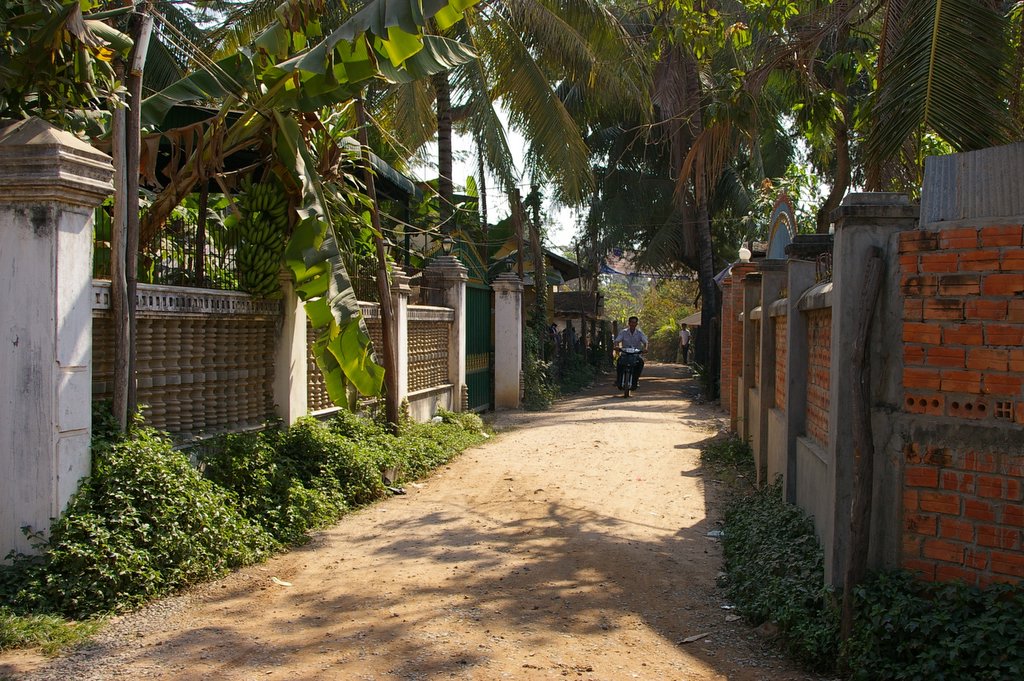 These are the roads leading to the guesthouse we stayed at. They are typical of many of the roads in Siem Reap. It seems that tar/bitumen is optional, really only necessary for main roads. As a result, many of the roads are dusty, bumpy, and sometimes smelly. The bonus, however, is that the pace of the traffic is pretty relaxed. This gives the local kiddies (and tourists!) plenty of time to get out of the way of plodding tuk-tuks.
These roads are great to explore on the back of a moped. One does not want to be actually driving as (a) Street signs are a rare species and (b) an intimate knowledge of the road rules not obeyed is essential.
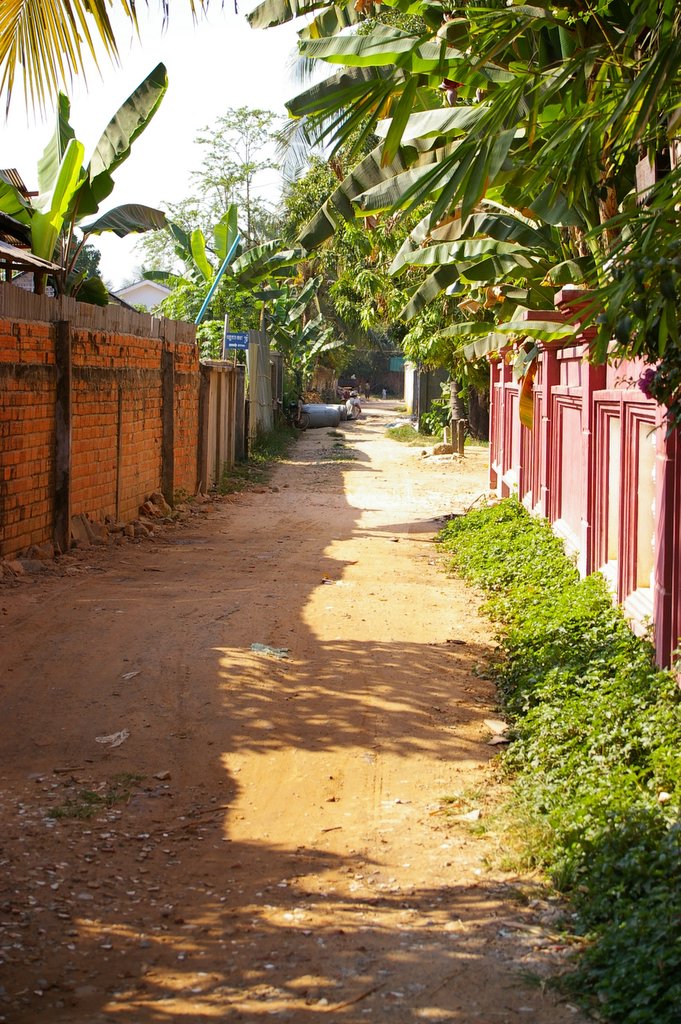
An interesting feature of the streetscape are the many and varied dwellings. What is most remarkable is the contrast between different homes on the same street. One may be the epitome of the city's economic development, replete with marble floor foyer, wood carved doors, and a fancy car standing on a paved driveway. Just next door is likely to be a home that resembles something that should have been abandoned years ago - if only the occupants had that option. These homes are mostly roofed, may have all of the thatched walls, a chicken or two will be wandering around the dusty back yard while a women washes clothes by hand. It would be like seeing a corrugated tin shack next to a stately mansion in Rockcliffe or Mosman.
Yet the description does not do these streets justice. Sure, there is dust, bumps, roadworks done by hand (those grey cylindrical things are part of the fledgling sewer system... waiting for the fellows with shovels), traffic goes every which way, and yes, there are desperately poor people around.
The streets are lively. All day, people are running/zooming/putputting along them. The streets feel friendly, and inviting to explorers. And in the end, how could you not love walking along a banana-tree lined dirt road?

Saturday, August 12, 2006
Gabriel's Lament - Paul Bailey
This book took a little longer to read - mostly because I've taken to listening to podcasts on the train, during the time when I normally focus on reading. Listening and reading is proving rather difficult, though I think I'm getting the hang of it.
Right... Gabriel's mother's about half his father's age, his father's a bit of an up-himself Willy Loman type. Mummy dearest leaves, Father makes like she's having a nice little holiday (now that he's come into some money), Gabriel doesn't account for much til the end of the book, which is more or less a chronological musing taking place some time after Father's passing.
There are interesting bits in the book, Mr Nazareth particularly; and the Lament itself is quite believable. I shall keep to myself the trigger of the grief which spawned the Lament, suffice to say that after the revelation it was more of a 'well, that makes sense' type of reaction than a 'no way! I'd never have thought' one.
And that fits in perfectly with the story.
Right... Gabriel's mother's about half his father's age, his father's a bit of an up-himself Willy Loman type. Mummy dearest leaves, Father makes like she's having a nice little holiday (now that he's come into some money), Gabriel doesn't account for much til the end of the book, which is more or less a chronological musing taking place some time after Father's passing.
There are interesting bits in the book, Mr Nazareth particularly; and the Lament itself is quite believable. I shall keep to myself the trigger of the grief which spawned the Lament, suffice to say that after the revelation it was more of a 'well, that makes sense' type of reaction than a 'no way! I'd never have thought' one.
And that fits in perfectly with the story.
Tuesday, August 01, 2006
The Will - Reed Arvin
The novel is plenty interesting - machinations of county politics and wealth in Kansas. It's not nearly so profound nor engaging as the back cover would make it seem: shocking secrets, confronting the truth about himself...
Nah. Small town boy goes to work in Chicago big time law firm, comes home and redisovers his roots. A few nasty local secrets, a contested will, and a crazy guy fill out the story.
Engaging enough to stay interested, though.
Nah. Small town boy goes to work in Chicago big time law firm, comes home and redisovers his roots. A few nasty local secrets, a contested will, and a crazy guy fill out the story.
Engaging enough to stay interested, though.
Friday, July 28, 2006
My career behind the Iron Curtain - Andrew Barry
A humorous recounting of life in Hungary up to the 1956 revolution.
It's a bit like a re-hashing of jokes about life in command economies rather than a really profound 'life in' story. Fun to read though.
It's a bit like a re-hashing of jokes about life in command economies rather than a really profound 'life in' story. Fun to read though.
Thursday, July 27, 2006
There's a track winding back - Phil Jarrett
Journalist retraces steps of explorers. Starts by walking from Sydney to Parramatta, goes a bunch of places, meets a guy with a dog along the way, takes his daughter fishing.
For some reason this wasn't the most engaging of retrospectives of Australian explorers. Jarrett did manage to have a fair few adventures tagging along Leichhardt's route (for example), and he does convey the bumbling along from stop to stop of olde-tyme Exploreing
For some reason this wasn't the most engaging of retrospectives of Australian explorers. Jarrett did manage to have a fair few adventures tagging along Leichhardt's route (for example), and he does convey the bumbling along from stop to stop of olde-tyme Exploreing
Tuesday, July 25, 2006
The Deprivers - Steven-Elliot Altman
Imagine that if you touched someone, they would lose the use of one of their senses - sight, hearing, touch, smell, taste - or even become paralysed or uncoordinated. Pretty freaky - and depending on what sense or ability was deprived, this could have severe implications for intimate relations too.
Such is the lot of the Deprivers, the pariahs of Altman's sci-fi exploration of a world where some people are Deps amongst the majority rule of Normals.
Interesting themes of 'us and them' conflict, with characters on both sides of the Dep/Normal division who are clearly to be cheered for and those who are to be despised, hint at the allegory to common human prejudice - except this time the people really are different, and can really mess up your day by shaking your hand. Gloves all around.
Impressive too is the biological explanation how this might all work - by not thinking too hard about it, it's not implausible.
But, the book barrels along and is very engaging, until the ending... which disappointed. No spoilers here, but again it seems like the author got bored, or ran into a deadline.
Such is the lot of the Deprivers, the pariahs of Altman's sci-fi exploration of a world where some people are Deps amongst the majority rule of Normals.
Interesting themes of 'us and them' conflict, with characters on both sides of the Dep/Normal division who are clearly to be cheered for and those who are to be despised, hint at the allegory to common human prejudice - except this time the people really are different, and can really mess up your day by shaking your hand. Gloves all around.
Impressive too is the biological explanation how this might all work - by not thinking too hard about it, it's not implausible.
But, the book barrels along and is very engaging, until the ending... which disappointed. No spoilers here, but again it seems like the author got bored, or ran into a deadline.
Sunday, July 23, 2006
Cambodia Trip 2006
Hi. I realised that poking around looking for the Cambodia pictures wouldn't be heaps of fun. So this post should keep all their links together.
Simone arrives
Rob arrives
Pink Pants
Shopping for the pants
Crossroads
Simone arrives
Rob arrives
Pink Pants
Shopping for the pants
Crossroads
Australienation: Portrait of a bi-cultural country - John Ogden
Great photos from three decades of shooting Australia, and a commentary on the Australian Aborginals vs everyone else who turned up - hence "bi" instead of "multi" cultural.
Thursday, July 20, 2006
The Negative - Ansel Adams
Part two in the series, and every bit as useful as the first one. I was reading this on the train, and a guy sitting next to me couldn't contain himself when he saw it, so we ended up chatting about the book and photography in general.
Again, I marvel at how applicable the stuff in this old book is to modern (35mm and digital) photography, even when he's talking about 8x10 cameras and 22 inch lenses. The basics don't change. It's much more helpful too, than "The latest collection of everything you need to know about using digital cameras", where step one is explaining how a CMOS sensor works compared to a CCD; but not the implications for shooting. (Maybe there aren't any; afterall, Photoshop can cure all, right?)
Anyway, I don't pretend to be a purist nor a particularly good photographer, but I can appreciate Adams' skill both as an artist and craftsman, not to mention as a teacher.
Again, I marvel at how applicable the stuff in this old book is to modern (35mm and digital) photography, even when he's talking about 8x10 cameras and 22 inch lenses. The basics don't change. It's much more helpful too, than "The latest collection of everything you need to know about using digital cameras", where step one is explaining how a CMOS sensor works compared to a CCD; but not the implications for shooting. (Maybe there aren't any; afterall, Photoshop can cure all, right?)
Anyway, I don't pretend to be a purist nor a particularly good photographer, but I can appreciate Adams' skill both as an artist and craftsman, not to mention as a teacher.
Tuesday, July 18, 2006
Oryx and Crake - Margaret Atwood
It's been years since I've read anything by Maggie. It's not as arduous as I remember... Handmaid's Tale, Alias Grace, Wilderness Tips, Lady Oracle. Somehow, they all call to mind a sense of forcing myself to continue reading, when I really would rather have not.
Either I've grown, or Atwood's writing differently - I whizzed through O&C, and thought it was pretty alright. Basically, combine an apocalyptic world, the stories of three main characters, rampant genetic and proteonomic modification, a touch of male hubris, and Atwood's unhurried examination of human misery, stir and voila: you have the book.
An interesting cautionary tale; and rather worth reading.
Either I've grown, or Atwood's writing differently - I whizzed through O&C, and thought it was pretty alright. Basically, combine an apocalyptic world, the stories of three main characters, rampant genetic and proteonomic modification, a touch of male hubris, and Atwood's unhurried examination of human misery, stir and voila: you have the book.
An interesting cautionary tale; and rather worth reading.
Saturday, July 15, 2006
The Etched City - K.J. Bishop
Another bit of sci-fi by a woman... Honestly, I don't plan these series of a type of book. I literally grab the first 7 or eight books that look interesting. Maybe the library knows this and is organising things to make it turn out this way... Now I'm worried.
Anyway. The world's gone to bits, it is a bit Mad Max-esque, but lacking internal combustion engines. An accomplished healer and an accomplished killer, colleagues and grudgingly friends during the convoluted wars of years past, meet and head off to one of the remaining cities where they might be able to settle down for a bit. Adventures ensue until they get there; he (the killer) works as a bodyguard for a local warlord type; she works in a rundown hospital in a poor part of town.
Time passes, they don't see each other a lot, and things start getting really wierd - like a lotus flower growing out of some guy's navel - and the flower can't be pulled out.
The barriers between the mundane and the fanstastic seem to become increasingly porous as the book goes on; the let down is the ending which seems to suggest that no one knows quite what happened to the main characters - 'some say that, some say this'... I suppose it's a literary trick to prolong the engagement with the fanstastic beyond the end of the book; but it could just as easily be giving up on the tale and telling the reader that it could go either way.
Interesting read, though.
Anyway. The world's gone to bits, it is a bit Mad Max-esque, but lacking internal combustion engines. An accomplished healer and an accomplished killer, colleagues and grudgingly friends during the convoluted wars of years past, meet and head off to one of the remaining cities where they might be able to settle down for a bit. Adventures ensue until they get there; he (the killer) works as a bodyguard for a local warlord type; she works in a rundown hospital in a poor part of town.
Time passes, they don't see each other a lot, and things start getting really wierd - like a lotus flower growing out of some guy's navel - and the flower can't be pulled out.
The barriers between the mundane and the fanstastic seem to become increasingly porous as the book goes on; the let down is the ending which seems to suggest that no one knows quite what happened to the main characters - 'some say that, some say this'... I suppose it's a literary trick to prolong the engagement with the fanstastic beyond the end of the book; but it could just as easily be giving up on the tale and telling the reader that it could go either way.
Interesting read, though.
Friday, July 14, 2006
Forest of the Pygmies - Isabel Allende
Wow! It's as good as City of the Beasts! (Somewhere else in this blog, searching might find it.)
Jaguar and Eagle are now fast friends, and travelling in Africa with Jaguar's grandmother. It's not long before they're escaping the clutches of a local despot who is treading all over the pygmies and Bantu in the area.
More of the same magical, lyrical writing that I fell in love with in the last book. The best part is that there is one more book in this series.
Jaguar and Eagle are now fast friends, and travelling in Africa with Jaguar's grandmother. It's not long before they're escaping the clutches of a local despot who is treading all over the pygmies and Bantu in the area.
More of the same magical, lyrical writing that I fell in love with in the last book. The best part is that there is one more book in this series.
Thursday, July 13, 2006
First Rider's Call - Kristen Britain
Sci-fi/fantasy, from a women's perspective. Not to shabby at all - a few more 'feelings' and 'emotions' than one might expect on the genre, but not at the cost of battles with orcs and stuff. Nifty.
Second book, but fortunately Ms Britain is considerate enough to have sufficent hints and background that the "First Rider's Call" stands pretty much on its own.
Cool.
Second book, but fortunately Ms Britain is considerate enough to have sufficent hints and background that the "First Rider's Call" stands pretty much on its own.
Cool.
Wednesday, July 12, 2006
Photography exposed - the story behind the image - Life Magazine
A whole bunch of famous pictures, with little stories next to them. Pretty, interesting, very suitable for the coffee table.
I think the descriptions are often too short, but then again, I like words as much as I do pictures.
I think the descriptions are often too short, but then again, I like words as much as I do pictures.
Monday, July 10, 2006
Saturday, July 08, 2006
Chiune Sugihara
The 31st of this month is the 20th anniversary of the death of Chiune Sugihara who basically became the Japanese Schindler during WWII while posted in Lithuania. At his discretion (and against the orders his bosses in Tokyo) he authorised thousands of visas to Jews to escape the onrushing Nazis.
The only reason I know anything about this is a television special on TV a couple of weeks ago; Wikipedia has a whole story here.
The only reason I know anything about this is a television special on TV a couple of weeks ago; Wikipedia has a whole story here.
Friday, July 07, 2006
The Camera - Ansel Adams
Now, this is a book on photography. Not only is Adams a pretty legendary photography, he talks about it really intelligibly (and usually intelligently, too). All the little electronic gizmos on a digital camera are pretty nifty, but I can imagine working with an 8"x10" view camera would be really cool.
#1: Composition, #2: Technical mastery of the medium to do the composition justice. Simple as that.
#1: Composition, #2: Technical mastery of the medium to do the composition justice. Simple as that.
Wednesday, July 05, 2006
New Complete Sailing Manual - Steve Sleight
I'm pretty sure this is the same book I can't find back after moving to Sydney. That's a shame - it's a really good book.
It's a sailing manual. If you like sailing, (and are still learning to do it), it's fabulous. If you're not interested in sailing, it's probably pretty boring.
It's a sailing manual. If you like sailing, (and are still learning to do it), it's fabulous. If you're not interested in sailing, it's probably pretty boring.
Monday, July 03, 2006
Digital Photographers Handbook - Tom Ang
I questioned my own judgement in picking up a book on digital photography printed in 2003. Apparently, 3.3 (and greater) megapixel cameras were in the realm of professional photographers.
Righty-o. I must be a real professional photographer then.
Conclusion: there really isn't a whack of difference between digital photography and film photography. The only thing is that if you stuff up a shot (technically), you can fiddle with it on the computer to recuperate the mistakes. Still, a fixed up boring shot is still a boring shot.
Righty-o. I must be a real professional photographer then.
Conclusion: there really isn't a whack of difference between digital photography and film photography. The only thing is that if you stuff up a shot (technically), you can fiddle with it on the computer to recuperate the mistakes. Still, a fixed up boring shot is still a boring shot.
Sunday, July 02, 2006
The salmon of doubt: hitchhiking the galaxy one last time - Douglas Adams
Ah, posthumous publications. Are they a last attempt to share the writer's brilliance, or a cynical cashgrab by the administrators of the estate and copyrights?
In this case, who cares. I'd forgotten why I liked Douglas Adams. He's pretty clever, and great fun to read. He reminds me (or vice versa, logical linearity isn't that important) of Terry Pratchett. Something to say, and a funny way to say it.
Yay for the guys and girls that put together the myriad jottings.
In this case, who cares. I'd forgotten why I liked Douglas Adams. He's pretty clever, and great fun to read. He reminds me (or vice versa, logical linearity isn't that important) of Terry Pratchett. Something to say, and a funny way to say it.
Yay for the guys and girls that put together the myriad jottings.
Somewhere East of life: Another European fantasia - Brian Aldiss
Criminy, did it again. Book three in a series. I suppose that's a risk of patronising the fiction section of the local library branch - they might not have everything in order.
Great vocabulary in this one; and a rather interesting twisty story. It's a good thing it ended when it did, though. The twists started getting a little routine, and the foil of the guy having his memory poached seemed to be running out of steam a bit... that is, after he'd been to backwater somethingistan trying to save a lost ikon from a mad guerilla (who he stabs in the throat), wandering almost randomly through Madrid, Budapest, and goodness knows where else.
The plot was almost like a Dali - the bits are recognisable, but the way they hang together is pretty different. Good fun.
Great vocabulary in this one; and a rather interesting twisty story. It's a good thing it ended when it did, though. The twists started getting a little routine, and the foil of the guy having his memory poached seemed to be running out of steam a bit... that is, after he'd been to backwater somethingistan trying to save a lost ikon from a mad guerilla (who he stabs in the throat), wandering almost randomly through Madrid, Budapest, and goodness knows where else.
The plot was almost like a Dali - the bits are recognisable, but the way they hang together is pretty different. Good fun.
Friday, June 30, 2006
The toughest Indian in the worlds: Stories - Sherman Alexie
No, there aren't too many motorcycles in this one. There are a lot of pretty odd stories though; what's he trying to do -make me feel guilty for being white?
Alright, that's the self-righteous "I didn't subjugate anyone" knee-jerk reaction out of the way. This guy can write some truly disturbing stuff - some of it sounds like a matter-of-fact record of hardship; some of it is truly whacked '60s paranoia story stuff.
Good or bad? I dunno. He's got the variety of styles down; they all share a common theme but are not boringly repetitive. I suppose it is good in that's interesting, but not necessarily pleasant.
Alright, that's the self-righteous "I didn't subjugate anyone" knee-jerk reaction out of the way. This guy can write some truly disturbing stuff - some of it sounds like a matter-of-fact record of hardship; some of it is truly whacked '60s paranoia story stuff.
Good or bad? I dunno. He's got the variety of styles down; they all share a common theme but are not boringly repetitive. I suppose it is good in that's interesting, but not necessarily pleasant.
Thursday, June 29, 2006
The Best of Outside: The first twenty years - Editors of Outside Magazine
There's a real breadth of stories in here, and while I felt skeptical at the claims of the magazine being an outlet for intelligent commentary, by and large I was won over. Even Tim Cahill's piece wasn't as painful as his books, possibly because it was an order of magnitude shorter.
Monday, June 26, 2006
Flash point - Paul Adam
A semi-fluffy thriller starring an intrepid photojournalist, some monks, some Tibetan guerrilla fighters and the new-born Dalai Lama, in a wholly unsubtle editorial on Chinese repression of Tibet.
I wonder whether the book is a vehicle for the editorial, or if the editorial is just to lend verisimilitude to the story.
I wonder whether the book is a vehicle for the editorial, or if the editorial is just to lend verisimilitude to the story.
Sunday, June 25, 2006
A short history of tractors in Ukrainian - Marina Lewycka
Okay, imagine you're an 84 year old man, and you think you have a shot with a 30-something Ukrainian woman with enormous breasts. What would you do?
Well, in this story, he 'helps' her go from Ukrana to England - as do numerous other men, apparently. He chews through his pension to buy her things, like travel visas, a blender, a car... And she marries him! Lucky guy, huh?
Nah, not quite, and the story of the buxom blonde bursting into the life of an old Ukranian migrant to England provides Lewycka a wonderful foil to do all sorts of things in one book: exploring a relationship of sisters born on either side of the end of the war; tracking through the dual personality of mechanisation as machines of agriculture and as machines of war; thinking about the changes in Eastern Europe and whether the rampant mode of capitalism from the early days of the Western model really need to be imitated for societies just starting down the path...
The tractors in the title got me interested enough to take the book, the notes on the back made me worried that it was going to be some girly maudlin story about families bonding in the face of hardship or some blather like that, and I ended up quite liking the book after all. Better than Updike's stories, that's for sure.
Well, in this story, he 'helps' her go from Ukrana to England - as do numerous other men, apparently. He chews through his pension to buy her things, like travel visas, a blender, a car... And she marries him! Lucky guy, huh?
Nah, not quite, and the story of the buxom blonde bursting into the life of an old Ukranian migrant to England provides Lewycka a wonderful foil to do all sorts of things in one book: exploring a relationship of sisters born on either side of the end of the war; tracking through the dual personality of mechanisation as machines of agriculture and as machines of war; thinking about the changes in Eastern Europe and whether the rampant mode of capitalism from the early days of the Western model really need to be imitated for societies just starting down the path...
The tractors in the title got me interested enough to take the book, the notes on the back made me worried that it was going to be some girly maudlin story about families bonding in the face of hardship or some blather like that, and I ended up quite liking the book after all. Better than Updike's stories, that's for sure.
Trust me: Stories - John Updike
Wow, what a lot of dysfunctional relationships in one book. There are many short stories, apparently spanning decades of the Updike's writing career. They're all quite well written, though his capacity to write about miserable relationships and cheating spouses boggles my mind. I know it goes on, but why on earth write 30 stories about it?
The title is "Trust me", and apparently that's the theme of the book - trust, in relationships between husbands and wives, parents and children, and whatever else. It seems to me that the stories together say that people can't be trusted.
Not my favourite collection of stories, but not a terrible read overall.
The title is "Trust me", and apparently that's the theme of the book - trust, in relationships between husbands and wives, parents and children, and whatever else. It seems to me that the stories together say that people can't be trusted.
Not my favourite collection of stories, but not a terrible read overall.
Thursday, June 22, 2006
When getting a wedding outfit takes 10 minutes
Chronologically, this picture comes before the Procession of the Pink Pants, probably a few days previously. I could check the EXIF data on the image, but that would mean switching windows... but who cares about how lazy I am. The guy in the orange pants is me. I happen to think the purple jacket is a dashing statement. The little guy is Kee - Nek's uncle who owns the guest house where we stayed. The bald guy is Glen - Liz's friend (not in the way that 'Liz's friend' was interpreted in SE Asia) who accompanied her kind of as the muscle. Liz is a little bit little, so it was a safety/comfort thing.
The guy you can't see because he's holding up a piece of material is the tailor. Lovely fellow, lent me the purple jacket on the condition that I not sweat in it. Righty-oh, no sweating in 30 degree humidity. I'm all over that. Think of home, Rob, in February.
So what's going on, now that we've all been introduced? Well, Kee was very encouraging of the idea that as a participant in a traditional Khmer wedding (particularly that of his niece) really ought to wear traditional Khmer clothing. No matter how silly it makes you look. Glen got to participate in the ceremony too, so he needed happypants too. In this image, Kee is bringing all his skills in convincing and persuading to bear: "Yes, you wear that. It's good."
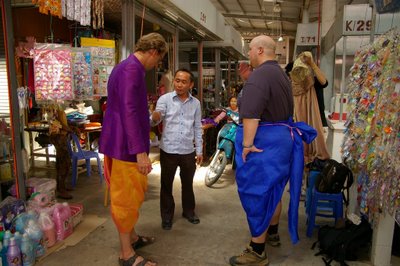 By gum, I'm sold! And indeed I was, on two lengths of silk (now destined to become cushion covers). That's right, I went to a wedding as father of the groom, wearing cushion covers.
You sort of stand in the middle of a couple of metres of silk, and a helper brings the ends together in front of you, kind of wraps/folds/rolls (the wardrobe girls on the wedding day had a genuine technique, we just faked it for the 'fitting') the whole works into a roll, and then that goes between the legs and is pegged up at the back. Tadah! All dressed.
Glen's tail is somewhat more pronounced as he has a more majestic girth than I do, hence it took a bit more material to get around. The consequence is that the rolled up bit is a lot longer... and ends up looking like that. In the market (one of a couple of markets; this may be the New Market, or the Central Market, but then again, those might be the one and the same. Never really did get the two straight. I know definitely wasn't the Old Market), the tail elicited nearly as much hilarity as the pink pants did.
Once our outfits were established (I also got an absolutely darling belt), we hung around briefly chatting in mutually incomprehensible languages with sporadic translations, but much smiling and laughter. Kee had appointed himself chauffeur on this expedition, and kept us to a rather strict and hectic schedule. Once we were done clowning around, we piled back into Kee's CRV, stuffed the tailor into the trunk (it's a little SUV, and there was pillows over the spare tire. He was fine.), and dropped him off from where we'd picked him up, and went back to the guest house to relive the glory of the day.
The guy you can't see because he's holding up a piece of material is the tailor. Lovely fellow, lent me the purple jacket on the condition that I not sweat in it. Righty-oh, no sweating in 30 degree humidity. I'm all over that. Think of home, Rob, in February.
So what's going on, now that we've all been introduced? Well, Kee was very encouraging of the idea that as a participant in a traditional Khmer wedding (particularly that of his niece) really ought to wear traditional Khmer clothing. No matter how silly it makes you look. Glen got to participate in the ceremony too, so he needed happypants too. In this image, Kee is bringing all his skills in convincing and persuading to bear: "Yes, you wear that. It's good."
 By gum, I'm sold! And indeed I was, on two lengths of silk (now destined to become cushion covers). That's right, I went to a wedding as father of the groom, wearing cushion covers.
You sort of stand in the middle of a couple of metres of silk, and a helper brings the ends together in front of you, kind of wraps/folds/rolls (the wardrobe girls on the wedding day had a genuine technique, we just faked it for the 'fitting') the whole works into a roll, and then that goes between the legs and is pegged up at the back. Tadah! All dressed.
Glen's tail is somewhat more pronounced as he has a more majestic girth than I do, hence it took a bit more material to get around. The consequence is that the rolled up bit is a lot longer... and ends up looking like that. In the market (one of a couple of markets; this may be the New Market, or the Central Market, but then again, those might be the one and the same. Never really did get the two straight. I know definitely wasn't the Old Market), the tail elicited nearly as much hilarity as the pink pants did.
Once our outfits were established (I also got an absolutely darling belt), we hung around briefly chatting in mutually incomprehensible languages with sporadic translations, but much smiling and laughter. Kee had appointed himself chauffeur on this expedition, and kept us to a rather strict and hectic schedule. Once we were done clowning around, we piled back into Kee's CRV, stuffed the tailor into the trunk (it's a little SUV, and there was pillows over the spare tire. He was fine.), and dropped him off from where we'd picked him up, and went back to the guest house to relive the glory of the day.
Tuesday, June 20, 2006
The Pink Pants
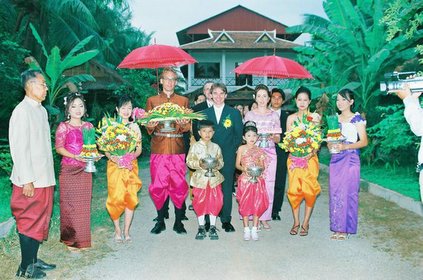 For all those who've heard about the pink pants, but not seen the pink pants, here are the pink pants as photographed at some ungodly early hour in the morning, probably near 6 am. I think Richard (centre, with the yellow flower) is grinning not because of his impending union with the light of his life, Nek, but because his best mate and best man, Shannon, has been joking about the pink pants for the better part of an hour. The old guy, our holy celebrant at left, was chuckling too. The guy holding the umbrella behind Simone... he laughed at the pink pants too. The cute little kids? They were too polite to laugh out loud. So they made big eyes and ran off to convulse in giggles behind the coconut tree. Nek's sisters, Hua and Boa (sorry if that's misspelt, I don't have a Khmer typeface on this computer) laughed very daintily... at the pink pants.
They'd have been just fine, but I think the orange (!) jacket really sets off the whole ensemble. So did Richard, Simone, Nek, Hua, Boa, the old guy.... It was a riot.
I forgot to mention that Simone had a couple of good chuckles at the pink pants too.
Enough about the pants. I had it on the highest authority (Nek's uncle, plus the tyrannical tailor women who bade me drop my trousers... in the courtyard...) and proceeded to swathe me in the pink silk you see radiant before you. Not the matching orangey silk that I had too. The pink silk. Shiny side out.
So what's really going on in that picture? I'm wearing pink pants. Just kidding. Richard, the guy in the middle, is getting married. His mother and father would normally be where Simone and I are, but they couldn't make the trip from Sydney to Cambodia, so we were subbed in. We're at a guest house down the road from Nek's uncle's guest house, where the wedding will take place. We are (all of us above) going to recreate the traditional procession from the groom's village to the bride's village, bearing all sorts of yummy presents to show her parents what a great guy the groom is. Traditionally we'd have walked a couple of kilometres; for the purposes of symbolism we trudged maybe 300 metres. Soon after this photo was taken, traditional (so I'm told, and I'll have to believe it, 'cos I don't know) Khmer wedding music started playing REALLY LOUDLY. EVEN LOUDER THAN WHEN WE ALL WOKE UP AROUND 4 AM. We therefore had many groggy looking spectators along the walk.
And so, the pink pants proceeded forth... peals of laughter issuing in their wake. And it's not like I could melt into the 5 foot tall crowd, either. Weddings are, indeed, a joyous affair.
Friday, June 16, 2006
Rob in Siem Reap
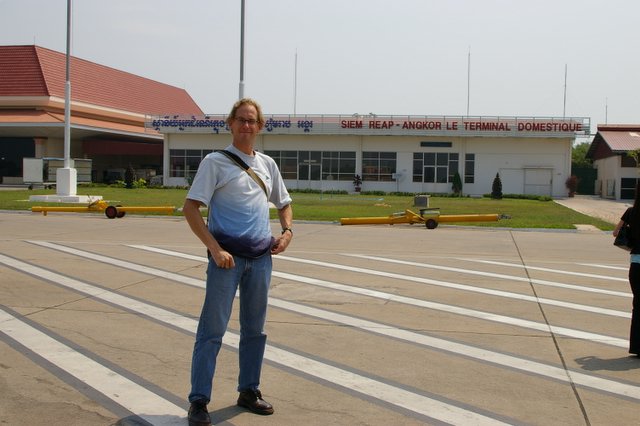 Me, same place, same time as Simone. The same people are just off frame.
Oh, I'm just messing around with this blog-this thingo. Seems to really smallify the pictures.
Simone in Siem Reap, Cambodia
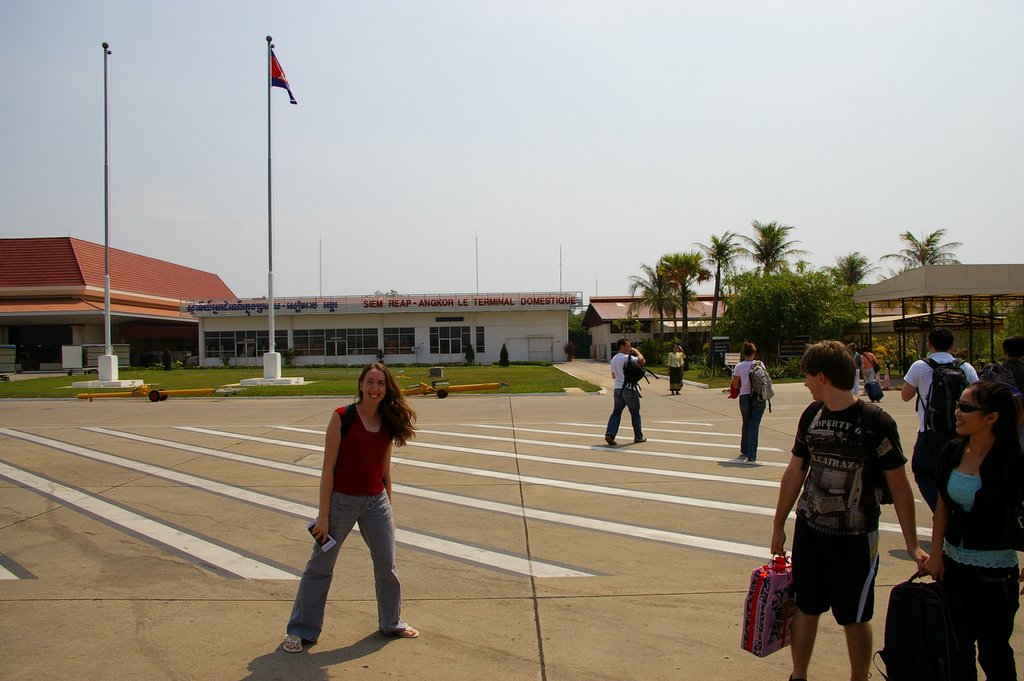 Simone's in the red top; her brother Richard's got the pink bag, and his soon-to-be wife Nek is looking on.
February 6, 2006
Interface - Neal Stephenson and Frederick George
A Manchurian Candidate for the computer age, according to Seattle Weekly.
Someone should have hired the candidate a bloody editor instead of a dim chimpanzee. There were so many mistakes in the book that I can only compare the reading to listening to a scratched CD. Stone the crows, that was annoying.
So, an utterly improbable sci-fi story, unless you are one of the conspiricists with tinfoil on your head. I'm not quite sure how implanting a stroke victim with a biochip that wires him into a computerised polling system renders him a special effect, as described on the back of the book. In fact, that's not the case at all. The li'l chip is courtesy of "The Network", one of those nefarious inchoate groups to whom the Government of the United States of America (God Bless y'all!) is but a means to an end. Naturally, that end is money - they've got the power already.
So, fella gets a stroke (he's already a Governor, so that helps), the Network offers to fix him up with this chip (after they practice on a bunch of Indian (India Indians) brain injury victims) which patches through connections from brain on either end of the damaged part. Neat idea. Of course, being all computery, it can respond to radio frequencies. So... the Network arranges for ongoing biometric polling of a sample of the electorate (far too small a sample, incidentally) that gets used live to advise the candidate via this chippy thing how to behave on the ol' election treadmill. And so on.
We therefore have a sci-fi commentary on 1) ethics in biophysical neurobiology (I don't know if that's what it's called... it's good enough for now), 2) American (God Bless!) electoral groundings, style over substance, etc, 3) a little bit of a cynical poke at the non-governmental power of capital flows, and 4) a plug for good old fashioned values of honesty, hard work, dignity, etc.
You know, I thought Neal Stephenson was a pretty decent sci-fi guy. This book... ah, he must have had an off day.
Someone should have hired the candidate a bloody editor instead of a dim chimpanzee. There were so many mistakes in the book that I can only compare the reading to listening to a scratched CD. Stone the crows, that was annoying.
So, an utterly improbable sci-fi story, unless you are one of the conspiricists with tinfoil on your head. I'm not quite sure how implanting a stroke victim with a biochip that wires him into a computerised polling system renders him a special effect, as described on the back of the book. In fact, that's not the case at all. The li'l chip is courtesy of "The Network", one of those nefarious inchoate groups to whom the Government of the United States of America (God Bless y'all!) is but a means to an end. Naturally, that end is money - they've got the power already.
So, fella gets a stroke (he's already a Governor, so that helps), the Network offers to fix him up with this chip (after they practice on a bunch of Indian (India Indians) brain injury victims) which patches through connections from brain on either end of the damaged part. Neat idea. Of course, being all computery, it can respond to radio frequencies. So... the Network arranges for ongoing biometric polling of a sample of the electorate (far too small a sample, incidentally) that gets used live to advise the candidate via this chippy thing how to behave on the ol' election treadmill. And so on.
We therefore have a sci-fi commentary on 1) ethics in biophysical neurobiology (I don't know if that's what it's called... it's good enough for now), 2) American (God Bless!) electoral groundings, style over substance, etc, 3) a little bit of a cynical poke at the non-governmental power of capital flows, and 4) a plug for good old fashioned values of honesty, hard work, dignity, etc.
You know, I thought Neal Stephenson was a pretty decent sci-fi guy. This book... ah, he must have had an off day.
The Devil and Miss Prym - Paulo Coelho
This is why I write these little warbles. I'd forgotten I'd read this book. I was rummaging through a pile of paper pulled it out, and was all like, whoa, like I've, you know, read this?
Perhaps it read so fast is why I didn't remember it... a train ride and a half is all it lasted. Unfortunately, I had nothing else to read for the last half of the commute home, so I got to ruminate on whether or not Paulo Coelho is 'all that' or if he's just a panacea for shallow yuppies seeking a sense of profundity in their solipsistic little lives. I really am undecided.
Between The Alchemist and this little number, which together constitute the entirety of Coelho's oeuvres that I've read, I've got this funny feeling that he's pulling the wool over my eyes by covering off deep questions about humanity in remarkably readable (hour and a half!) books. See, in this one he's all over the "are humans good, or are they evil; and if evil, is it an irredeemable evil" question. And that's fine - worse, and more foolish, than Coelho have taken it on.
The thing is, the story trips along so merrily it feels like it's fluffy! And how can a fluffy book be so doggone focussed on Good n' Evil? Remember those whacky thought experiments where an dilemma is posed and your response suggests what kind of person (you think) you are? You know, lead a group of people one way and there's a 100% chance that half of them will die, go the other way and there's a 50% percent chance either way that all live or all die. Which do you do?
Well, it's a bit like ol' Paulo came up with a thought experiment, and turned it into a novel. Plausible? What the heck, it's a thought experiment. I reckon it could have gone either way with regard to the ending.
I enjoyed reading the book; I enjoyed the way Coelho really worked the tension within the main characters; I'm not sure about the proposition that fear is humankind's main motivator; I thought the whole light/dark parts of the soul were a bit trite and cliché - especially after the visualisation or personification of the Devil, which was cool.
And I can't shake the idea that the story's not as profound as it seems. That frustrates me.
Perhaps it read so fast is why I didn't remember it... a train ride and a half is all it lasted. Unfortunately, I had nothing else to read for the last half of the commute home, so I got to ruminate on whether or not Paulo Coelho is 'all that' or if he's just a panacea for shallow yuppies seeking a sense of profundity in their solipsistic little lives. I really am undecided.
Between The Alchemist and this little number, which together constitute the entirety of Coelho's oeuvres that I've read, I've got this funny feeling that he's pulling the wool over my eyes by covering off deep questions about humanity in remarkably readable (hour and a half!) books. See, in this one he's all over the "are humans good, or are they evil; and if evil, is it an irredeemable evil" question. And that's fine - worse, and more foolish, than Coelho have taken it on.
The thing is, the story trips along so merrily it feels like it's fluffy! And how can a fluffy book be so doggone focussed on Good n' Evil? Remember those whacky thought experiments where an dilemma is posed and your response suggests what kind of person (you think) you are? You know, lead a group of people one way and there's a 100% chance that half of them will die, go the other way and there's a 50% percent chance either way that all live or all die. Which do you do?
Well, it's a bit like ol' Paulo came up with a thought experiment, and turned it into a novel. Plausible? What the heck, it's a thought experiment. I reckon it could have gone either way with regard to the ending.
I enjoyed reading the book; I enjoyed the way Coelho really worked the tension within the main characters; I'm not sure about the proposition that fear is humankind's main motivator; I thought the whole light/dark parts of the soul were a bit trite and cliché - especially after the visualisation or personification of the Devil, which was cool.
And I can't shake the idea that the story's not as profound as it seems. That frustrates me.
Wednesday, June 14, 2006
Realware - Rudy Rucker
After a brief hiatus, I'm back into the books!
And don't I start reading the 4th book of a tetrology. I suppose if I was a "real" sci-fi fan, I'd have known this instinctively. But I'm not. I go to the library, grab a bunch of books more or less randomly, and read them. I have a new appreciation for those books that have "Book 3 in the series!" written on the front.
Fortunately, it's written well enough, with sufficient clues to the futuristic gizmos and stuff that eventually it's all comprehensible. The little genealogy of the characters at the front doesn't help - and really, who flips to the front to see who's related to who as the story progresses? It worked in War and Peace, but then, I reckon Tolstoi needed help keeping everyone straight.
Anyway, way off in the mid-21st century, things are a little different, when at some point aliens make contact. Naturally, humans fight back. Die, unknown beings, die. Which most of the aliens appeared to do, from what I can make out. (I'm assuming this was covered in detail in one of the previous 3 books).
An alien survives, remembers one of the nice humans from the Moon fight. Guess what? It's the pretty, smart girl that the main boy character meets by chance and, like, totally falls for.
Realware is the alien technology that gets shared with humans. It's futuristic alchemy - turn stuff into other stuff. Are humans grown up enough as a species to handle this kind of power and freedom?
And don't I start reading the 4th book of a tetrology. I suppose if I was a "real" sci-fi fan, I'd have known this instinctively. But I'm not. I go to the library, grab a bunch of books more or less randomly, and read them. I have a new appreciation for those books that have "Book 3 in the series!" written on the front.
Fortunately, it's written well enough, with sufficient clues to the futuristic gizmos and stuff that eventually it's all comprehensible. The little genealogy of the characters at the front doesn't help - and really, who flips to the front to see who's related to who as the story progresses? It worked in War and Peace, but then, I reckon Tolstoi needed help keeping everyone straight.
Anyway, way off in the mid-21st century, things are a little different, when at some point aliens make contact. Naturally, humans fight back. Die, unknown beings, die. Which most of the aliens appeared to do, from what I can make out. (I'm assuming this was covered in detail in one of the previous 3 books).
An alien survives, remembers one of the nice humans from the Moon fight. Guess what? It's the pretty, smart girl that the main boy character meets by chance and, like, totally falls for.
Realware is the alien technology that gets shared with humans. It's futuristic alchemy - turn stuff into other stuff. Are humans grown up enough as a species to handle this kind of power and freedom?
Wednesday, April 19, 2006
Longleg - Glenda Adams
This was a curious little book. Ms Adams is a lecturer (so the bio claims) at one of the universities here in Sydney - UTS, I think. That tidbit has no real relevance to the book... so I figured I'd share it anyway.
Set in not too long ago Sydney, little laddie's growing up. His family's a little strange, consequently he's a little strange... and he finally finds himself when he's about 40 or so.
The story took a bit to get into - it started off sounding a bit like one of those sort of dusty, raspy historic novels, where the past seems to be so heavily troweled onto the pages that the flow of the story gets buried. A little perserverance is warranted, as the main character slowly attracts interest, and things start to make sense.
In fact, the story seems to gather just a little too much momentum, and starts to skip over things toward the end, so that it was a little less satisfying that I'd hoped.
Not a bad book all round, and rather fun to read about the places that I pass through from time to time.
Set in not too long ago Sydney, little laddie's growing up. His family's a little strange, consequently he's a little strange... and he finally finds himself when he's about 40 or so.
The story took a bit to get into - it started off sounding a bit like one of those sort of dusty, raspy historic novels, where the past seems to be so heavily troweled onto the pages that the flow of the story gets buried. A little perserverance is warranted, as the main character slowly attracts interest, and things start to make sense.
In fact, the story seems to gather just a little too much momentum, and starts to skip over things toward the end, so that it was a little less satisfying that I'd hoped.
Not a bad book all round, and rather fun to read about the places that I pass through from time to time.
Sunday, April 16, 2006
Hold the Enlightenment - Tim Cahill
Apparently, Tim Cahill is a travel writer with a sense of humour, and he also teaches people to write. Apparently.
This is one of those cases where someone's written the blurb on the back of the book, and the jerks are lying. It's not uproariously funny. It is trying to be funny - trying quite hard, in fact.
Consequently, it's rather sophomoric - remember that kid in school was was all profound and funny and stuff at the same time? It was Tim, and he's not grown up.
About the only good thing about the collection of short stories that constitutes the book is that he seems to know he's an entirely average writer who gets to go to some interesting places.
This is one of those cases where someone's written the blurb on the back of the book, and the jerks are lying. It's not uproariously funny. It is trying to be funny - trying quite hard, in fact.
Consequently, it's rather sophomoric - remember that kid in school was was all profound and funny and stuff at the same time? It was Tim, and he's not grown up.
About the only good thing about the collection of short stories that constitutes the book is that he seems to know he's an entirely average writer who gets to go to some interesting places.
Thursday, April 13, 2006
Catcher in the Rye - J D Salinger
Finally got around to reading an old classic. And it was pretty good.
What else is there to say about something that's been studied by everyone from high school students to PhD hopefuls?
What else is there to say about something that's been studied by everyone from high school students to PhD hopefuls?
Sunday, April 09, 2006
Interpreter of maladies - Jhumpa Lahiri
This is a great little collection of stories - I'm writing this far too long after finishing the book to really remember them in detail. There's one about a poor woman who lives as the caretaker sort of person for a small apartment building in India; there's a couple getting through the first bit of an arranged marriage - I think that's the one where he moves to America to work at a university...
I do recall that all the stories were notably empathetic - not in the sense that one comes away from reading them feeling "oh, those poor people" or "how darling the way they love each other". In little vignette style glimpses of peoples' lives, the verisimilitude in the special ordinariness of everyone's stories made the people exceptionally real.
It's not - and doesn't claim to be - an exhaustive or authoritative treatise on the lives of Indians around the world. It is a collection of well written, engaging short stories.
I do recall that all the stories were notably empathetic - not in the sense that one comes away from reading them feeling "oh, those poor people" or "how darling the way they love each other". In little vignette style glimpses of peoples' lives, the verisimilitude in the special ordinariness of everyone's stories made the people exceptionally real.
It's not - and doesn't claim to be - an exhaustive or authoritative treatise on the lives of Indians around the world. It is a collection of well written, engaging short stories.
Sunday, March 26, 2006
Stay Alive My Son - Pin Yathay
Now for a Cambodia book that really got me to say not much at all - what the hell can you say about the memoir of a guy who survived Pol Pot's insanity?
The title alone should be enough to provide that funny choking feeling in your throat - those are the words that his father said to him when they were separated during an enforced migration; and they are the words he said to his son as he left the boy with a friend of the family just before his attempt to escape the country on foot.
This book was hard enough to read; thankfully Mr Yathay did not include the gruesomeness that he might have.
The title alone should be enough to provide that funny choking feeling in your throat - those are the words that his father said to him when they were separated during an enforced migration; and they are the words he said to his son as he left the boy with a friend of the family just before his attempt to escape the country on foot.
This book was hard enough to read; thankfully Mr Yathay did not include the gruesomeness that he might have.
Wednesday, March 22, 2006
Red Lights and Green Lizards: A Cambodia Adventure - Liz Anderson
Hey, a book by someone who went and had an adventure in Cambodia! Of course I'm gonna read that...
Okay, so it's the story of two English doctors in the early '90's; I was there in 2006. They were in Phnom Penh; I was in Siem Reap. So, I don't know how good the story is at actually capturing what was going on while they were there. I do know that I didn't find the book as enthralling as the Duchess of Kent or the British Ambassador to Cambodia did.
It's a fairly straightforward chronology of a couple of doctors in their 60s or so who decide to, before they're too old and creaky, to depart the quiet doctoring life in England to do the good work in Cambodia for a year or so. That is, we get:
a) Their awakening and delight at their decision,
b) The hijinks of the flight over, shared with a bunch of other interesting travellers,
c) The wonder and shock at disembarking in a strange world,
d) The honeymoon period,
e) The reality sinking in period,
f) The adjustment and settling in period, and
g) The "I don't really wanna go home" period.
This is getting just a little harsh - it's wonderful stuff they did, bringing education and health services to a brothel, and helping run a hospital. It's just that these voyages tend to yield the same sort of stories, and without something to set them apart, it gets a little difficult to really get into the story - even when there is a shared locality.
Not a terrible story, there's some insights, but it's a lot of reportage.
Okay, so it's the story of two English doctors in the early '90's; I was there in 2006. They were in Phnom Penh; I was in Siem Reap. So, I don't know how good the story is at actually capturing what was going on while they were there. I do know that I didn't find the book as enthralling as the Duchess of Kent or the British Ambassador to Cambodia did.
It's a fairly straightforward chronology of a couple of doctors in their 60s or so who decide to, before they're too old and creaky, to depart the quiet doctoring life in England to do the good work in Cambodia for a year or so. That is, we get:
a) Their awakening and delight at their decision,
b) The hijinks of the flight over, shared with a bunch of other interesting travellers,
c) The wonder and shock at disembarking in a strange world,
d) The honeymoon period,
e) The reality sinking in period,
f) The adjustment and settling in period, and
g) The "I don't really wanna go home" period.
This is getting just a little harsh - it's wonderful stuff they did, bringing education and health services to a brothel, and helping run a hospital. It's just that these voyages tend to yield the same sort of stories, and without something to set them apart, it gets a little difficult to really get into the story - even when there is a shared locality.
Not a terrible story, there's some insights, but it's a lot of reportage.
Monday, March 13, 2006
The Leopard - Giuseppe Tomasi di Lampedusa
From the frontispiece: " Giuseppe Tomasi was a Sicilian nobleman, Duke of Palma and Prince of Lampedusa. He was born in Palermo in 1896 an died in Rome in 1957... He published nothing during his lifetime, but bequeathed, in addition to his great novel [that'd be The Leopard - R] a memoir, some short stories, an incomplete novel and some fascinating appraisals of English and French literature."
Must be nice to be a nobleman. Anyway...
This is a historical novel based on the transition in the 1800s in Italy from the end of the Kingdome of the Two Sicilies to the declaration of Rome as capital of Italy 1870. (Credit to the translator's note; I don't know much about 19th century Italy.) So, one political system is transitioning to another, the key characters are princes and their families... what can the book be about but the strangeness of a changing world?
It's really a pretty impressive book - challenging enough to get into through the style, has plenty of interesting little asides and allusions and interesting characters, and in the end feels nicely rounded out.
Thanks to Simone for this one!
Must be nice to be a nobleman. Anyway...
This is a historical novel based on the transition in the 1800s in Italy from the end of the Kingdome of the Two Sicilies to the declaration of Rome as capital of Italy 1870. (Credit to the translator's note; I don't know much about 19th century Italy.) So, one political system is transitioning to another, the key characters are princes and their families... what can the book be about but the strangeness of a changing world?
It's really a pretty impressive book - challenging enough to get into through the style, has plenty of interesting little asides and allusions and interesting characters, and in the end feels nicely rounded out.
Thanks to Simone for this one!
Friday, March 10, 2006
The Black Ice - Michael Connelly
Not a badbook, just another detective thriller type, set in LA. Apparently the critics think the book is excellent, so I guess I was lucky not to get a dog of the genre.
Friday, March 03, 2006
October Sky - Homer H. Hickam, Jr
Once in a while you find a memoir by someone who actually had an interesting life, and is able to write about it in an interesting way. Hurray!
Okay, Homer Jr lived in a West Virginia coal town in the 1950s, and instead of high school ball and working in the mines, he got stuck into rocketry. Being an egghead in a coal town wasn't always the best plan, but Homer and his mates made out alright.
I think what keeps this story interesting is that it doesn't rely on the "I did this, then that, then this, then that..." approach. He's managed to tie in the events that happened around his immediate experience, and then with the hindsight of a few decades, relate the whole works as intertwined events - like when his father, the coal company's head guy in the town, couldn't slip him some materials for building rockets after the company was bought out and the unions showed up and so on.
Almost made me want to go out and build a rocket.
Okay, Homer Jr lived in a West Virginia coal town in the 1950s, and instead of high school ball and working in the mines, he got stuck into rocketry. Being an egghead in a coal town wasn't always the best plan, but Homer and his mates made out alright.
I think what keeps this story interesting is that it doesn't rely on the "I did this, then that, then this, then that..." approach. He's managed to tie in the events that happened around his immediate experience, and then with the hindsight of a few decades, relate the whole works as intertwined events - like when his father, the coal company's head guy in the town, couldn't slip him some materials for building rockets after the company was bought out and the unions showed up and so on.
Almost made me want to go out and build a rocket.
Tuesday, February 28, 2006
Striptease - Carl Hiassen
Yes, two books in a row by the same author. What can I do? It's one of those two-in-one volumes.
Another amusing, fluffy, vaguely nonsensical Florida based crime/comedy novel. This time it starts in a strip joint and ends in a sugar cane field.
Light 'n easy...
Another amusing, fluffy, vaguely nonsensical Florida based crime/comedy novel. This time it starts in a strip joint and ends in a sugar cane field.
Light 'n easy...
Saturday, February 25, 2006
Native Tongue - Carl Hiaasen
Hurray! Fluff!
Light, easy, and not completely insipid.
From the back: PR man Joe Wilder didn't believe the theft of the last two blue-tongued voles on earth from a billionaire's Florida theme park. He just wrote the story. Before he could say Robbie Raccoon, he was hiding out in the Everglades with a one-eyed man and a gun toting granny in pink curlers, and ready to put the skids on the craziest crime con in the history of the state.
I think it's a parody of the hard-bitten crime novel genre... even if it's not meant to be, it was fun to read.
Light, easy, and not completely insipid.
From the back: PR man Joe Wilder didn't believe the theft of the last two blue-tongued voles on earth from a billionaire's Florida theme park. He just wrote the story. Before he could say Robbie Raccoon, he was hiding out in the Everglades with a one-eyed man and a gun toting granny in pink curlers, and ready to put the skids on the craziest crime con in the history of the state.
I think it's a parody of the hard-bitten crime novel genre... even if it's not meant to be, it was fun to read.
Monday, February 20, 2006
The Constant Gardner - John le Carré
A tour de force of plot development... the plot is developed slowly and meticulously. It's not a fast moving book at all, and not as exciting as the cover suggests.
Very writerly - hints of events in the past are fleshed out later on in the book. Only the main character turns out to be particularly interesting in terms of development; everyone else is sort of just there.
The story is built on the nefarious activities of 'big pharma', and essentially the argument against those activities drives the actions of the protagonists.
If it wasn't for the qualities of the writing, this would be a rather generic take on the 'big pharma does bad things' approach; however, le Carré manages to heighten the sinister without sounding like a loony lefty.
Very writerly - hints of events in the past are fleshed out later on in the book. Only the main character turns out to be particularly interesting in terms of development; everyone else is sort of just there.
The story is built on the nefarious activities of 'big pharma', and essentially the argument against those activities drives the actions of the protagonists.
If it wasn't for the qualities of the writing, this would be a rather generic take on the 'big pharma does bad things' approach; however, le Carré manages to heighten the sinister without sounding like a loony lefty.
Tuesday, January 31, 2006
The Mysterious North - Pierre Berton
Berton's a darn fine story teller, and here he is telling the story of his time in Canada's North from 1947 to 1954, with retrospective chapters from 1989, where with the hindsight of 25 years, he can comment upon what he's written.
I can't help but be a bit jealous of ol' Pierre - what an interesting batch of stories. Imagine, getting a phone call from a buddy who's flying to Baffin Island in a few hours, and he asks you if you'd like to pop along for the ride? Of course you do - and later on you fly around the Rockies in northern BC looking to prove/disprove the existence of an Eden-like valley amidst the rock and snow.
The way things used to be... I couldn't really imagine if it wasn't for stories like these.
And a special thanks to Simone for bringing this book home one day.
I can't help but be a bit jealous of ol' Pierre - what an interesting batch of stories. Imagine, getting a phone call from a buddy who's flying to Baffin Island in a few hours, and he asks you if you'd like to pop along for the ride? Of course you do - and later on you fly around the Rockies in northern BC looking to prove/disprove the existence of an Eden-like valley amidst the rock and snow.
The way things used to be... I couldn't really imagine if it wasn't for stories like these.
And a special thanks to Simone for bringing this book home one day.
Friday, January 20, 2006
Overthrown by Strangers - Ronan Bennett
This was a pretty good book - a bunch of people get mixed up with each other, and they are mostly non-descript and utter unremarkable in their abilities - strange for a book about people taking on the forces of evil (normally there's a trump card in their character that allows them to overcome). Not so these sad sacks. They seem clever at times... but is it enough?
I kind of enjoyed it for the unconventional ending, which is probably pretty realistic given the subject matter - the exercising of power in developing countries, and the naivete of starry eyed idealists who hop on in trying to make it all right.
This story actually drew me in enough to care about the characters - it starts off like any old thriller good vs. evil plot, but as I got into it, the story was like one of those stories but just enough not like the norm to be interesting.
I kind of enjoyed it for the unconventional ending, which is probably pretty realistic given the subject matter - the exercising of power in developing countries, and the naivete of starry eyed idealists who hop on in trying to make it all right.
This story actually drew me in enough to care about the characters - it starts off like any old thriller good vs. evil plot, but as I got into it, the story was like one of those stories but just enough not like the norm to be interesting.
Sunday, January 15, 2006
Naked - David Sedaris
This isn't a bad book at all, although it was not 'sidesplitting' as the NYT book review declares on the back cover.
Step one: Take the wave of memoir-itis where everyone thinks their life story is interesting enough to write a book about.
Step two: Write a whacked out parodic example of said wave.
Step three: Publish "naked".
What's so brilliant about it - that it's taking the mickey out of narcisism, or that it's a 'gay book', or what?
A nice light read, but if this is the freshest in American writing, the genre's getting pretty worn out.
Step one: Take the wave of memoir-itis where everyone thinks their life story is interesting enough to write a book about.
Step two: Write a whacked out parodic example of said wave.
Step three: Publish "naked".
What's so brilliant about it - that it's taking the mickey out of narcisism, or that it's a 'gay book', or what?
A nice light read, but if this is the freshest in American writing, the genre's getting pretty worn out.
Tuesday, January 10, 2006
The Abomination - Paul Golding
This is a gay book (literally) about a Continental boy dropped into a proper English school system (like his dad was), but his character is more like that of his Spanish mom. So he doesn't really fit in, which is exacerbated by his homosexuality. As he grows older, he doesn't become any more interesting.
Once the mild shock of the more graphic descriptions had worn off, it wasn't all that impressive, and again, I found myself not really caring too much about the character. Through his trials and tribulations, self-loathing, self questioning, defiance, I didn't feel like there was any great insights made, no profound linkages between the retread of a hard time in school and being gay (other than the other boys call you specific names).
I actually felt most for the mother. In the beginning, she's a bit of a character, to the end she's a shell of who she was, and she loses the spark of liveliness that made her interesting at the start. The father's just a bit of a twit, and while I think the reader's meant to loathe him in the same way the main character does, I couldn't muster the enthusiasm to really feel anything in this regard either.
So, overall not nearly as good as the cover quotes would suggest.
Once the mild shock of the more graphic descriptions had worn off, it wasn't all that impressive, and again, I found myself not really caring too much about the character. Through his trials and tribulations, self-loathing, self questioning, defiance, I didn't feel like there was any great insights made, no profound linkages between the retread of a hard time in school and being gay (other than the other boys call you specific names).
I actually felt most for the mother. In the beginning, she's a bit of a character, to the end she's a shell of who she was, and she loses the spark of liveliness that made her interesting at the start. The father's just a bit of a twit, and while I think the reader's meant to loathe him in the same way the main character does, I couldn't muster the enthusiasm to really feel anything in this regard either.
So, overall not nearly as good as the cover quotes would suggest.
Saturday, October 15, 2005
The Wealth and Poverty of Nations - David Landes
It's been a while since I read this, and my memory of it is a little hazy. The question being answered is, in short, why is it that some countries are so wealthy, and others are so poor?
Now, Landes wrote this as emeritus professor of history at Harvard, so that in itself should lend some credence to the book. I do recall, that I felt a little unconvinced at the end of the book - his position that the values and attitudes that led to and sustained the industrial revolution are the drivers of success felt glib and pat, but presented with such a tone of self-assuredness that I can't help but think that he is, rather than having a good think about things, regurgitating in book form the convictions that he's developed over however many years as a distinguished academic.
I don't really disagree with most of his observations. It's more the lack of any indicators of success besides wealth. The other thing I didn't really agree with was his estimation of sustainable wealth generation - e.g., the wealthy countries today are growing sustainably because their growth has been sustainable for the last couple of hundred years. Glib, pat, and debatable.
It's a historical tour de force, and I'd say a good point to start chatting about the issues raised, but by no means should it be held as the final word.
Now, Landes wrote this as emeritus professor of history at Harvard, so that in itself should lend some credence to the book. I do recall, that I felt a little unconvinced at the end of the book - his position that the values and attitudes that led to and sustained the industrial revolution are the drivers of success felt glib and pat, but presented with such a tone of self-assuredness that I can't help but think that he is, rather than having a good think about things, regurgitating in book form the convictions that he's developed over however many years as a distinguished academic.
I don't really disagree with most of his observations. It's more the lack of any indicators of success besides wealth. The other thing I didn't really agree with was his estimation of sustainable wealth generation - e.g., the wealthy countries today are growing sustainably because their growth has been sustainable for the last couple of hundred years. Glib, pat, and debatable.
It's a historical tour de force, and I'd say a good point to start chatting about the issues raised, but by no means should it be held as the final word.
Friday, September 30, 2005
City of the beasts - Isabel Allende
This is a really engaging mystical story. In broad strokes, young American boy has to go hang out with his grandma on the other side of the country during a family health crisis. Grandma's scheduled to go to the Amazon - she's a writer type for National Geographic or something. So, junior has to go along. The Amazon, in reality as well as in this book, is equal parts unknown mysterious and scary wonderland, and a place for unscrupulous people to try and boost their egos and bank balances at the expense of the indigenous folks.
Junior learns to adapt, to be brave and live up to his totemic animal's reputation (I kinda want a totemic animal. With my luck, it'd be something like a cricket.) Anyway, he learns to see with his heart and accept the rythm of the jungle.
Books translated, as this one is, into English run the risk of losing some of the qualities of the original language (Spanish, in this case). Either the translator was brilliant, or the original book has huge qualities that some could get lost and it is still wondrous to read - or both.
The book isn't supremely spiritual and metaphysical as to be impenetrable - on the contrary, it makes the (perhaps mythologized and romanticised) Amazonian wonder accessible. It makes the point of the plight of indigenous people without being preachy.
A good read, and recommended.
Junior learns to adapt, to be brave and live up to his totemic animal's reputation (I kinda want a totemic animal. With my luck, it'd be something like a cricket.) Anyway, he learns to see with his heart and accept the rythm of the jungle.
Books translated, as this one is, into English run the risk of losing some of the qualities of the original language (Spanish, in this case). Either the translator was brilliant, or the original book has huge qualities that some could get lost and it is still wondrous to read - or both.
The book isn't supremely spiritual and metaphysical as to be impenetrable - on the contrary, it makes the (perhaps mythologized and romanticised) Amazonian wonder accessible. It makes the point of the plight of indigenous people without being preachy.
A good read, and recommended.
Thursday, September 29, 2005
Down under - Bill Bryson
This is my first Bill Bryson book, and I'm still not sure if I like it or not. He's definitely good at writing from the point of view of the tourist. There are parts of the book, such as when he's describing the diversity and vastness of the continent, or the way the blackfellas been treated, when he demonstrates a sensitivity as well as an awareness of his own lack of deep understanding of things, when I really admire his style and observations.
Other times, he just sounds like a dumb American who lived as a whingeing Pom for twenty years, and who's been to Australia, likes it, and wrote a book about it.
Oh, he makes fun of cricket... nothing new there. It's not a terribly interesting story he tells, that's all. He seems to like it, but like so many journals of where people have gone and seen wondrous things, it's hard to really care about it.
Sure read the book, there's some flashes of brilliance, but over all, a pretty light read.
Other times, he just sounds like a dumb American who lived as a whingeing Pom for twenty years, and who's been to Australia, likes it, and wrote a book about it.
Oh, he makes fun of cricket... nothing new there. It's not a terribly interesting story he tells, that's all. He seems to like it, but like so many journals of where people have gone and seen wondrous things, it's hard to really care about it.
Sure read the book, there's some flashes of brilliance, but over all, a pretty light read.
Tuesday, September 27, 2005
Five past midnight in Bhopal - Dominique Lapierre & Javier Moro
Sucks to be poor and unimportant as the waves of the global market splash and ebb capital around, doesn't it? One day you're sitting there wondering if the damn rice is ever going to grow and the little power brokers in your remote province will ever cut you a bit of a break, when lo! some nice guy wanders around and gives you super duper seeds and an amazing cow, and life is going to be fabulous when the super seeds get eaten by little buggies and the cow doesn't have enough to eat so it keels over, so you have a really nice steak with no salad and then bugger all.
Act 2. Things get worse! So, you pack up the wife and kiddies and leave the nice little rural area you've been scratching by in for ever, and go to a city, where, as we all know, the streets are paved with gold. Well, maybe they were, because now there's just mud and more grinding poverty. Oh, but the kiddies can go make matches and cigarettes by hand in dark, close buildings, or scuttle over trains looking for things to salvage or maybe beg a couple of units of currency...
And lo! A wondrous thing happens. Out of nothing but concern for fellow human beings, and the boost in the pocketbook is really just a nice side effect, some big company which makes batteries, has decided to conquer the little buggies mentioned above, so the rice can grow proud and strong, the people can eat, prosper, and buy more bug-icide.
That company looks to your country which has lots of hungry people, and a history of climactic difficulties when it comes to feeding them, and decides that it'd be a heck of an idea to build a big factory right in your new city to manufacture this bug-icide. Right on, dude! Work, money and more food to buy with the money... a dream come true.
The factory gets built, people get good work, and training in handling the dangerous chemicals that go together to make their bug-icide. Your little slum even gets a television! Happy days!
Remember that bit about the pocket book? Turns out it's more important than we thought. So, things go downhill in the shiny new factory, as a couple of currency units here and a couple over there are saved... until... things go really wrong, and lots of people die, and no one really is assigned responsibility; the survivors and the victims' families never get compensated - and the compensation that they were supposed to get was minimal anyway.
Pretty crummy story, huh? It's a true one. A chemical plant blew up because it wasn't maintained, and killed 30 000 people in India.
This is by the same fellow who wrote City of Joy, and it's just as sensitive and disturbing.
Read it.
Act 2. Things get worse! So, you pack up the wife and kiddies and leave the nice little rural area you've been scratching by in for ever, and go to a city, where, as we all know, the streets are paved with gold. Well, maybe they were, because now there's just mud and more grinding poverty. Oh, but the kiddies can go make matches and cigarettes by hand in dark, close buildings, or scuttle over trains looking for things to salvage or maybe beg a couple of units of currency...
And lo! A wondrous thing happens. Out of nothing but concern for fellow human beings, and the boost in the pocketbook is really just a nice side effect, some big company which makes batteries, has decided to conquer the little buggies mentioned above, so the rice can grow proud and strong, the people can eat, prosper, and buy more bug-icide.
That company looks to your country which has lots of hungry people, and a history of climactic difficulties when it comes to feeding them, and decides that it'd be a heck of an idea to build a big factory right in your new city to manufacture this bug-icide. Right on, dude! Work, money and more food to buy with the money... a dream come true.
The factory gets built, people get good work, and training in handling the dangerous chemicals that go together to make their bug-icide. Your little slum even gets a television! Happy days!
Remember that bit about the pocket book? Turns out it's more important than we thought. So, things go downhill in the shiny new factory, as a couple of currency units here and a couple over there are saved... until... things go really wrong, and lots of people die, and no one really is assigned responsibility; the survivors and the victims' families never get compensated - and the compensation that they were supposed to get was minimal anyway.
Pretty crummy story, huh? It's a true one. A chemical plant blew up because it wasn't maintained, and killed 30 000 people in India.
This is by the same fellow who wrote City of Joy, and it's just as sensitive and disturbing.
Read it.
Monday, September 12, 2005
Drylands - Thea Astley
Cool - a fiction book, the first one in a long time. Shortish story shorter: The lives of a bunch of people in a fading Australian rural town are intertwined.
This is a pretty darn good book - it's readable AND it's technically interesting. There's a bunch of Aussie-centred subtexts I'm sure, but I've not been here long enough to pick up on all of them. I do know that chronology, psychology, economics and ecology are very believably dealt with in this book. The characters are not too complex; just enough so that they're interesting. The plot is the focus of writerly effort, I think, and it was worthwhile.
Good stuff, worth reading.
This is a pretty darn good book - it's readable AND it's technically interesting. There's a bunch of Aussie-centred subtexts I'm sure, but I've not been here long enough to pick up on all of them. I do know that chronology, psychology, economics and ecology are very believably dealt with in this book. The characters are not too complex; just enough so that they're interesting. The plot is the focus of writerly effort, I think, and it was worthwhile.
Good stuff, worth reading.
Sunday, August 28, 2005
Collapse: Why societies choose to suceed or fail - Jared Diamond
We're not as screwed as David Suzuki thinks, but we're still pretty screwed.
This is a damn big book. I started it on a flight from Ottawa to Sydney, and just finished it. Diamond seems like a pretty rigorous researcher, and he's generally a pretty good writer.
(Very) long story short: there's lots of factors that contribute the demise of civilisations. The environment is a really important one, but it operates in concert with other things, not the least of which is the decisions made by the civilisation. That's why the Easter Islanders died off, but the Icelanders and Inuit managed to stick around.
Well worth reading, this one.
This is a damn big book. I started it on a flight from Ottawa to Sydney, and just finished it. Diamond seems like a pretty rigorous researcher, and he's generally a pretty good writer.
(Very) long story short: there's lots of factors that contribute the demise of civilisations. The environment is a really important one, but it operates in concert with other things, not the least of which is the decisions made by the civilisation. That's why the Easter Islanders died off, but the Icelanders and Inuit managed to stick around.
Well worth reading, this one.
Wednesday, August 24, 2005
Public Relations - A matter of spin: N E Renton
This is basically a little collection of how-to tips for the public relations practitioner in Australia, from planning press releases to spinning and timing stories so that the media covers it the way you want to.
Trouble is, I think people are too damn good at this sort of stuff, and the PR folks have a grand old time getting away with little massages of news and so on.
There's not a lot to this book - it's more of "another treasure of wisdom" from "a renowned leader in Australian PR" blah blah blah. It's just a manual.
Trouble is, I think people are too damn good at this sort of stuff, and the PR folks have a grand old time getting away with little massages of news and so on.
There's not a lot to this book - it's more of "another treasure of wisdom" from "a renowned leader in Australian PR" blah blah blah. It's just a manual.
Monday, August 22, 2005
Naked Ape to Superspecies - David Suzuki and Holly Dressel
We're screwed, folks.
Well, that may actually be a glib interpretation. There's a lot of things going wrong with the world, and David Suzuki is a heck of a guide through the dystopia that we're turning our planet into. You know, we're kind of like dogs that haven't learned not to pee in the house, or stupid kids who get their own place and just have fun and trash the joint. Actually, I think we're more like the kids than the dogs - we're supposed to have some sense, being human and all.
About the book. David Suzuki, in case you haven't heard of him, is a geneticist turned environmentalist, and he's pretty darn good at it. His story is that he was having a grand old time down at the genetics lab, and one day he found out about some worrying goin's on over in corporate genetics ville, and had a fundamental re-thing about what was going on.
Essentially, there's no argument that humans (and their ancestors, and all the other creatures great and small) have an effect on the environment. But to use this argument as a panacea against the doom and gloom of the enviro-lefties is disingenuous. Humans, as superspecies rather than naked ape of days gone by, is able to cause enormous environmental change in such short periods of time that ol' Mother Earth can't keep up with cleaning up after us.
Sometimes we're pretty clueless: I think it was this book (though it could be one of the other envirodoom books I've read lately) that tells the story of some wonderful bio-engineered microorganism that was supposed to do something particularly handy, like eat pollution and turn it into sunlight, or make loaves of bread appear on wheat stalks or something like that. Neat, and readily commercialisable. The way things worked, in order to get approval to release this into the wild in the States, the FDA said to the company "Make sure this gizmo won't do anything real bad, m'kay?" And the company said "Sure! We'll run some tests." So they sterilized some soil, put the gizmo in the lab in the soil, and lo and behold, it sat there kind of bored cos there was nothing to do. Some bright young grad student had an idea. Soil isn't sterile, he thought to himself. So he wandered out on his lunch break, grabbed a bucket of soil and brought it in to the lab. He put in some of the genetically engineered wonder, and nearly pooped himself when in short order there was nothing left alive in the 'natural' soil. The wonder-organism killed off every other biotic element in the sample. Ergo, release this into the wild and... it's gonna kill off all the microorganisms, upon which everything that grows in the soil depends... and that we depend on to, you know, live.
It was a fluke that there's still stuff growing in North America, dudes. One bright young fella with a bucket of dirt made a big difference.
That's the story that's stuck with me after finishing the book. The book's typically well written, and is rigourously researched. I can't fault Suzuki's motives or persuasion.
The only problem is, it's the enviro-left again. The folks making the money off GMOs and wrecking our house have control of the discourse, and the regulations. The arguments that their technological wizardry is going to save the earth is drowning out the little pesty voices suggesting that they're mucking up more than their fair share of it.
Righto, here's a whack of links from the back of the book. I've updated URLs that I've been able to find.
Well, that may actually be a glib interpretation. There's a lot of things going wrong with the world, and David Suzuki is a heck of a guide through the dystopia that we're turning our planet into. You know, we're kind of like dogs that haven't learned not to pee in the house, or stupid kids who get their own place and just have fun and trash the joint. Actually, I think we're more like the kids than the dogs - we're supposed to have some sense, being human and all.
About the book. David Suzuki, in case you haven't heard of him, is a geneticist turned environmentalist, and he's pretty darn good at it. His story is that he was having a grand old time down at the genetics lab, and one day he found out about some worrying goin's on over in corporate genetics ville, and had a fundamental re-thing about what was going on.
Essentially, there's no argument that humans (and their ancestors, and all the other creatures great and small) have an effect on the environment. But to use this argument as a panacea against the doom and gloom of the enviro-lefties is disingenuous. Humans, as superspecies rather than naked ape of days gone by, is able to cause enormous environmental change in such short periods of time that ol' Mother Earth can't keep up with cleaning up after us.
Sometimes we're pretty clueless: I think it was this book (though it could be one of the other envirodoom books I've read lately) that tells the story of some wonderful bio-engineered microorganism that was supposed to do something particularly handy, like eat pollution and turn it into sunlight, or make loaves of bread appear on wheat stalks or something like that. Neat, and readily commercialisable. The way things worked, in order to get approval to release this into the wild in the States, the FDA said to the company "Make sure this gizmo won't do anything real bad, m'kay?" And the company said "Sure! We'll run some tests." So they sterilized some soil, put the gizmo in the lab in the soil, and lo and behold, it sat there kind of bored cos there was nothing to do. Some bright young grad student had an idea. Soil isn't sterile, he thought to himself. So he wandered out on his lunch break, grabbed a bucket of soil and brought it in to the lab. He put in some of the genetically engineered wonder, and nearly pooped himself when in short order there was nothing left alive in the 'natural' soil. The wonder-organism killed off every other biotic element in the sample. Ergo, release this into the wild and... it's gonna kill off all the microorganisms, upon which everything that grows in the soil depends... and that we depend on to, you know, live.
It was a fluke that there's still stuff growing in North America, dudes. One bright young fella with a bucket of dirt made a big difference.
That's the story that's stuck with me after finishing the book. The book's typically well written, and is rigourously researched. I can't fault Suzuki's motives or persuasion.
The only problem is, it's the enviro-left again. The folks making the money off GMOs and wrecking our house have control of the discourse, and the regulations. The arguments that their technological wizardry is going to save the earth is drowning out the little pesty voices suggesting that they're mucking up more than their fair share of it.
Righto, here's a whack of links from the back of the book. I've updated URLs that I've been able to find.
- GreenNet
- Friends of the Earth
- GreenPeace (Canada)
- The Population Institute
- Sierra Club (Canada)
- TWN
- Adbusters
- Redefining Progress
- Quebec Public Interest Research Group at McGill (QPIRG-McGill)
- Organic Consumers Association (Old site) (New site)
- Biotechnology.org
- Institute for Agriculture and Trade Policy
- International Centre for Technology Assessment
- Council of Canadians
- International Forum on Globalization
- Center for Media and Democracy - PRWatch
- CorpWatch
- David Suzuki Foundation
- Rainforest Action Network
- World Resources Institute
- Sea Sheperd Conservation Society
- Essential Information Encouraging Activism
- Health Care without Harm
- Environmental Rights Action
Saturday, August 20, 2005
Collateral language: A user's guide to America's new war - John Collins and Ross Glover, eds.
The trouble with lefty challenges to the way the world works is that for some reason, they can't get their position to be taken seriously either by the power elite nor the majority of the Joe and Jane Sixpacks. Heck, they can't even be heard. So what happens? A bunch of intelligent, concerned, and politically engaged people tell each other how misguided the people in charge are, how they're pulling the wool over the people's eyes, betraying the trust of democracy and freedom, and generally agreeing that something needs to be done.
Here we go again. This collection of essays, published shortly after the attacks of September 11, 2001, are fairly cogent and reasonable arguments against the status quo of the War on Terror(ism), and all the other things the US power elite does in order to ensure its global hegemony, like sponsoring the 'disappearance' of social democratic figures in South America in favour of despotic arseholes who'd rather kill off their own citizens in exchange for money and weapons from Uncle Sam.
The problem, and several of the essays get it, is that the discourse has been so effectively framed to support the dominant world view - America as a beacon of freedom and democracy, ill-defined terrorists (generally, whomsoever the American executive doesn't like) are threats, therefore high ho, it's off to war we go.
I had a rather leftish university education, and two things led to my distance from the cause, as it were: First, saving the world and advancing the cause of the proletariat, unless one is a suitably well-regarded professor or populist writer, does not the mortgage pay. Second, this problem of actually getting anything done sort of is disillusioning. Answers to the problem of being heard, of having an effect, are few and far between. The discourse has been so coopted and controlled by the elites, that when the lefties make a statment or organise a march, it's really easy for them to be marginalised as the nutters in the way of progress. Only the left takes the left seriously, unfortunately.
After that rather cynical rant, I must admit having a soft sport for the arguments in the book. Hell yeah, I think our civil liberties are being eroded in favour of a false sense of security. Hell no, I don't think bombing the bejesus out of poor hungry people is the way to global security. Hell no, I don't think accelerating the consumption of natural resources is the manifest destiny of the 'developed world'. Hell yeah, I think a nation ought to be able to protect its global trading interests (does anyone else want their copyright laws remodeled in America's image? Most Aussies don't seem to remember this part of the Free Trade Agreement). Hell yeah, I think people are being fooled by the power elites. Yeah, I think that innocent Iraqis, Afghanis, and Nicaraguans get just as dead as innocent Americans, and their families weep in sorrow and in anger just as much.
I am aware of populist resistance to the machinations of the global groups - WTO et al - but the stuff that doesn't make the headlines is the scary stuff. Genetic engineering and genome patenting and so on - we don't hear so much about that.
There's a bunch of non-mainstream news sources listed at the end of the book - I'll put in links to them here in the hope that maybe one or two more people see one of the alternative realities. The left needs to figure out how to play the power and discourse framing game with the big boys, though.
Interesting links from the book (page 223):
Here we go again. This collection of essays, published shortly after the attacks of September 11, 2001, are fairly cogent and reasonable arguments against the status quo of the War on Terror(ism), and all the other things the US power elite does in order to ensure its global hegemony, like sponsoring the 'disappearance' of social democratic figures in South America in favour of despotic arseholes who'd rather kill off their own citizens in exchange for money and weapons from Uncle Sam.
The problem, and several of the essays get it, is that the discourse has been so effectively framed to support the dominant world view - America as a beacon of freedom and democracy, ill-defined terrorists (generally, whomsoever the American executive doesn't like) are threats, therefore high ho, it's off to war we go.
I had a rather leftish university education, and two things led to my distance from the cause, as it were: First, saving the world and advancing the cause of the proletariat, unless one is a suitably well-regarded professor or populist writer, does not the mortgage pay. Second, this problem of actually getting anything done sort of is disillusioning. Answers to the problem of being heard, of having an effect, are few and far between. The discourse has been so coopted and controlled by the elites, that when the lefties make a statment or organise a march, it's really easy for them to be marginalised as the nutters in the way of progress. Only the left takes the left seriously, unfortunately.
After that rather cynical rant, I must admit having a soft sport for the arguments in the book. Hell yeah, I think our civil liberties are being eroded in favour of a false sense of security. Hell no, I don't think bombing the bejesus out of poor hungry people is the way to global security. Hell no, I don't think accelerating the consumption of natural resources is the manifest destiny of the 'developed world'. Hell yeah, I think a nation ought to be able to protect its global trading interests (does anyone else want their copyright laws remodeled in America's image? Most Aussies don't seem to remember this part of the Free Trade Agreement). Hell yeah, I think people are being fooled by the power elites. Yeah, I think that innocent Iraqis, Afghanis, and Nicaraguans get just as dead as innocent Americans, and their families weep in sorrow and in anger just as much.
I am aware of populist resistance to the machinations of the global groups - WTO et al - but the stuff that doesn't make the headlines is the scary stuff. Genetic engineering and genome patenting and so on - we don't hear so much about that.
There's a bunch of non-mainstream news sources listed at the end of the book - I'll put in links to them here in the hope that maybe one or two more people see one of the alternative realities. The left needs to figure out how to play the power and discourse framing game with the big boys, though.
Interesting links from the book (page 223):
- Alternet
- Amnesty International
- Common Dreams News Center
- Food First
- FreeSpeech Television
- Global Exchange
- Guardian Unlimited (Mainstream, but a little more critical)
- Human Rights Watch
- The Independent (Hey, a competitor to the Guardian?)
- Independent Media Center
- The MediaChannel
- Media Workers against War - ah, this appears to be no longer working.
- Media Working Group
- Middle East International
- Middle East Research and Information Project
- Mother Jones
- The Nation
- Posters for Peace
- The Progressive
- Re:constructions
- United for a Fair Economy
- War & Peace
- Z Magazine
Thursday, August 18, 2005
The Race - Tim Zimmerman
Well, I found me another 'extreme sailing' book - in the theme of the Vendee Globe, except with more people and fewer rules.
Zimmerman starts in true round-the-world sailing story tradition, by nailing the highlights of the various races that have marked milestones in sailing - Slocum's circumnavigation, the trans-atlantic solos, the Whitbread, the OSTAR, et cetera, et cetera. Not a particularly innovative start to the book, but what are the options, really? In any event, I kind of liked his summary, as it moved along the chronology pretty quickly - good for me as I've read a couple of versions of sailing history, perhaps not so good for someone for whom this is the first introduction. Then again, a quick introduction could be appreciated. In any event...
"The Race" is essentially a race around the world in crewed boats. Competitors take off, and first one to the finish wins. Stopping in port for repairs nets a time penalty. Since they sail around Antarctica, the boats have to be pretty tough to survive in the Southern Ocean - but not so tough that they fall apart in rough oceans.
Zimmerman's storytelling is competent, but I didn't get the same urgency to turn pages as I did in reading about the Vendee.
Zimmerman starts in true round-the-world sailing story tradition, by nailing the highlights of the various races that have marked milestones in sailing - Slocum's circumnavigation, the trans-atlantic solos, the Whitbread, the OSTAR, et cetera, et cetera. Not a particularly innovative start to the book, but what are the options, really? In any event, I kind of liked his summary, as it moved along the chronology pretty quickly - good for me as I've read a couple of versions of sailing history, perhaps not so good for someone for whom this is the first introduction. Then again, a quick introduction could be appreciated. In any event...
"The Race" is essentially a race around the world in crewed boats. Competitors take off, and first one to the finish wins. Stopping in port for repairs nets a time penalty. Since they sail around Antarctica, the boats have to be pretty tough to survive in the Southern Ocean - but not so tough that they fall apart in rough oceans.
Zimmerman's storytelling is competent, but I didn't get the same urgency to turn pages as I did in reading about the Vendee.
Tuesday, July 19, 2005
Leviathan: The unauthorised biography of Sydney (John Birmingham)
So, right from Year Dot, the various groups that formed the elite of Sydney have been wangling things to best suit their interests – gaining money and power – and essentially not even bothering to flip the bird at the interests of the rest of the population, and the city in general. Naturally, when a bunch of people starts screwing another bunch of people, that other bunch of people starts getting a little grumpy, and there is conflict.
I dare say Birmingham has done yeoman's work in researching his book. It's long, full of detail, and in a book this size, most importantly readable. The only real quibble I have with the book is that it is inconsistent in style - it wobbles between a historical recitation of events and a more interpretive approach. Birmingham writes that his inspiration is "New Journalism" - a style in which writers strive to bring the readers into the story more than just relating a series of facts. The only problem is that the style can come off reading like a clichéd detective novel, given the subject. I suppose it's a writerly approach to a project, and Birmingham has the bona fides to go for it - he's written for a bunch of different pop cultural magazines and done some pretty hard core journalism - but... I half expected Sam Spade to wander around a Sydney street corner.
As for the content of the book, I'm astounded that with all the shenanigans and selfishness that Birmingham details over Sydney's history that it even resembles a decent place to live. I rather thought that I'd find myself getting shafted so some enterprising hood could develop a monopoly in some lucrative endeavour. However, my short experience of Sydney is that it's not as bad as Leviathan makes it out to be - perhaps things have improved over the last 200 years.
Of course, perhaps it's simply accepted that some powerful interests get to screw everyone else over. Recently, a state government portfolio was amended to afford the minister veto rights over environmental and other potential interferences to development projects worth over $50 million. That's state, not local though. I really think that the instinct to corruption is inherent in greedy little humans, and that it's not unique to a city or a time.
What this book seems to do then, is highlight the evil that lurked within the hearts of some Sydneysiders. Its focus precludes it from presenting the rosy side of the coin - all the nice things that Sydneysiders do for each other, which make for a pretty dire picture indeed.
Subscribe to:
Posts (Atom)

 Posts
Posts


