Friday, June 16, 2006

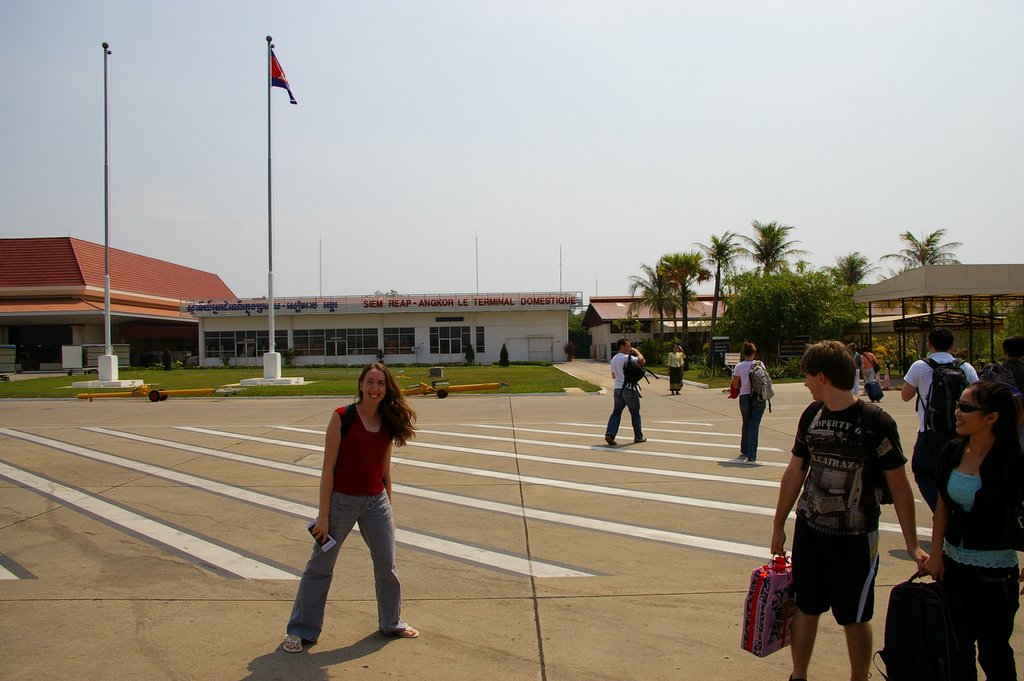
Simone in Siem Reap, Cambodia

Simone's in the red top; her brother Richard's got the pink bag, and his soon-to-be wife Nek is looking on.

February 6, 2006 Posted by Picasa

Interface - Neal Stephenson and Frederick George

A Manchurian Candidate for the computer age, according to Seattle Weekly.

Someone should have hired the candidate a bloody editor instead of a dim chimpanzee. There were so many mistakes in the book that I can only compare the reading to listening to a scratched CD. Stone the crows, that was annoying.

So, an utterly improbable sci-fi story, unless you are one of the conspiricists with tinfoil on your head. I'm not quite sure how implanting a stroke victim with a biochip that wires him into a computerised polling system renders him a special effect, as described on the back of the book. In fact, that's not the case at all. The li'l chip is courtesy of "The Network", one of those nefarious inchoate groups to whom the Government of the United States of America (God Bless y'all!) is but a means to an end. Naturally, that end is money - they've got the power already.

So, fella gets a stroke (he's already a Governor, so that helps), the Network offers to fix him up with this chip (after they practice on a bunch of Indian (India Indians) brain injury victims) which patches through connections from brain on either end of the damaged part. Neat idea. Of course, being all computery, it can respond to radio frequencies. So... the Network arranges for ongoing biometric polling of a sample of the electorate (far too small a sample, incidentally) that gets used live to advise the candidate via this chippy thing how to behave on the ol' election treadmill. And so on.

We therefore have a sci-fi commentary on 1) ethics in biophysical neurobiology (I don't know if that's what it's called... it's good enough for now), 2) American (God Bless!) electoral groundings, style over substance, etc, 3) a little bit of a cynical poke at the non-governmental power of capital flows, and 4) a plug for good old fashioned values of honesty, hard work, dignity, etc.

You know, I thought Neal Stephenson was a pretty decent sci-fi guy. This book... ah, he must have had an off day.

The Devil and Miss Prym - Paulo Coelho

This is why I write these little warbles. I'd forgotten I'd read this book. I was rummaging through a pile of paper pulled it out, and was all like, whoa, like I've, you know, read this?

Perhaps it read so fast is why I didn't remember it... a train ride and a half is all it lasted. Unfortunately, I had nothing else to read for the last half of the commute home, so I got to ruminate on whether or not Paulo Coelho is 'all that' or if he's just a panacea for shallow yuppies seeking a sense of profundity in their solipsistic little lives. I really am undecided.

Between The Alchemist and this little number, which together constitute the entirety of Coelho's oeuvres that I've read, I've got this funny feeling that he's pulling the wool over my eyes by covering off deep questions about humanity in remarkably readable (hour and a half!) books. See, in this one he's all over the "are humans good, or are they evil; and if evil, is it an irredeemable evil" question. And that's fine - worse, and more foolish, than Coelho have taken it on.

The thing is, the story trips along so merrily it feels like it's fluffy! And how can a fluffy book be so doggone focussed on Good n' Evil? Remember those whacky thought experiments where an dilemma is posed and your response suggests what kind of person (you think) you are? You know, lead a group of people one way and there's a 100% chance that half of them will die, go the other way and there's a 50% percent chance either way that all live or all die. Which do you do?

Well, it's a bit like ol' Paulo came up with a thought experiment, and turned it into a novel. Plausible? What the heck, it's a thought experiment. I reckon it could have gone either way with regard to the ending.

I enjoyed reading the book; I enjoyed the way Coelho really worked the tension within the main characters; I'm not sure about the proposition that fear is humankind's main motivator; I thought the whole light/dark parts of the soul were a bit trite and cliché - especially after the visualisation or personification of the Devil, which was cool.

And I can't shake the idea that the story's not as profound as it seems. That frustrates me.

Wednesday, June 14, 2006

Realware - Rudy Rucker

After a brief hiatus, I'm back into the books!

And don't I start reading the 4th book of a tetrology. I suppose if I was a "real" sci-fi fan, I'd have known this instinctively. But I'm not. I go to the library, grab a bunch of books more or less randomly, and read them. I have a new appreciation for those books that have "Book 3 in the series!" written on the front.

Fortunately, it's written well enough, with sufficient clues to the futuristic gizmos and stuff that eventually it's all comprehensible. The little genealogy of the characters at the front doesn't help - and really, who flips to the front to see who's related to who as the story progresses? It worked in War and Peace, but then, I reckon Tolstoi needed help keeping everyone straight.

Anyway, way off in the mid-21st century, things are a little different, when at some point aliens make contact. Naturally, humans fight back. Die, unknown beings, die. Which most of the aliens appeared to do, from what I can make out. (I'm assuming this was covered in detail in one of the previous 3 books).

An alien survives, remembers one of the nice humans from the Moon fight. Guess what? It's the pretty, smart girl that the main boy character meets by chance and, like, totally falls for.

Realware is the alien technology that gets shared with humans. It's futuristic alchemy - turn stuff into other stuff. Are humans grown up enough as a species to handle this kind of power and freedom?

Wednesday, April 19, 2006

Longleg - Glenda Adams

This was a curious little book. Ms Adams is a lecturer (so the bio claims) at one of the universities here in Sydney - UTS, I think. That tidbit has no real relevance to the book... so I figured I'd share it anyway.

Set in not too long ago Sydney, little laddie's growing up. His family's a little strange, consequently he's a little strange... and he finally finds himself when he's about 40 or so.

The story took a bit to get into - it started off sounding a bit like one of those sort of dusty, raspy historic novels, where the past seems to be so heavily troweled onto the pages that the flow of the story gets buried. A little perserverance is warranted, as the main character slowly attracts interest, and things start to make sense.

In fact, the story seems to gather just a little too much momentum, and starts to skip over things toward the end, so that it was a little less satisfying that I'd hoped.

Not a bad book all round, and rather fun to read about the places that I pass through from time to time.

Sunday, April 16, 2006

Hold the Enlightenment - Tim Cahill

Apparently, Tim Cahill is a travel writer with a sense of humour, and he also teaches people to write. Apparently.

This is one of those cases where someone's written the blurb on the back of the book, and the jerks are lying. It's not uproariously funny. It is trying to be funny - trying quite hard, in fact.

Consequently, it's rather sophomoric - remember that kid in school was was all profound and funny and stuff at the same time? It was Tim, and he's not grown up.

About the only good thing about the collection of short stories that constitutes the book is that he seems to know he's an entirely average writer who gets to go to some interesting places.

Thursday, April 13, 2006

Catcher in the Rye - J D Salinger

Finally got around to reading an old classic. And it was pretty good.

What else is there to say about something that's been studied by everyone from high school students to PhD hopefuls?

Sunday, April 09, 2006

Interpreter of maladies - Jhumpa Lahiri

This is a great little collection of stories - I'm writing this far too long after finishing the book to really remember them in detail. There's one about a poor woman who lives as the caretaker sort of person for a small apartment building in India; there's a couple getting through the first bit of an arranged marriage - I think that's the one where he moves to America to work at a university...

I do recall that all the stories were notably empathetic - not in the sense that one comes away from reading them feeling "oh, those poor people" or "how darling the way they love each other". In little vignette style glimpses of peoples' lives, the verisimilitude in the special ordinariness of everyone's stories made the people exceptionally real.

It's not - and doesn't claim to be - an exhaustive or authoritative treatise on the lives of Indians around the world. It is a collection of well written, engaging short stories.

Sunday, March 26, 2006

Stay Alive My Son - Pin Yathay

Now for a Cambodia book that really got me to say not much at all - what the hell can you say about the memoir of a guy who survived Pol Pot's insanity?

The title alone should be enough to provide that funny choking feeling in your throat - those are the words that his father said to him when they were separated during an enforced migration; and they are the words he said to his son as he left the boy with a friend of the family just before his attempt to escape the country on foot.

This book was hard enough to read; thankfully Mr Yathay did not include the gruesomeness that he might have.

Wednesday, March 22, 2006

Red Lights and Green Lizards: A Cambodia Adventure - Liz Anderson

Hey, a book by someone who went and had an adventure in Cambodia! Of course I'm gonna read that...

Okay, so it's the story of two English doctors in the early '90's; I was there in 2006. They were in Phnom Penh; I was in Siem Reap. So, I don't know how good the story is at actually capturing what was going on while they were there. I do know that I didn't find the book as enthralling as the Duchess of Kent or the British Ambassador to Cambodia did.

It's a fairly straightforward chronology of a couple of doctors in their 60s or so who decide to, before they're too old and creaky, to depart the quiet doctoring life in England to do the good work in Cambodia for a year or so. That is, we get:

a) Their awakening and delight at their decision,
b) The hijinks of the flight over, shared with a bunch of other interesting travellers,
c) The wonder and shock at disembarking in a strange world,
d) The honeymoon period,
e) The reality sinking in period,
f) The adjustment and settling in period, and
g) The "I don't really wanna go home" period.

This is getting just a little harsh - it's wonderful stuff they did, bringing education and health services to a brothel, and helping run a hospital. It's just that these voyages tend to yield the same sort of stories, and without something to set them apart, it gets a little difficult to really get into the story - even when there is a shared locality.

Not a terrible story, there's some insights, but it's a lot of reportage.
Monday, March 13, 2006

The Leopard - Giuseppe Tomasi di Lampedusa

From the frontispiece: " Giuseppe Tomasi was a Sicilian nobleman, Duke of Palma and Prince of Lampedusa. He was born in Palermo in 1896 an died in Rome in 1957... He published nothing during his lifetime, but bequeathed, in addition to his great novel [that'd be The Leopard - R] a memoir, some short stories, an incomplete novel and some fascinating appraisals of English and French literature."

Must be nice to be a nobleman. Anyway...

This is a historical novel based on the transition in the 1800s in Italy from the end of the Kingdome of the Two Sicilies to the declaration of Rome as capital of Italy 1870. (Credit to the translator's note; I don't know much about 19th century Italy.) So, one political system is transitioning to another, the key characters are princes and their families... what can the book be about but the strangeness of a changing world?

It's really a pretty impressive book - challenging enough to get into through the style, has plenty of interesting little asides and allusions and interesting characters, and in the end feels nicely rounded out.

Thanks to Simone for this one!

Friday, March 10, 2006

The Black Ice - Michael Connelly

Not a badbook, just another detective thriller type, set in LA. Apparently the critics think the book is excellent, so I guess I was lucky not to get a dog of the genre.

Friday, March 03, 2006

October Sky - Homer H. Hickam, Jr

Once in a while you find a memoir by someone who actually had an interesting life, and is able to write about it in an interesting way. Hurray!

Okay, Homer Jr lived in a West Virginia coal town in the 1950s, and instead of high school ball and working in the mines, he got stuck into rocketry. Being an egghead in a coal town wasn't always the best plan, but Homer and his mates made out alright.

I think what keeps this story interesting is that it doesn't rely on the "I did this, then that, then this, then that..." approach. He's managed to tie in the events that happened around his immediate experience, and then with the hindsight of a few decades, relate the whole works as intertwined events - like when his father, the coal company's head guy in the town, couldn't slip him some materials for building rockets after the company was bought out and the unions showed up and so on.

Almost made me want to go out and build a rocket.

Tuesday, February 28, 2006

Striptease - Carl Hiassen

Yes, two books in a row by the same author. What can I do? It's one of those two-in-one volumes.

Another amusing, fluffy, vaguely nonsensical Florida based crime/comedy novel. This time it starts in a strip joint and ends in a sugar cane field.

Light 'n easy...

Saturday, February 25, 2006

Native Tongue - Carl Hiaasen

Hurray! Fluff!

Light, easy, and not completely insipid.

From the back: PR man Joe Wilder didn't believe the theft of the last two blue-tongued voles on earth from a billionaire's Florida theme park. He just wrote the story. Before he could say Robbie Raccoon, he was hiding out in the Everglades with a one-eyed man and a gun toting granny in pink curlers, and ready to put the skids on the craziest crime con in the history of the state.

I think it's a parody of the hard-bitten crime novel genre... even if it's not meant to be, it was fun to read.

Monday, February 20, 2006

The Constant Gardner - John le Carré

A tour de force of plot development... the plot is developed slowly and meticulously. It's not a fast moving book at all, and not as exciting as the cover suggests.

Very writerly - hints of events in the past are fleshed out later on in the book. Only the main character turns out to be particularly interesting in terms of development; everyone else is sort of just there.

The story is built on the nefarious activities of 'big pharma', and essentially the argument against those activities drives the actions of the protagonists.

If it wasn't for the qualities of the writing, this would be a rather generic take on the 'big pharma does bad things' approach; however, le Carré manages to heighten the sinister without sounding like a loony lefty.

Tuesday, January 31, 2006

The Mysterious North - Pierre Berton

Berton's a darn fine story teller, and here he is telling the story of his time in Canada's North from 1947 to 1954, with retrospective chapters from 1989, where with the hindsight of 25 years, he can comment upon what he's written.

I can't help but be a bit jealous of ol' Pierre - what an interesting batch of stories. Imagine, getting a phone call from a buddy who's flying to Baffin Island in a few hours, and he asks you if you'd like to pop along for the ride? Of course you do - and later on you fly around the Rockies in northern BC looking to prove/disprove the existence of an Eden-like valley amidst the rock and snow.

The way things used to be... I couldn't really imagine if it wasn't for stories like these.

And a special thanks to Simone for bringing this book home one day.

Friday, January 20, 2006

Overthrown by Strangers - Ronan Bennett

This was a pretty good book - a bunch of people get mixed up with each other, and they are mostly non-descript and utter unremarkable in their abilities - strange for a book about people taking on the forces of evil (normally there's a trump card in their character that allows them to overcome). Not so these sad sacks. They seem clever at times... but is it enough?

I kind of enjoyed it for the unconventional ending, which is probably pretty realistic given the subject matter - the exercising of power in developing countries, and the naivete of starry eyed idealists who hop on in trying to make it all right.

This story actually drew me in enough to care about the characters - it starts off like any old thriller good vs. evil plot, but as I got into it, the story was like one of those stories but just enough not like the norm to be interesting.

Sunday, January 15, 2006

Naked - David Sedaris

This isn't a bad book at all, although it was not 'sidesplitting' as the NYT book review declares on the back cover.

Step one: Take the wave of memoir-itis where everyone thinks their life story is interesting enough to write a book about.
Step two: Write a whacked out parodic example of said wave.
Step three: Publish "naked".

What's so brilliant about it - that it's taking the mickey out of narcisism, or that it's a 'gay book', or what?

A nice light read, but if this is the freshest in American writing, the genre's getting pretty worn out.

Tuesday, January 10, 2006

The Abomination - Paul Golding

This is a gay book (literally) about a Continental boy dropped into a proper English school system (like his dad was), but his character is more like that of his Spanish mom. So he doesn't really fit in, which is exacerbated by his homosexuality. As he grows older, he doesn't become any more interesting.

Once the mild shock of the more graphic descriptions had worn off, it wasn't all that impressive, and again, I found myself not really caring too much about the character. Through his trials and tribulations, self-loathing, self questioning, defiance, I didn't feel like there was any great insights made, no profound linkages between the retread of a hard time in school and being gay (other than the other boys call you specific names).

I actually felt most for the mother. In the beginning, she's a bit of a character, to the end she's a shell of who she was, and she loses the spark of liveliness that made her interesting at the start. The father's just a bit of a twit, and while I think the reader's meant to loathe him in the same way the main character does, I couldn't muster the enthusiasm to really feel anything in this regard either.

So, overall not nearly as good as the cover quotes would suggest.