Wow, what a lot of dysfunctional relationships in one book. There are many short stories, apparently spanning decades of the Updike's writing career. They're all quite well written, though his capacity to write about miserable relationships and cheating spouses boggles my mind. I know it goes on, but why on earth write 30 stories about it?
The title is "Trust me", and apparently that's the theme of the book - trust, in relationships between husbands and wives, parents and children, and whatever else. It seems to me that the stories together say that people can't be trusted.
Not my favourite collection of stories, but not a terrible read overall.
Sunday, June 25, 2006


Thursday, June 22, 2006
When getting a wedding outfit takes 10 minutes
Chronologically, this picture comes before the Procession of the Pink Pants, probably a few days previously. I could check the EXIF data on the image, but that would mean switching windows... but who cares about how lazy I am. The guy in the orange pants is me. I happen to think the purple jacket is a dashing statement. The little guy is Kee - Nek's uncle who owns the guest house where we stayed. The bald guy is Glen - Liz's friend (not in the way that 'Liz's friend' was interpreted in SE Asia) who accompanied her kind of as the muscle. Liz is a little bit little, so it was a safety/comfort thing.
The guy you can't see because he's holding up a piece of material is the tailor. Lovely fellow, lent me the purple jacket on the condition that I not sweat in it. Righty-oh, no sweating in 30 degree humidity. I'm all over that. Think of home, Rob, in February.
So what's going on, now that we've all been introduced? Well, Kee was very encouraging of the idea that as a participant in a traditional Khmer wedding (particularly that of his niece) really ought to wear traditional Khmer clothing. No matter how silly it makes you look. Glen got to participate in the ceremony too, so he needed happypants too. In this image, Kee is bringing all his skills in convincing and persuading to bear: "Yes, you wear that. It's good."
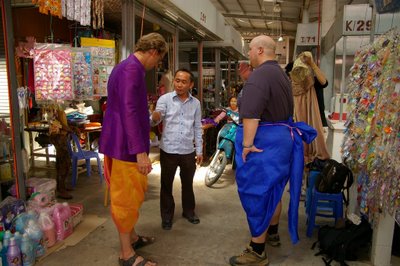 By gum, I'm sold! And indeed I was, on two lengths of silk (now destined to become cushion covers). That's right, I went to a wedding as father of the groom, wearing cushion covers.
You sort of stand in the middle of a couple of metres of silk, and a helper brings the ends together in front of you, kind of wraps/folds/rolls (the wardrobe girls on the wedding day had a genuine technique, we just faked it for the 'fitting') the whole works into a roll, and then that goes between the legs and is pegged up at the back. Tadah! All dressed.
Glen's tail is somewhat more pronounced as he has a more majestic girth than I do, hence it took a bit more material to get around. The consequence is that the rolled up bit is a lot longer... and ends up looking like that. In the market (one of a couple of markets; this may be the New Market, or the Central Market, but then again, those might be the one and the same. Never really did get the two straight. I know definitely wasn't the Old Market), the tail elicited nearly as much hilarity as the pink pants did.
Once our outfits were established (I also got an absolutely darling belt), we hung around briefly chatting in mutually incomprehensible languages with sporadic translations, but much smiling and laughter. Kee had appointed himself chauffeur on this expedition, and kept us to a rather strict and hectic schedule. Once we were done clowning around, we piled back into Kee's CRV, stuffed the tailor into the trunk (it's a little SUV, and there was pillows over the spare tire. He was fine.), and dropped him off from where we'd picked him up, and went back to the guest house to relive the glory of the day.
The guy you can't see because he's holding up a piece of material is the tailor. Lovely fellow, lent me the purple jacket on the condition that I not sweat in it. Righty-oh, no sweating in 30 degree humidity. I'm all over that. Think of home, Rob, in February.
So what's going on, now that we've all been introduced? Well, Kee was very encouraging of the idea that as a participant in a traditional Khmer wedding (particularly that of his niece) really ought to wear traditional Khmer clothing. No matter how silly it makes you look. Glen got to participate in the ceremony too, so he needed happypants too. In this image, Kee is bringing all his skills in convincing and persuading to bear: "Yes, you wear that. It's good."
By gum, I'm sold! And indeed I was, on two lengths of silk (now destined to become cushion covers). That's right, I went to a wedding as father of the groom, wearing cushion covers.You sort of stand in the middle of a couple of metres of silk, and a helper brings the ends together in front of you, kind of wraps/folds/rolls (the wardrobe girls on the wedding day had a genuine technique, we just faked it for the 'fitting') the whole works into a roll, and then that goes between the legs and is pegged up at the back. Tadah! All dressed.
Glen's tail is somewhat more pronounced as he has a more majestic girth than I do, hence it took a bit more material to get around. The consequence is that the rolled up bit is a lot longer... and ends up looking like that. In the market (one of a couple of markets; this may be the New Market, or the Central Market, but then again, those might be the one and the same. Never really did get the two straight. I know definitely wasn't the Old Market), the tail elicited nearly as much hilarity as the pink pants did.
Once our outfits were established (I also got an absolutely darling belt), we hung around briefly chatting in mutually incomprehensible languages with sporadic translations, but much smiling and laughter. Kee had appointed himself chauffeur on this expedition, and kept us to a rather strict and hectic schedule. Once we were done clowning around, we piled back into Kee's CRV, stuffed the tailor into the trunk (it's a little SUV, and there was pillows over the spare tire. He was fine.), and dropped him off from where we'd picked him up, and went back to the guest house to relive the glory of the day.
Tuesday, June 20, 2006
The Pink Pants
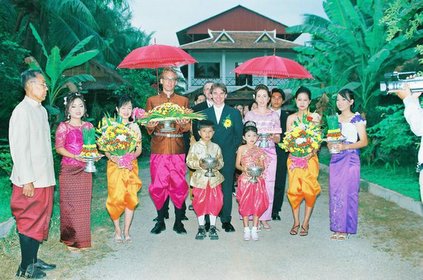 For all those who've heard about the pink pants, but not seen the pink pants, here are the pink pants as photographed at some ungodly early hour in the morning, probably near 6 am. I think Richard (centre, with the yellow flower) is grinning not because of his impending union with the light of his life, Nek, but because his best mate and best man, Shannon, has been joking about the pink pants for the better part of an hour. The old guy, our holy celebrant at left, was chuckling too. The guy holding the umbrella behind Simone... he laughed at the pink pants too. The cute little kids? They were too polite to laugh out loud. So they made big eyes and ran off to convulse in giggles behind the coconut tree. Nek's sisters, Hua and Boa (sorry if that's misspelt, I don't have a Khmer typeface on this computer) laughed very daintily... at the pink pants.
They'd have been just fine, but I think the orange (!) jacket really sets off the whole ensemble. So did Richard, Simone, Nek, Hua, Boa, the old guy.... It was a riot.
I forgot to mention that Simone had a couple of good chuckles at the pink pants too.
Enough about the pants. I had it on the highest authority (Nek's uncle, plus the tyrannical tailor women who bade me drop my trousers... in the courtyard...) and proceeded to swathe me in the pink silk you see radiant before you. Not the matching orangey silk that I had too. The pink silk. Shiny side out.
So what's really going on in that picture? I'm wearing pink pants. Just kidding. Richard, the guy in the middle, is getting married. His mother and father would normally be where Simone and I are, but they couldn't make the trip from Sydney to Cambodia, so we were subbed in. We're at a guest house down the road from Nek's uncle's guest house, where the wedding will take place. We are (all of us above) going to recreate the traditional procession from the groom's village to the bride's village, bearing all sorts of yummy presents to show her parents what a great guy the groom is. Traditionally we'd have walked a couple of kilometres; for the purposes of symbolism we trudged maybe 300 metres. Soon after this photo was taken, traditional (so I'm told, and I'll have to believe it, 'cos I don't know) Khmer wedding music started playing REALLY LOUDLY. EVEN LOUDER THAN WHEN WE ALL WOKE UP AROUND 4 AM. We therefore had many groggy looking spectators along the walk.
And so, the pink pants proceeded forth... peals of laughter issuing in their wake. And it's not like I could melt into the 5 foot tall crowd, either. Weddings are, indeed, a joyous affair.
Friday, June 16, 2006
Rob in Siem Reap
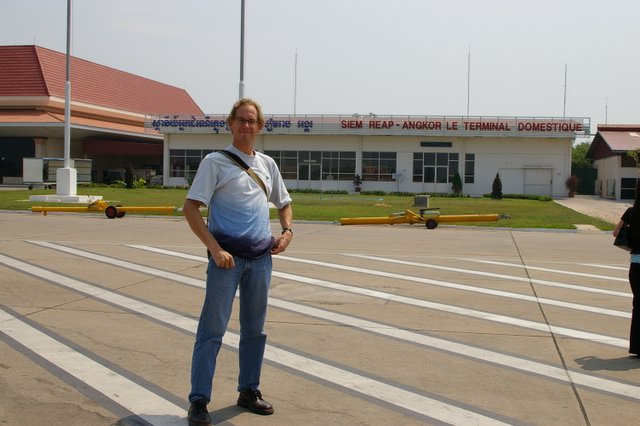 Me, same place, same time as Simone. The same people are just off frame.
Oh, I'm just messing around with this blog-this thingo. Seems to really smallify the pictures.
Simone in Siem Reap, Cambodia
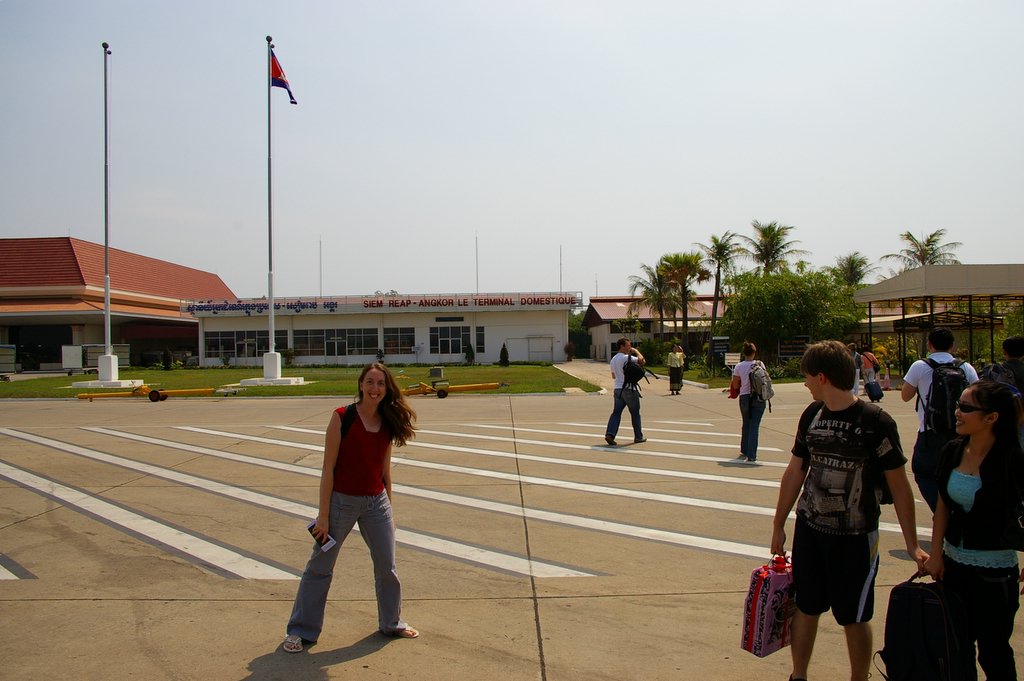 Simone's in the red top; her brother Richard's got the pink bag, and his soon-to-be wife Nek is looking on.
February 6, 2006
Interface - Neal Stephenson and Frederick George
A Manchurian Candidate for the computer age, according to Seattle Weekly.
Someone should have hired the candidate a bloody editor instead of a dim chimpanzee. There were so many mistakes in the book that I can only compare the reading to listening to a scratched CD. Stone the crows, that was annoying.
So, an utterly improbable sci-fi story, unless you are one of the conspiricists with tinfoil on your head. I'm not quite sure how implanting a stroke victim with a biochip that wires him into a computerised polling system renders him a special effect, as described on the back of the book. In fact, that's not the case at all. The li'l chip is courtesy of "The Network", one of those nefarious inchoate groups to whom the Government of the United States of America (God Bless y'all!) is but a means to an end. Naturally, that end is money - they've got the power already.
So, fella gets a stroke (he's already a Governor, so that helps), the Network offers to fix him up with this chip (after they practice on a bunch of Indian (India Indians) brain injury victims) which patches through connections from brain on either end of the damaged part. Neat idea. Of course, being all computery, it can respond to radio frequencies. So... the Network arranges for ongoing biometric polling of a sample of the electorate (far too small a sample, incidentally) that gets used live to advise the candidate via this chippy thing how to behave on the ol' election treadmill. And so on.
We therefore have a sci-fi commentary on 1) ethics in biophysical neurobiology (I don't know if that's what it's called... it's good enough for now), 2) American (God Bless!) electoral groundings, style over substance, etc, 3) a little bit of a cynical poke at the non-governmental power of capital flows, and 4) a plug for good old fashioned values of honesty, hard work, dignity, etc.
You know, I thought Neal Stephenson was a pretty decent sci-fi guy. This book... ah, he must have had an off day.
The Devil and Miss Prym - Paulo Coelho
This is why I write these little warbles. I'd forgotten I'd read this book. I was rummaging through a pile of paper pulled it out, and was all like, whoa, like I've, you know, read this?
Perhaps it read so fast is why I didn't remember it... a train ride and a half is all it lasted. Unfortunately, I had nothing else to read for the last half of the commute home, so I got to ruminate on whether or not Paulo Coelho is 'all that' or if he's just a panacea for shallow yuppies seeking a sense of profundity in their solipsistic little lives. I really am undecided.
Between The Alchemist and this little number, which together constitute the entirety of Coelho's oeuvres that I've read, I've got this funny feeling that he's pulling the wool over my eyes by covering off deep questions about humanity in remarkably readable (hour and a half!) books. See, in this one he's all over the "are humans good, or are they evil; and if evil, is it an irredeemable evil" question. And that's fine - worse, and more foolish, than Coelho have taken it on.
The thing is, the story trips along so merrily it feels like it's fluffy! And how can a fluffy book be so doggone focussed on Good n' Evil? Remember those whacky thought experiments where an dilemma is posed and your response suggests what kind of person (you think) you are? You know, lead a group of people one way and there's a 100% chance that half of them will die, go the other way and there's a 50% percent chance either way that all live or all die. Which do you do?
Well, it's a bit like ol' Paulo came up with a thought experiment, and turned it into a novel. Plausible? What the heck, it's a thought experiment. I reckon it could have gone either way with regard to the ending.
I enjoyed reading the book; I enjoyed the way Coelho really worked the tension within the main characters; I'm not sure about the proposition that fear is humankind's main motivator; I thought the whole light/dark parts of the soul were a bit trite and cliché - especially after the visualisation or personification of the Devil, which was cool.
And I can't shake the idea that the story's not as profound as it seems. That frustrates me.
Wednesday, June 14, 2006
Realware - Rudy Rucker
After a brief hiatus, I'm back into the books!
And don't I start reading the 4th book of a tetrology. I suppose if I was a "real" sci-fi fan, I'd have known this instinctively. But I'm not. I go to the library, grab a bunch of books more or less randomly, and read them. I have a new appreciation for those books that have "Book 3 in the series!" written on the front.
Fortunately, it's written well enough, with sufficient clues to the futuristic gizmos and stuff that eventually it's all comprehensible. The little genealogy of the characters at the front doesn't help - and really, who flips to the front to see who's related to who as the story progresses? It worked in War and Peace, but then, I reckon Tolstoi needed help keeping everyone straight.
Anyway, way off in the mid-21st century, things are a little different, when at some point aliens make contact. Naturally, humans fight back. Die, unknown beings, die. Which most of the aliens appeared to do, from what I can make out. (I'm assuming this was covered in detail in one of the previous 3 books).
An alien survives, remembers one of the nice humans from the Moon fight. Guess what? It's the pretty, smart girl that the main boy character meets by chance and, like, totally falls for.
Realware is the alien technology that gets shared with humans. It's futuristic alchemy - turn stuff into other stuff. Are humans grown up enough as a species to handle this kind of power and freedom?
Wednesday, April 19, 2006
Longleg - Glenda Adams
This was a curious little book. Ms Adams is a lecturer (so the bio claims) at one of the universities here in Sydney - UTS, I think. That tidbit has no real relevance to the book... so I figured I'd share it anyway.
Set in not too long ago Sydney, little laddie's growing up. His family's a little strange, consequently he's a little strange... and he finally finds himself when he's about 40 or so.
The story took a bit to get into - it started off sounding a bit like one of those sort of dusty, raspy historic novels, where the past seems to be so heavily troweled onto the pages that the flow of the story gets buried. A little perserverance is warranted, as the main character slowly attracts interest, and things start to make sense.
In fact, the story seems to gather just a little too much momentum, and starts to skip over things toward the end, so that it was a little less satisfying that I'd hoped.
Not a bad book all round, and rather fun to read about the places that I pass through from time to time.
Sunday, April 16, 2006
Hold the Enlightenment - Tim Cahill
Apparently, Tim Cahill is a travel writer with a sense of humour, and he also teaches people to write. Apparently.
This is one of those cases where someone's written the blurb on the back of the book, and the jerks are lying. It's not uproariously funny. It is trying to be funny - trying quite hard, in fact.
Consequently, it's rather sophomoric - remember that kid in school was was all profound and funny and stuff at the same time? It was Tim, and he's not grown up.
About the only good thing about the collection of short stories that constitutes the book is that he seems to know he's an entirely average writer who gets to go to some interesting places.
Thursday, April 13, 2006
Catcher in the Rye - J D Salinger
Finally got around to reading an old classic. And it was pretty good.
What else is there to say about something that's been studied by everyone from high school students to PhD hopefuls?
What else is there to say about something that's been studied by everyone from high school students to PhD hopefuls?
Sunday, April 09, 2006
Interpreter of maladies - Jhumpa Lahiri
This is a great little collection of stories - I'm writing this far too long after finishing the book to really remember them in detail. There's one about a poor woman who lives as the caretaker sort of person for a small apartment building in India; there's a couple getting through the first bit of an arranged marriage - I think that's the one where he moves to America to work at a university...
I do recall that all the stories were notably empathetic - not in the sense that one comes away from reading them feeling "oh, those poor people" or "how darling the way they love each other". In little vignette style glimpses of peoples' lives, the verisimilitude in the special ordinariness of everyone's stories made the people exceptionally real.
It's not - and doesn't claim to be - an exhaustive or authoritative treatise on the lives of Indians around the world. It is a collection of well written, engaging short stories.
Sunday, March 26, 2006
Stay Alive My Son - Pin Yathay
Now for a Cambodia book that really got me to say not much at all - what the hell can you say about the memoir of a guy who survived Pol Pot's insanity?
The title alone should be enough to provide that funny choking feeling in your throat - those are the words that his father said to him when they were separated during an enforced migration; and they are the words he said to his son as he left the boy with a friend of the family just before his attempt to escape the country on foot.
This book was hard enough to read; thankfully Mr Yathay did not include the gruesomeness that he might have.
Wednesday, March 22, 2006
Red Lights and Green Lizards: A Cambodia Adventure - Liz Anderson
Hey, a book by someone who went and had an adventure in Cambodia! Of course I'm gonna read that...
Okay, so it's the story of two English doctors in the early '90's; I was there in 2006. They were in Phnom Penh; I was in Siem Reap. So, I don't know how good the story is at actually capturing what was going on while they were there. I do know that I didn't find the book as enthralling as the Duchess of Kent or the British Ambassador to Cambodia did.
It's a fairly straightforward chronology of a couple of doctors in their 60s or so who decide to, before they're too old and creaky, to depart the quiet doctoring life in England to do the good work in Cambodia for a year or so. That is, we get:
a) Their awakening and delight at their decision,
b) The hijinks of the flight over, shared with a bunch of other interesting travellers,
c) The wonder and shock at disembarking in a strange world,
d) The honeymoon period,
e) The reality sinking in period,
f) The adjustment and settling in period, and
g) The "I don't really wanna go home" period.
This is getting just a little harsh - it's wonderful stuff they did, bringing education and health services to a brothel, and helping run a hospital. It's just that these voyages tend to yield the same sort of stories, and without something to set them apart, it gets a little difficult to really get into the story - even when there is a shared locality.
Not a terrible story, there's some insights, but it's a lot of reportage.
Monday, March 13, 2006
The Leopard - Giuseppe Tomasi di Lampedusa
From the frontispiece: " Giuseppe Tomasi was a Sicilian nobleman, Duke of Palma and Prince of Lampedusa. He was born in Palermo in 1896 an died in Rome in 1957... He published nothing during his lifetime, but bequeathed, in addition to his great novel [that'd be The Leopard - R] a memoir, some short stories, an incomplete novel and some fascinating appraisals of English and French literature."
Must be nice to be a nobleman. Anyway...
This is a historical novel based on the transition in the 1800s in Italy from the end of the Kingdome of the Two Sicilies to the declaration of Rome as capital of Italy 1870. (Credit to the translator's note; I don't know much about 19th century Italy.) So, one political system is transitioning to another, the key characters are princes and their families... what can the book be about but the strangeness of a changing world?
It's really a pretty impressive book - challenging enough to get into through the style, has plenty of interesting little asides and allusions and interesting characters, and in the end feels nicely rounded out.
Thanks to Simone for this one!
Friday, March 10, 2006
The Black Ice - Michael Connelly
Not a badbook, just another detective thriller type, set in LA. Apparently the critics think the book is excellent, so I guess I was lucky not to get a dog of the genre.
Friday, March 03, 2006
October Sky - Homer H. Hickam, Jr
Once in a while you find a memoir by someone who actually had an interesting life, and is able to write about it in an interesting way. Hurray!
Okay, Homer Jr lived in a West Virginia coal town in the 1950s, and instead of high school ball and working in the mines, he got stuck into rocketry. Being an egghead in a coal town wasn't always the best plan, but Homer and his mates made out alright.
I think what keeps this story interesting is that it doesn't rely on the "I did this, then that, then this, then that..." approach. He's managed to tie in the events that happened around his immediate experience, and then with the hindsight of a few decades, relate the whole works as intertwined events - like when his father, the coal company's head guy in the town, couldn't slip him some materials for building rockets after the company was bought out and the unions showed up and so on.
Almost made me want to go out and build a rocket.
Tuesday, February 28, 2006
Striptease - Carl Hiassen
Yes, two books in a row by the same author. What can I do? It's one of those two-in-one volumes.
Another amusing, fluffy, vaguely nonsensical Florida based crime/comedy novel. This time it starts in a strip joint and ends in a sugar cane field.
Light 'n easy...
Another amusing, fluffy, vaguely nonsensical Florida based crime/comedy novel. This time it starts in a strip joint and ends in a sugar cane field.
Light 'n easy...
Saturday, February 25, 2006
Native Tongue - Carl Hiaasen
Hurray! Fluff!
Light, easy, and not completely insipid.
From the back: PR man Joe Wilder didn't believe the theft of the last two blue-tongued voles on earth from a billionaire's Florida theme park. He just wrote the story. Before he could say Robbie Raccoon, he was hiding out in the Everglades with a one-eyed man and a gun toting granny in pink curlers, and ready to put the skids on the craziest crime con in the history of the state.
I think it's a parody of the hard-bitten crime novel genre... even if it's not meant to be, it was fun to read.
Monday, February 20, 2006
The Constant Gardner - John le Carré
A tour de force of plot development... the plot is developed slowly and meticulously. It's not a fast moving book at all, and not as exciting as the cover suggests.
Very writerly - hints of events in the past are fleshed out later on in the book. Only the main character turns out to be particularly interesting in terms of development; everyone else is sort of just there.
The story is built on the nefarious activities of 'big pharma', and essentially the argument against those activities drives the actions of the protagonists.
If it wasn't for the qualities of the writing, this would be a rather generic take on the 'big pharma does bad things' approach; however, le Carré manages to heighten the sinister without sounding like a loony lefty.
Subscribe to:
Posts (Atom)

 Posts


